
ARSC Tech School

Amateur Extra E1F: Miscellaneous rules

599 questions · pool July 1, 2024 to June 30, 2028 · the exam has 50 questions; 37 to pass

E1 · COMMISSION RULES

Miscellaneous rules: external RF power amplifiers; prohibited communications; spread spectrum; auxiliary stations; Canadian amateurs operating in the US; special temporary authority

11 questions in group E1F

One question from this group appears on each exam.

E1F01FCC rule 97.305

On what frequencies are spread spectrum transmissions permitted?

Show the answer and why

Answer B. Only on amateur frequencies above 222 MHz

FCC rule 97.305

Spread spectrum is authorized only on 222 MHz and above, which in the emission table means the 1.25 m band (222-225 MHz) and the UHF and higher bands.
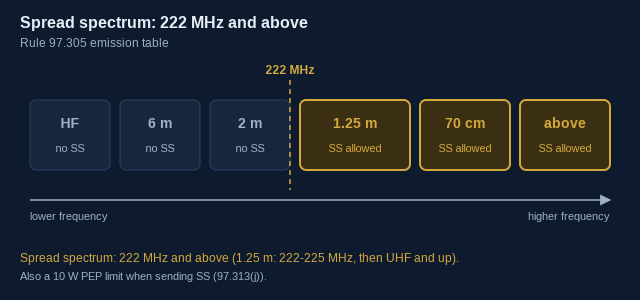
A frequency ladder showing spread spectrum allowed only from 222 MHz upward.
Describe this graphic in words

Six band blocks from low to high frequency: HF, 6 m and 2 m are dimmed with no spread spectrum. A dashed gold line at 222 MHz separates them from the gold 1.25 m, 70 cm and above blocks where spread spectrum is allowed. A note mentions a 10 W PEP limit.

In the 97.305 emission table, spread spectrum (SS) is listed for 222-225 MHz, all of 70 cm, and the bands above. It is not listed for 6 meters or 2 meters, nor for the HF bands. So the answer is "only above 222 MHz."

There is also a 10 W PEP transmitter power limit when sending SS in 97.313(j).

Why the other choices are wrong

  • A. SS is not authorized on 6 or 2 meters, so "above 50 MHz" is too broad.
  • C. SS is also authorized on 222-225 MHz, below 420 MHz.
  • D. SS is not authorized on 2 meters.

References

Rule text checked against the official source on November 17, 2026. This is a study aid; the linked rule is what governs.
E1F02FCC rule 97.107

What privileges are authorized in the US to persons holding an amateur service license granted by the government of Canada?

Show the answer and why

Answer C. The operating terms and conditions of the Canadian amateur service license, not to exceed US Amateur Extra class license privileges

FCC rule 97.107

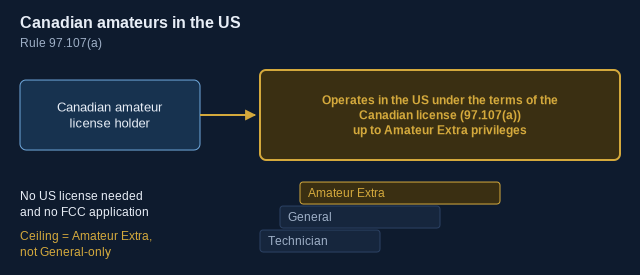
A Canadian license holder may operate with the terms of the Canadian license, up to Amateur Extra privileges.

A Canadian license holder operating in the US with privileges up to Amateur Extra.
Describe this graphic in words

A Canadian license holder box with an arrow to a gold box saying they operate in the US under the terms of the Canadian license, up to Amateur Extra privileges. A staircase of license classes tops out at Amateur Extra. Notes say no US license or FCC application is needed.

Rule 97.107(a) covers Canadian amateurs: they operate under the terms of the US-Canada convention, the conditions of the Canadian license, and the applicable Part 97 rules, but not beyond the control operator privileges of an Amateur Extra license.

No US license is required, and the privileges are not tied to the General class bands. This is reciprocal operating authority under 97.107, so the visitor does not apply for an FCC license.

Why the other choices are wrong

  • A. A reciprocal operating authority exists, so a US license is not required.
  • B. Privileges follow the Canadian license terms, not a fixed set of General class bands.
  • D. Privileges depend on the Canadian license, not full Extra privileges on those bands.

References

Rule text checked against the official source on November 17, 2026. This is a study aid; the linked rule is what governs.
E1F03FCC rule 97.315

Under what circumstances may a dealer sell an external RF power amplifier capable of operation below 144 MHz if it has not been granted FCC certification?

Show the answer and why

Answer D. The amplifier is constructed or modified by an amateur radio operator for use at an amateur station

FCC rule 97.315

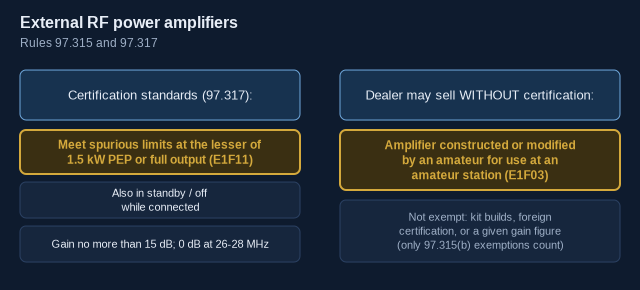
A dealer may sell an uncertified amplifier if it was constructed or modified by an amateur for use at an amateur station.

Two columns: what an HF amplifier must meet to be certified, and when a dealer may sell one without certification.
Describe this graphic in words

Left column: certification standards, led in gold by meeting the spurious emission limits at the lesser of 1.5 kW PEP or its full output, plus standby and gain limits of 15 dB and none at 26 to 28 MHz. Right column: a dealer may sell an uncertified amplifier only if it was constructed or modified by an amateur for use at an amateur station; other claimed exemptions are dimmed.

Rule 97.315(b)(1) says the certification requirement does not apply to an amplifier constructed or modified by an amateur radio operator for use at an amateur station. Paragraph (b)(3) also allows sale to an amateur or dealer in used condition.

Building it from a kit, or reciprocal foreign certification, does not appear in the rule. The gain figure in choice A is not an exemption in 97.315. For what it is worth, the certification standard in 97.317(a)(2) is a 15 dB gain limit, not 23 dB, so that choice's number does not match the current rule either.

Why the other choices are wrong

  • A. Gain is not an exemption in 97.315, and the 23 dB figure does not match the 15 dB limit in the current 97.317(a)(2).
  • B. A dealer assembling a kit is not an exemption in 97.315.
  • C. A reciprocal certification agreement is not an exemption in 97.315.

References

Rule text checked against the official source on November 17, 2026. This is a study aid; the linked rule is what governs.
E1F04FCC rule 97.3

Which of the following geographic descriptions approximately describes "Line A"?

Show the answer and why

Answer A. A line roughly parallel to and south of the border between the US and Canada

FCC rule 97.3

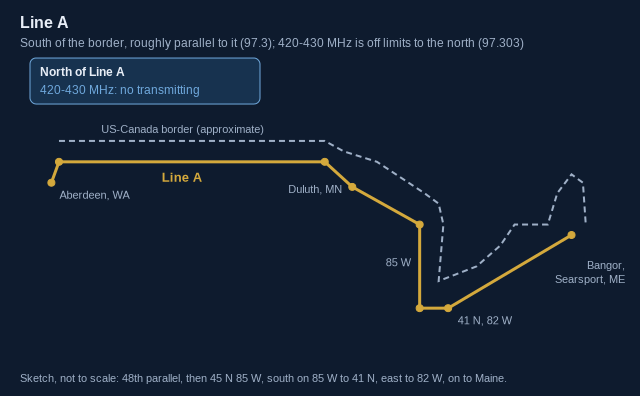
Line A is a line roughly parallel to and south of the US-Canada border.

Schematic map of Line A running south of and roughly parallel to the US-Canada border.
Describe this graphic in words

A rough sketch of the northern United States shows the US-Canada border as a dashed line and Line A as a solid gold line south of it. Line A starts at Aberdeen, Washington, follows the 48th parallel east, passes Duluth, Minnesota, then runs along 85 W and 41 N before heading to Bangor and Searsport, Maine. A label notes that transmitting in 420-430 MHz is not allowed north of Line A.

The 97.3 definition of Line A starts at Aberdeen, Washington, runs along the 48th parallel to 95 W, passes through the southernmost point of Duluth, Minnesota, drops to 45 N 85 W, runs south along 85 W to 41 N, follows 41 N to 82 W, and ends through Bangor and Searsport, Maine. That is a line south of, and roughly parallel to, the US-Canada border.

Rule 97.303(m)(1) uses Line A to bar transmitting in 420-430 MHz north of it.

Why the other choices are wrong

  • B. It is not an Atlantic coast line.
  • C. It is not near the Mexican border.
  • D. It is not near the Pacific coast, apart from starting at Aberdeen, WA.

References

Rule text checked against the official source on November 17, 2026. This is a study aid; the linked rule is what governs.
E1F05FCC rule 97.303

Amateur stations may not transmit in which of the following frequency segments if they are located in the contiguous 48 states and north of Line A?

Show the answer and why

Answer D. 420 MHz - 430 MHz

FCC rule 97.303

The 420-430 MHz segment is off limits north of Line A.

Schematic map of Line A running south of and roughly parallel to the US-Canada border.
Describe this graphic in words

A rough sketch of the northern United States shows the US-Canada border as a dashed line and Line A as a solid gold line south of it. Line A starts at Aberdeen, Washington, follows the 48th parallel east, passes Duluth, Minnesota, then runs along 85 W and 41 N before heading to Bangor and Searsport, Maine. A label notes that transmitting in 420-430 MHz is not allowed north of Line A.

Rule 97.303(m)(1) says no amateur station shall transmit from north of Line A in the 420-430 MHz segment. The restriction protects other users of that spectrum near the border.

The 440-450 MHz, 53-54 MHz, and 222-223 MHz segments are not banned north of Line A by this rule.

Why the other choices are wrong

  • A. 440-450 MHz is not prohibited by this rule.
  • B. 53-54 MHz is not prohibited by this rule.
  • C. 222-223 MHz is not prohibited by this rule.

References

Rule text checked against the official source on November 17, 2026. This is a study aid; the linked rule is what governs.
E1F06FCC rule 1.931

Under what circumstances might the FCC issue a Special Temporary Authority (STA) to an amateur station?

Show the answer and why

Answer A. To provide for experimental amateur communications

FCC rule 1.931

The key says the FCC may issue an STA for experimental amateur communications.

The pool keys choice A, experimental amateur communications, and this could not be confirmed against the rule text. 47 CFR 1.931(b)(2) allows a special temporary authority for private wireless services in emergencies, to restore or relocate facilities, to conduct tests for an application, for temporary non-recurring service, and in other extraordinary situations. It never names amateur radio or "experimental amateur communications." Choice A is the closest fit only in the loose sense of "tests." Treat this key as unconfirmed and memorize it as the pool's answer.

The other choices are handled elsewhere: a VE team needs at least 3 VEs under 97.509(a), and special event call signs come from a coordinators' database under 97.119(d). Section 1.931(b)(7) separately lets a licensee with a CSCE operate with the higher class privileges while the upgrade is processed, but that is a standing rule, not an individual STA.

Why the other choices are wrong

  • B. Special event call signs come from the coordinators' database, not an STA (97.119(d)).
  • C. A VE team must have at least 3 VEs under 97.509(a); the rules contain no STA exception.
  • D. Operating with upgraded privileges while the application is processed is covered by 47 CFR 1.931(b)(7) and a CSCE, not by an individually issued STA.

References

Rule text checked against the official source on November 17, 2026. This is a study aid; the linked rule is what governs.
E1F07FCC rule 97.113

When may an amateur station send a message to a business?

Show the answer and why

Answer D. When neither the amateur nor their employer has a pecuniary interest in the communications

FCC rule 97.113

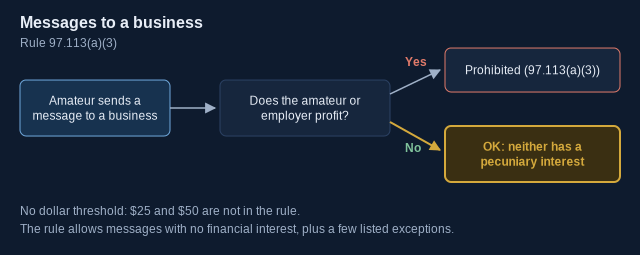
An amateur may send a message to a business only when neither the amateur nor their employer has a pecuniary interest in it.

A decision flow: a message to a business is allowed only when neither the amateur nor their employer has a pecuniary interest.
Describe this graphic in words

A decision from an amateur sending a message to a business: if the amateur or employer has a financial interest the message is prohibited in red; if not, it is allowed in gold. A note says there is no dollar threshold.

Rule 97.113(a)(3) bars communications in which the licensee or control operator has a pecuniary interest, including on behalf of an employer, with a few listed exceptions. There is no dollar threshold. Sending a message to a business is fine if it does not benefit you or your employer financially.

The $25 and $50 values are not in the rule, and "at no time" is wrong because the rule allows messages with no financial interest, plus the listed exceptions such as emergency drills.

Why the other choices are wrong

  • A. There is no $25 threshold in the rule.
  • B. There is no $50 threshold in the rule.
  • C. Messages to a business are allowed if there is no pecuniary interest.

References

Rule text checked against the official source on November 17, 2026. This is a study aid; the linked rule is what governs.

E1F08FCC rule 97.113(c)

Which of the following types of amateur station communications are prohibited?

Show the answer and why

Answer A. Communications transmitted for hire or material compensation, except as otherwise provided in the rules

FCC rule 97.113(c)

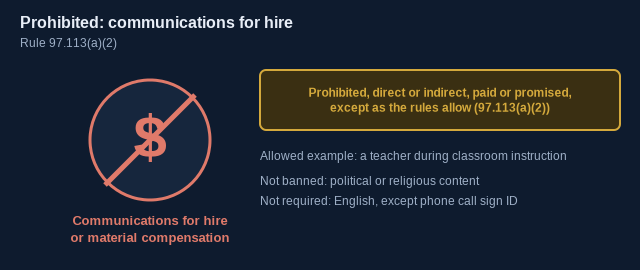
Communications for hire or material compensation are prohibited, except as the rules allow.

A crossed-out dollar sign: communications for hire or material compensation are prohibited.
Describe this graphic in words

A large dollar sign in a red crossed-out circle labeled communications for hire or material compensation. A gold box says they are prohibited, direct or indirect, paid or promised, except as the rules allow. Notes say political and religious content are not banned and English is not required except for phone identification.

Rule 97.113(a)(2) says no amateur station shall transmit communications for hire or for material compensation, direct or indirect, paid or promised, except as otherwise provided in the rules (for example, a teacher during classroom instruction).

Part 97 does not ban political or religious content, and does not require English (though phone call sign identification must be in English under 97.119(b)(2)). The Fairness Doctrine does not apply to amateur stations.

Why the other choices are wrong

  • B. Political content is not prohibited by Part 97, and the Fairness Doctrine is not the test.
  • C. Religious content is not prohibited by Part 97.
  • D. Other languages are allowed; only phone identification must be in English.

References

Rule text checked against the official source on November 17, 2026. This is a study aid; the linked rule is what governs.

E1F09FCC rule FCC Part 97.113(a)(4)

Which of the following cannot be transmitted over an amateur radio mesh network?

Show the answer and why

Answer C. Messages encoded to obscure their meaning

FCC rule FCC Part 97.113(a)(4)

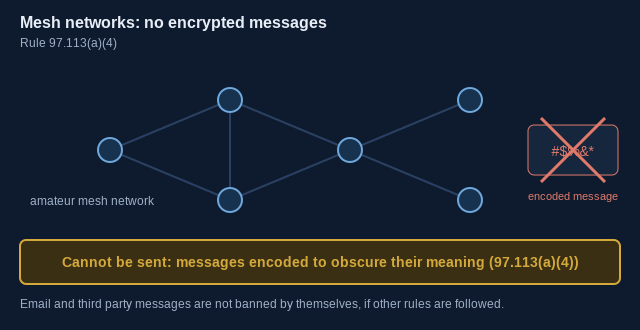
Messages encoded to obscure their meaning cannot be sent over an amateur mesh network.

A mesh network of amateur nodes with an encoded message crossed out, since encoding to obscure meaning is prohibited.
Describe this graphic in words

Six connected nodes form an amateur mesh network. At the right an encoded, scrambled message is crossed out in red. A gold banner says messages encoded to obscure their meaning cannot be sent. A note says ordinary email and third party messages are not themselves banned.

Rule 97.113(a)(4) prohibits messages encoded for the purpose of obscuring their meaning, except as otherwise provided. So encryption is not allowed on a mesh network. Email and third party messages are not themselves banned, as long as they follow the other rules (for example, 97.115 for third party traffic and no business use).

The ban is about hiding the content, not about the type of message.

Why the other choices are wrong

  • A. Third party traffic is allowed within the limits of 97.115.
  • B. Email is allowed as long as it complies with the rules.
  • D. Only the encoded message choice is prohibited, so "all of these" fails.

References

Rule text checked against the official source on November 17, 2026. This is a study aid; the linked rule is what governs.

E1F10FCC rule 97.201

Who may be the control operator of an auxiliary station?

Show the answer and why

Answer B. Only Technician, General, Advanced, or Amateur Extra class operators

FCC rule 97.201

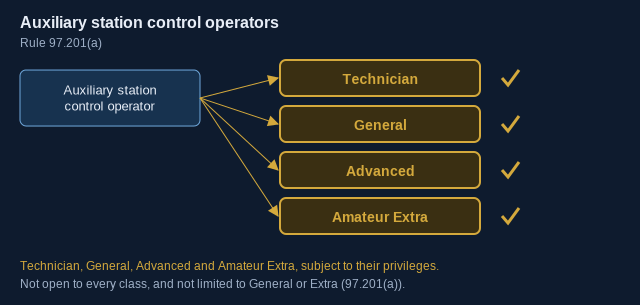
Technician, General, Advanced and Amateur Extra operators may be control operators of an auxiliary station.

Technician, General, Advanced and Amateur Extra licensees may be control operators of an auxiliary station.
Describe this graphic in words

An auxiliary station control operator box with arrows to four gold license classes with check marks: Technician, General, Advanced and Amateur Extra. A note says each is subject to their privileges and it is not limited to General or Extra.

Rule 97.201(a) says any amateur station licensed to a holder of a Technician, General, Advanced or Amateur Extra class license may be an auxiliary station, and holders of those classes may be its control operator, subject to their privileges.

So it is not open to every license class, and it is not limited to General or Extra. Check the full 97.201 text for the other auxiliary station rules, such as the band limits in paragraph (b).

Why the other choices are wrong

  • A. The rule names the license classes; it does not say any licensed operator.
  • C. Technician class operators are included.
  • D. Extra class is not required.

References

Rule text checked against the official source on November 17, 2026. This is a study aid; the linked rule is what governs.

E1F11FCC rule 97.317

Which of the following best describes one of the standards that must be met by an external RF power amplifier if it is to qualify for a grant of FCC certification?

Show the answer and why

Answer D. It must satisfy the FCC’s spurious emission standards when operated at the lesser of 1500 watts or its full output power

FCC rule 97.317

To be certified, an amplifier must meet the spurious emission standards at the lesser of 1.5 kW PEP or its full output power.

Two columns: what an HF amplifier must meet to be certified, and when a dealer may sell one without certification.
Describe this graphic in words

Left column: certification standards, led in gold by meeting the spurious emission limits at the lesser of 1.5 kW PEP or its full output, plus standby and gain limits of 15 dB and none at 26 to 28 MHz. Right column: a dealer may sell an uncertified amplifier only if it was constructed or modified by an amateur for use at an amateur station; other claimed exemptions are dimmed.

Rule 97.317(a)(1) requires the amplifier to satisfy the 97.307(d) or (e) spurious emission limits when operated at the lesser of 1.5 kW PEP or its full output, and also when in standby or off while connected to the transmitter.

The rule also limits gain to 15 dB and requires no amplification between 26 and 28 MHz. A 15 dB gain is a factor of about 31.6 in power, so a 10 W drive would give at most about 316 W.

Why the other choices are wrong

  • A. There is no 5 W drive requirement in the rule.
  • B. No UL certification or IEEE standard is named in the rule.
  • C. The gain limit is 15 dB, not 23 dB.

References

Rule text checked against the official source on November 17, 2026. This is a study aid; the linked rule is what governs.