
ARSC Tech School

Amateur Extra E2A: Amateur radio in space

599 questions · pool July 1, 2024 to June 30, 2028 · the exam has 50 questions; 37 to pass

E2 · OPERATING PROCEDURES

Amateur radio in space: amateur satellites; orbital mechanics; frequencies and modes; satellite hardware; satellite operations

12 questions in group E2A

One question from this group appears on each exam.

E2A01

What is the direction of an ascending pass for an amateur satellite?

Show the answer and why

Answer C. From south to north

An ascending pass is one where the satellite moves from south to north.
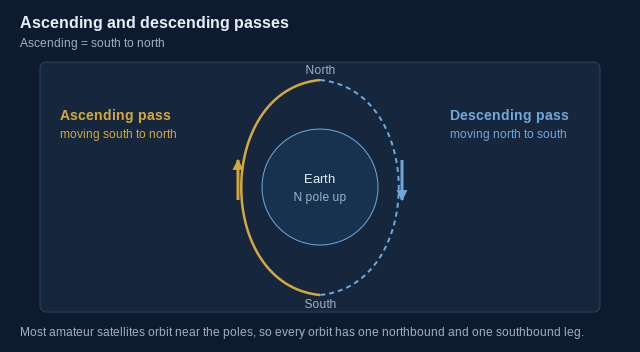
A near-polar orbit with the northbound leg labeled ascending and the southbound leg labeled descending.
Describe this graphic in words

Earth is drawn in the middle with north at the top. A gold curve on the left side of the orbit has an arrow pointing up toward north and is labeled ascending pass, south to north. A dashed blue curve on the right side has an arrow pointing down and is labeled descending pass, north to south.

This is a teaching note. Most amateur satellites are in near-polar orbits. As the satellite circles the Earth it is heading north on one half of each orbit (the ascending pass) and south on the other half (the descending pass).

So when you track a pass in your software, an ascending pass means the satellite is travelling roughly south to north over your location, and a descending pass means north to south.

Why the other choices are wrong

  • A. West to east describes the way many satellites drift around the globe overall, not the ascending/descending terms.
  • B. East to west is not what ascending means; the term refers to the northward leg of the orbit.
  • D. North to south is the descending pass, the opposite of ascending.

Rule text checked against the official source on November 17, 2026. This is a study aid; the linked rule is what governs.
E2A02

Which of the following is characteristic of an inverting linear transponder?

Show the answer and why

Answer D. All these choices are correct

All three statements describe an inverting linear transponder, so all are correct.

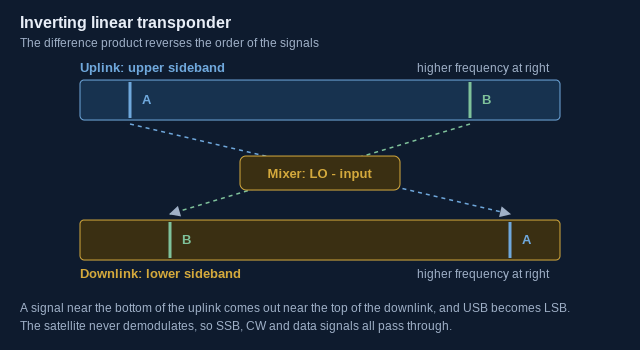
An inverting transponder mixes the uplink band with a local oscillator so the band comes out reversed.
Describe this graphic in words

A blue uplink band bar sits above a gold downlink band bar with a mixer box between them. Signal A near the low edge of the uplink crosses to the high edge of the downlink, and signal B near the high edge crosses to the low edge. The crossing lines show the band is flipped, which also turns an upper sideband signal into lower sideband.

This is a teaching note. A linear transponder takes a whole slice of the uplink band, flips it, and sends it out on the downlink band. Because the band is flipped, an upper-sideband signal going up comes back as lower sideband, and a signal near the bottom of the uplink passband comes out near the top of the downlink passband.

The flip also helps with Doppler. As the satellite moves, the uplink and downlink shifts work in opposite directions, so the net shift you hear is reduced.

Why the other choices are wrong

  • A. This is true, but the other two statements are true as well.
  • B. This is true, but the other two statements are true as well.
  • C. This is true, but the other two statements are true as well.

Rule text checked against the official source on November 17, 2026. This is a study aid; the linked rule is what governs.
E2A03

How is an upload signal processed by an inverting linear transponder?

Show the answer and why

Answer D. The signal is mixed with a local oscillator signal and the difference product is transmitted

The uplink signal is mixed with a local oscillator and the difference product is transmitted.

An inverting transponder mixes the uplink band with a local oscillator so the band comes out reversed.
Describe this graphic in words

A blue uplink band bar sits above a gold downlink band bar with a mixer box between them. Signal A near the low edge of the uplink crosses to the high edge of the downlink, and signal B near the high edge crosses to the low edge. The crossing lines show the band is flipped, which also turns an upper sideband signal into lower sideband.

This is a teaching note. An inverting transponder does not demodulate anything. It shifts the whole uplink passband with a mixer. If the local oscillator is higher in frequency than the uplink signals, the difference product (LO minus input) reverses their order: low input frequencies become high output frequencies.

That frequency reversal is what turns USB into LSB and flips the band. Because the satellite never demodulates, it can carry SSB, CW and digital signals at the same time.

Why the other choices are wrong

  • A. The signal is not detected and remodulated; a linear transponder translates the frequency without demodulating.
  • B. A nonlinear filter would distort the signals; the transponder must stay linear.
  • C. Splitting into I and Q and dropping Q is not how an inverting transponder works.

Rule text checked against the official source on November 17, 2026. This is a study aid; the linked rule is what governs.
E2A04

What is meant by the “mode” of an amateur radio satellite?

Show the answer and why

Answer B. The satellite’s uplink and downlink frequency bands

The mode of an amateur satellite is its pair of uplink and downlink frequency bands.

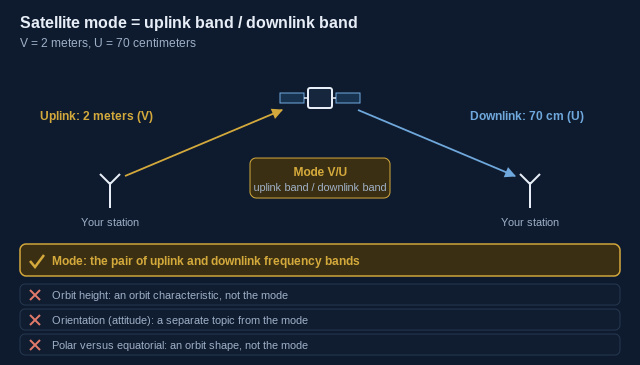
A satellite with a 2 meter uplink and a 70 centimeter downlink, labeled Mode V/U.
Describe this graphic in words

A satellite sits at the top with a station on each side. An arrow carries the uplink on 2 meters (V) up to the satellite, and an arrow carries the downlink on 70 centimeters (U) back down. The pair of bands is the mode, here Mode V/U.

This is a teaching note. Satellite operators use "mode" to say which bands a satellite listens on and talks on. For example, a satellite that receives on 2 meters and transmits on 70 centimeters is "Mode V/U".

The word has nothing to do with the orbit or how the satellite is oriented. It simply tells you which radios and antennas you need.

Why the other choices are wrong

  • A. Orbit height is an orbit characteristic, not the satellite mode.
  • C. Orientation (attitude) is a separate topic from the mode designator.
  • D. Polar versus equatorial is an orbit shape, not the mode.

Rule text checked against the official source on November 17, 2026. This is a study aid; the linked rule is what governs.
E2A05

What do the letters in a satellite’s mode designator specify?

Show the answer and why

Answer D. The uplink and downlink frequency ranges

The letters in a mode designator give the uplink and downlink frequency ranges.

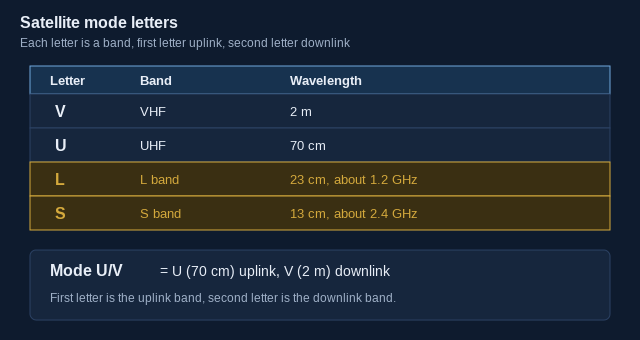
Table of satellite mode letters V, U, L and S with their bands, and the meaning of Mode U/V.
Describe this graphic in words

A table lists V for VHF 2 m, U for UHF 70 cm, L for L band 23 cm about 1.2 GHz, and S for S band 13 cm about 2.4 GHz, with L and S highlighted. Below it, Mode U/V is explained: the first letter is the uplink band and the second is the downlink band, so U/V is UHF up and VHF down.

This is a teaching note. Each letter stands for a band, such as V for VHF (2 m), U for UHF (70 cm), L for L band (23 cm) and S for S band (13 cm). The first letter is the uplink band and the second is the downlink band, so Mode U/V means uplink on UHF and downlink on VHF.

The letters say nothing about power, polarization or where the control station is.

Why the other choices are wrong

  • A. Power limits are not part of the designator.
  • B. The control station location is not encoded in the mode letters.
  • C. Polarization is not specified by the mode letters; they identify frequency bands.

Rule text checked against the official source on November 17, 2026. This is a study aid; the linked rule is what governs.
E2A06

What are Keplerian elements?

Show the answer and why

Answer A. Parameters that define the orbit of a satellite

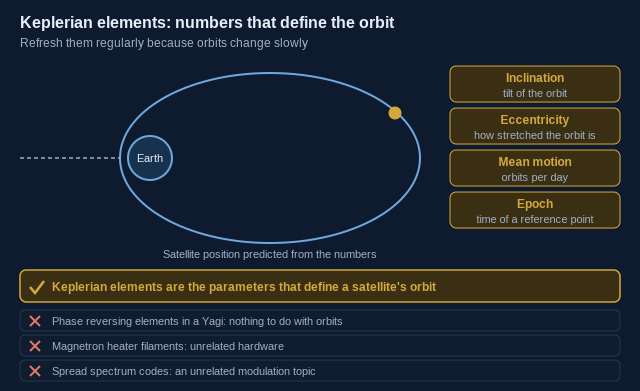
Keplerian elements are the parameters that define a satellite's orbit.

An elliptical orbit around Earth with four Keplerian elements listed beside it.
Describe this graphic in words

An elliptical orbit circles the Earth, with a dashed line showing the tilt against the equator. Four gold boxes list the Keplerian elements: inclination, eccentricity, mean motion and epoch. Tracking software turns them into predicted passes.

This is a teaching note. They are a set of numbers (such as inclination, eccentricity, mean motion and the time of a reference point) that describe the shape and orientation of an orbit. Tracking software uses them to predict where a satellite will be and when it will pass over you.

The names come from Johannes Kepler, who described how bodies orbit. Because orbits change slowly, you should refresh the elements regularly.

Why the other choices are wrong

  • B. Phase reversing elements in a Yagi have nothing to do with orbits.
  • C. Magnetron heater filaments are unrelated hardware.
  • D. Spread spectrum codes are an unrelated modulation topic.

Rule text checked against the official source on November 17, 2026. This is a study aid; the linked rule is what governs.
E2A07

Which of the following types of signals can be relayed through a linear transponder?

Show the answer and why

Answer D. All these choices are correct

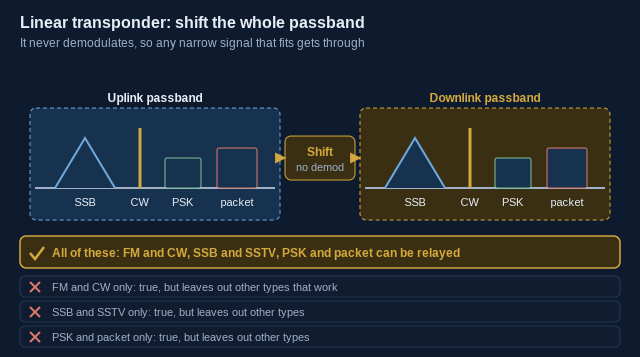
A linear transponder can relay all of these signal types.

A block of spectrum containing SSB, CW, PSK and packet signals shifted intact by a linear transponder.
Describe this graphic in words

On the left is the uplink passband holding an SSB signal, a CW signal, a PSK signal and a packet signal. A center box shifts the whole block without demodulating it. The same four signals appear in the downlink passband on the right.

This is a teaching note. A linear transponder simply shifts a block of spectrum without demodulating it, so whatever fits in that passband comes out the other side. That includes SSB voice, CW, and narrowband digital modes such as PSK and packet.

Because it is not tied to one modulation, it is more versatile than an FM repeater-style transponder. FM can technically pass through, but a wide FM signal takes up a large part of the shared passband and is discouraged. The pool keys the all-inclusive answer.

Why the other choices are wrong

  • A. FM and CW can both be relayed, but this leaves out the other types that also work.
  • B. SSB and SSTV can be relayed, but so can the other types listed.
  • C. PSK and packet can be relayed, but so can the other types listed.

Rule text checked against the official source on November 17, 2026. This is a study aid; the linked rule is what governs.
E2A08

Why should effective radiated power (ERP) be limited to a satellite that uses a linear transponder?

Show the answer and why

Answer B. To avoid reducing the downlink power to all other users

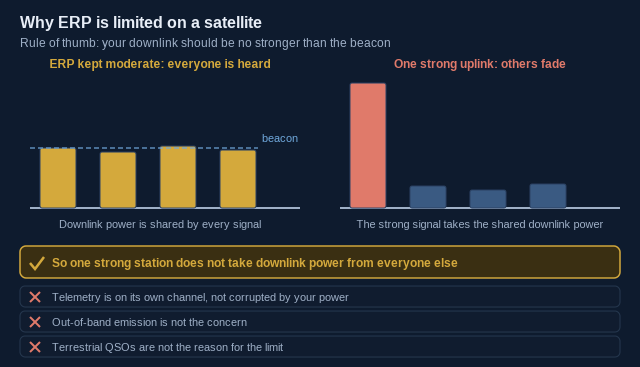
ERP is limited so that one strong station does not take downlink power from everyone else.

Two panels showing equal signals in a transponder passband versus one very strong signal that crowds out the rest.
Describe this graphic in words

The left panel shows four signals of similar height near the satellite beacon level. The right panel shows one very tall signal and three short ones. The transponder power is shared, so a strong signal takes power from everyone else.

This is a teaching note. The satellite's transmitter power is shared among every signal in the passband. A linear transponder amplifies the whole passband, so a very strong uplink signal grabs a larger share of that power and the other signals come out weaker.

A good rule of thumb is that your downlink signal should be no stronger than the satellite's own beacon. If you hear your own signal louder than that, reduce your power.

Why the other choices are wrong

  • A. Telemetry is on its own channel and is not corrupted by your power.
  • C. Out-of-band emission is not the concern; the issue is sharing limited downlink power.
  • D. Terrestrial QSOs are not the reason for the limit.

Rule text checked against the official source on November 17, 2026. This is a study aid; the linked rule is what governs.
E2A09

What do the terms “L band” and “S band” specify?

Show the answer and why

Answer A. The 23- and 13-centimeter bands

L band and S band refer to the 23-centimeter and 13-centimeter bands.

Table of satellite mode letters V, U, L and S with their bands, and the meaning of Mode U/V.
Describe this graphic in words

A table lists V for VHF 2 m, U for UHF 70 cm, L for L band 23 cm about 1.2 GHz, and S for S band 13 cm about 2.4 GHz, with L and S highlighted. Below it, Mode U/V is explained: the first letter is the uplink band and the second is the downlink band, so U/V is UHF up and VHF down.

This is a teaching note. In satellite work, L band is the 23 cm band (around 1.2 GHz) and S band is the 13 cm band (around 2.4 GHz). These are used in mode designators alongside V (2 m) and U (70 cm).

They are band names, not sideband or digital-mode descriptions.

Why the other choices are wrong

  • B. 2 meters and 70 centimeters are called V and U, not L and S.
  • C. L and S are band names, not descriptions of operating modes or store-and-forward services.
  • D. They have nothing to do with choosing a sideband.

Rule text checked against the official source on November 17, 2026. This is a study aid; the linked rule is what governs.

E2A10

What type of satellite appears to stay in one position in the sky?

Show the answer and why

Answer B. Geostationary

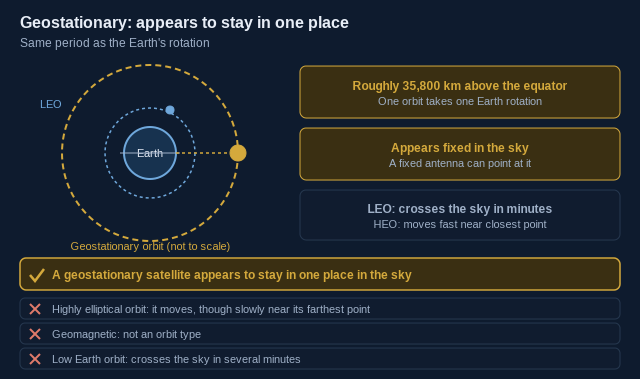
A geostationary satellite appears to stay in one place in the sky.

A geostationary orbit above the equator, with a satellite that stays over one spot and a low orbit for comparison.
Describe this graphic in words

Earth is drawn with a dashed gold circle for the geostationary orbit and a smaller dashed circle for a low Earth orbit. The geostationary satellite sits over the equator at about 35,800 km and takes one Earth rotation per orbit, so it seems fixed. Low and elliptical orbit satellites move across the sky quickly.

This is a teaching note. A geostationary satellite orbits above the equator at roughly 35,800 km, where one orbit takes the same time as one rotation of the Earth. From the ground it seems to hang motionless, so you can point a fixed antenna at it.

LEO satellites zip across the sky in minutes, and HEO satellites follow elongated orbits that move quickly near their closest point.

Why the other choices are wrong

  • A. A highly elliptical orbit satellite moves, though slowly near its farthest point.
  • C. Geomagnetic is not an orbit type.
  • D. A low-Earth-orbit satellite crosses the sky in several minutes.

Rule text checked against the official source on November 17, 2026. This is a study aid; the linked rule is what governs.

E2A11

What type of antenna can be used to minimize the effects of spin modulation and Faraday rotation?

Show the answer and why

Answer B. A circularly polarized antenna

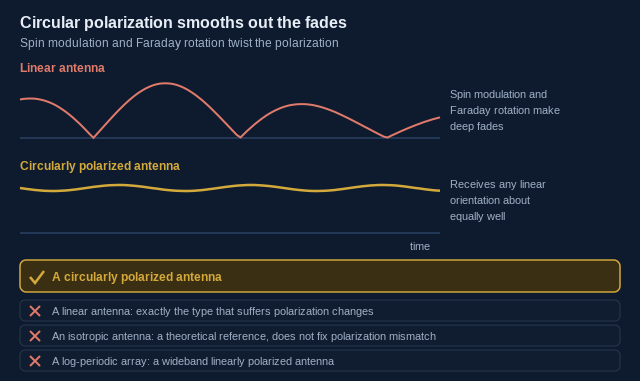
A circularly polarized antenna reduces the effects of spin modulation and Faraday rotation.

Two signal strength plots: a linear antenna with deep fades and a circular antenna with a steady level.
Describe this graphic in words

The top plot shows received signal strength with a linear antenna rising and falling to deep nulls as the satellite spins and the polarization is rotated. The bottom plot, for a circularly polarized antenna, stays nearly level.

This is a teaching note. A spinning satellite with a linear antenna produces signal strength that rises and falls with its spin (spin modulation), and the ionosphere twists the polarization of a signal as it passes through (Faraday rotation). Both change how well a linear antenna lines up with the signal.

A circularly polarized antenna receives any linear orientation about equally well, so those fades are much less noticeable.

Why the other choices are wrong

  • A. A linear antenna is exactly the type that suffers from polarization changes.
  • C. An isotropic antenna is a theoretical reference and does not solve polarization mismatch.
  • D. A log-periodic array is a wideband linearly polarized antenna.

Rule text checked against the official source on November 17, 2026. This is a study aid; the linked rule is what governs.

E2A12

What is the purpose of digital store-and-forward functions on an amateur radio satellite?

Show the answer and why

Answer C. To hold digital messages in the satellite for later download

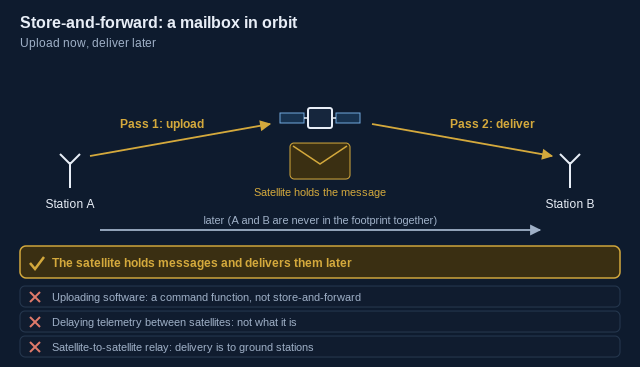
Store-and-forward lets a satellite hold messages and deliver them later.

Station A uploads a message in one pass, the satellite holds it, and delivers it to station B on a later pass.
Describe this graphic in words

Station A sends a message up to the satellite during pass 1. The satellite keeps it, like a mailbox in orbit. Later, during pass 2, it sends the message down to station B, even though the two stations were never in the footprint at the same time.

This is a teaching note. A satellite with digital store-and-forward acts like a mailbox in orbit. You upload a message during one pass, the satellite keeps it, and it sends the message down when another station is in range.

This lets two stations who are never in the satellite footprint at the same time still exchange messages.

Why the other choices are wrong

  • A. Uploading software is a command function, not store-and-forward.
  • B. It is not a way to delay telemetry between satellites.
  • D. The purpose is delivery to ground stations later, not satellite-to-satellite relay.

Rule text checked against the official source on November 17, 2026. This is a study aid; the linked rule is what governs.