
ARSC Tech School

Amateur Extra E1E: Volunteer examiner program

599 questions · pool July 1, 2024 to June 30, 2028 · the exam has 50 questions; 37 to pass

E1 · COMMISSION RULES

Volunteer examiner program: definitions; qualifications; preparation and administration of exams; reimbursement; accreditation; question pools; documentation requirements

11 questions in group E1E

One question from this group appears on each exam.

E1E01FCC rule 97.527

For which types of out-of-pocket expenses do the Part 97 rules state that VEs and VECs may be reimbursed?

Show the answer and why

Answer A. Preparing, processing, administering, and coordinating an examination for an amateur radio operator license

FCC rule 97.527

VEs and VECs may be reimbursed for out-of-pocket expenses in preparing, processing, administering, or coordinating an exam.
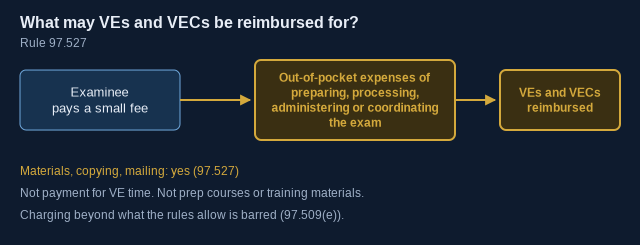
Examinee fees flow to reimburse VEs and VECs for out-of-pocket expenses of preparing, processing, administering and coordinating an exam.
Describe this graphic in words

An examinee pays a small fee, which covers out-of-pocket expenses of preparing, processing, administering or coordinating the exam, reimbursing the VEs and VECs. Notes say this covers materials, copying and mailing, not payment for VE time or prep courses.

Rule 97.527 allows reimbursement by examinees for out-of-pocket expenses of preparing, processing, administering or coordinating an examination for an amateur operator license. That is a small exam fee covering materials, copying and mailing, not payment for VE time.

The rule does not cover teaching prep courses or selling training materials. Also, 97.509(e) forbids administering an exam for monetary or other consideration beyond what is permitted.

Why the other choices are wrong

  • B. Teaching a prep course is not listed as a reimbursable expense.
  • C. Reimbursement for the listed expenses is authorized.
  • D. Providing training materials is not listed as a reimbursable expense.

References

Rule text checked against the official source on November 17, 2026. This is a study aid; the linked rule is what governs.
E1E02FCC rule 97.523

Who is tasked by Part 97 with maintaining the pools of questions for all US amateur license examinations?

Show the answer and why

Answer C. The VECs

FCC rule 97.523

The VECs cooperate in maintaining the question pools.

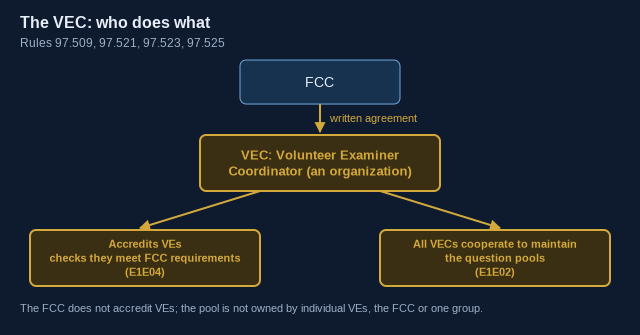
The FCC signs a written agreement with each VEC; VECs accredit VEs and cooperate on the question pools.
Describe this graphic in words

The FCC is linked by a written agreement to a VEC, an organization that coordinates exams. Two gold boxes below show its duties: accrediting VEs after confirming they meet FCC requirements, and all VECs cooperating to maintain the question pools.

Rule 97.523 says all VECs must cooperate in maintaining one question pool for each written examination element. Each pool must hold at least 10 times the number of questions in one exam and be published before use. The questions are prepared by VEs holding the required license.

So the pool belongs to the VEC community as a whole, not to individual VEs, the FCC, or one organization such as the ARRL.

Why the other choices are wrong

  • A. Individual VEs write questions but do not maintain the pools.
  • B. The FCC does not maintain the pools; the VECs do.
  • D. The ARRL is one VEC, but the rule tasks all VECs together.

References

Rule text checked against the official source on November 17, 2026. This is a study aid; the linked rule is what governs.
E1E03FCC rule 97.521

What is a Volunteer Examiner Coordinator?

Show the answer and why

Answer C. An organization that has entered into an agreement with the FCC to coordinate, prepare, and administer amateur operator license examinations

FCC rule 97.521

A VEC is an organization that has a written agreement with the FCC to coordinate amateur exams.

The FCC signs a written agreement with each VEC; VECs accredit VEs and cooperate on the question pools.
Describe this graphic in words

The FCC is linked by a written agreement to a VEC, an organization that coordinates exams. Two gold boxes below show its duties: accrediting VEs after confirming they meet FCC requirements, and all VECs cooperating to maintain the question pools.

Rule 97.521 says no organization may serve as a Volunteer Examiner Coordinator unless it has entered into a written agreement with the FCC. It must exist to further the amateur service and agree to coordinate exams for any class of license.

A VEC is an organization, not a person, and it does not get paid by the examiner team.

Why the other choices are wrong

  • A. That describes a Volunteer Examiner, not a coordinator.
  • B. A VEC does not work for payment from the VE team.
  • D. A VEC is an organization, not a single person, and the session manager is a different role.

References

Rule text checked against the official source on November 17, 2026. This is a study aid; the linked rule is what governs.
E1E04FCC rule 97.509, 97.525

What is required to be accredited as a Volunteer Examiner?

Show the answer and why

Answer D. A VEC must confirm that the VE applicant meets FCC requirements to serve as an examiner

FCC rule 97.509, 97.525

A VEC must confirm that the applicant meets FCC requirements to be a VE.

The FCC signs a written agreement with each VEC; VECs accredit VEs and cooperate on the question pools.
Describe this graphic in words

The FCC is linked by a written agreement to a VEC, an organization that coordinates exams. Two gold boxes below show its duties: accrediting VEs after confirming they meet FCC requirements, and all VECs cooperating to maintain the question pools.

Rule 97.509(b)(1) requires each administering VE to be accredited by the coordinating VEC. Rule 97.525 says the VEC may not accredit a person who does not meet the minimum qualifications, so the VEC checks the requirements. A VE must also be at least 18 and hold the right license class.

The FCC itself does not accredit VEs, there is no FCC Enforcement Bureau exam, and accreditation is not automatic when the license is granted.

Why the other choices are wrong

  • A. Accreditation is not automatic with a license grant.
  • B. There is no VE exam administered by the FCC Enforcement Bureau.
  • C. The VEC, not the FCC, accredits VEs.

References

Rule text checked against the official source on November 17, 2026. This is a study aid; the linked rule is what governs.
E1E05FCC rule 97.509(j)

What must the VE team do with the application form if the examinee does not pass the exam?

Show the answer and why

Answer B. Return the application document to the examinee

FCC rule 97.509(j)

If the examinee does not pass, the VEs return the application document to the examinee and inform them of the grade.

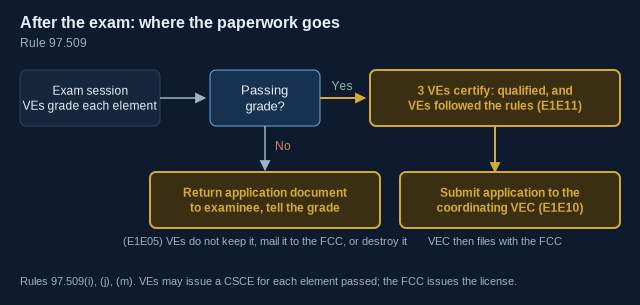
A flowchart of what VEs do with the paperwork after grading an exam: return it on a fail, certify and send to the VEC on a pass.
Describe this graphic in words

After grading, a passing decision splits. On a fail, the VEs return the application document to the examinee and tell them the grade. On a pass, three VEs certify that the examinee is qualified and that the VEs followed the rules, and then submit the application document to the coordinating VEC, which files with the FCC.

Rule 97.509(j) says when an examinee does not score a passing grade on an element, the administering VEs must return the application document to the examinee and inform the examinee of the grade.

The VEs do not keep the form, send it to the FCC, or destroy it. Only a passing grade moves the paperwork on to the VEC under 97.509(m).

Why the other choices are wrong

  • A. The form goes back to the examinee; it is not kept with the VEC records.
  • C. The form is not sent to the FCC for a failed exam.
  • D. The form is returned, not destroyed.

References

Rule text checked against the official source on November 17, 2026. This is a study aid; the linked rule is what governs.

E1E06FCC rule 97.509

Who is responsible for the proper conduct and necessary supervision during an amateur operator license examination session?

Show the answer and why

Answer C. Each administering VE

FCC rule 97.509

Each administering VE is responsible for the proper conduct and necessary supervision of the exam.

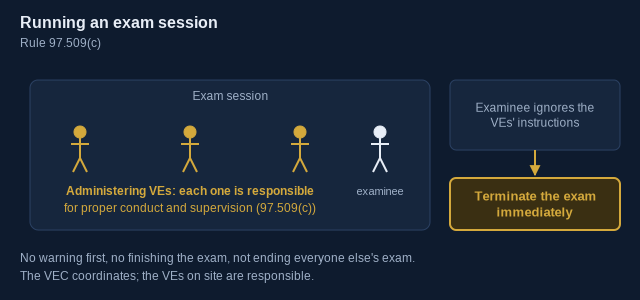
Administering VEs are responsible for supervising the exam and must immediately terminate it if an examinee fails to comply with instructions.
Describe this graphic in words

Three VEs in gold stand in an exam room with an examinee; every administering VE is responsible for conduct and supervision. To the right, an examinee who ignores instructions leads by arrow to a gold box: terminate the exam immediately.

Rule 97.509(c) says each administering VE must observe the examinee throughout the entire examination, and that the administering VEs are responsible for the proper conduct and necessary supervision of each examination. The responsibility is shared by every VE on the team, not a single person.

The VEC coordinates the session but the VEs on site are responsible for it.

Why the other choices are wrong

  • A. The VEC coordinates but does not supervise the room.
  • B. There is no single designated monitoring VE in the rule.
  • D. The session manager is not the only responsible VE; every administering VE is.

References

Rule text checked against the official source on November 17, 2026. This is a study aid; the linked rule is what governs.

E1E07FCC rule 97.509, 97.511

What should a VE do if a candidate fails to comply with the examiner’s instructions during an amateur operator license examination?

Show the answer and why

Answer B. Immediately terminate the candidate’s examination

FCC rule 97.509, 97.511

The VEs must immediately terminate the exam when an examinee fails to comply with their instructions.

Administering VEs are responsible for supervising the exam and must immediately terminate it if an examinee fails to comply with instructions.
Describe this graphic in words

Three VEs in gold stand in an exam room with an examinee; every administering VE is responsible for conduct and supervision. To the right, an examinee who ignores instructions leads by arrow to a gold box: terminate the exam immediately.

Rule 97.509(c) says the administering VEs must immediately terminate the examination upon failure of the examinee to comply with their instructions. Rule 97.511 puts the matching duty on the examinee: they must comply with the VEs' instructions.

The rule does not call for a warning first, for letting the exam finish, or for ending everyone else's exam.

Why the other choices are wrong

  • A. The rule does not require a warning before termination.
  • C. The exam is terminated, not finished and invalidated.
  • D. Only the noncompliant examinee's exam is terminated.

References

Rule text checked against the official source on November 17, 2026. This is a study aid; the linked rule is what governs.

E1E08FCC rule 97.509

To which of the following examinees may a VE not administer an examination?

Show the answer and why

Answer C. Relatives of the VE as listed in the FCC rules

FCC rule 97.509

A VE may not administer an exam to relatives listed in the FCC rules.

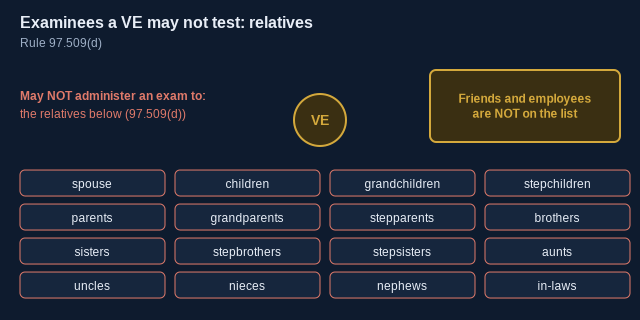
The relatives a VE may not examine, with friends and employees not on the list.
Describe this graphic in words

A central VE circle above a grid of sixteen red-outlined relatives: spouse, children, grandchildren, stepchildren, parents, grandparents, stepparents, brothers, sisters, stepbrothers, stepsisters, aunts, uncles, nieces, nephews and in-laws. A gold box notes friends and employees are not on the list.

Rule 97.509(d) lists the relatives: spouse, children, grandchildren, stepchildren, parents, grandparents, stepparents, brothers, sisters, stepbrothers, stepsisters, aunts, uncles, nieces, nephews and in-laws.

Friends and employees are not on the list, so the rule does not bar a VE from testing them. The prohibition is about family relationships, so being a friend or employee of the VE does not bar the exam.

Why the other choices are wrong

  • A. Employees are not in the list of prohibited examinees.
  • B. Friends are not in the list of prohibited examinees.
  • D. Only relatives are barred, so "all of these" fails.

References

Rule text checked against the official source on November 17, 2026. This is a study aid; the linked rule is what governs.

E1E09FCC rule 97.509

What may be the penalty for a VE who fraudulently administers or certifies an examination?

Show the answer and why

Answer A. Revocation of the VE’s amateur station license grant and the suspension of the VE’s amateur operator license grant

FCC rule 97.509

A VE who fraudulently administers or certifies an exam may lose their station license grant and have their operator license suspended.

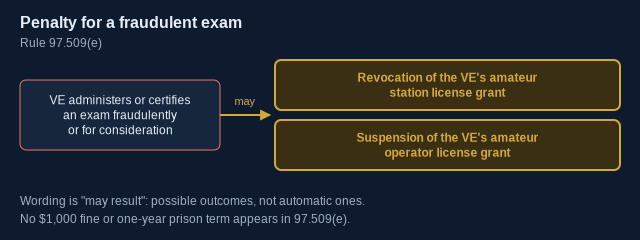
Fraud by a VE may result in revocation of the station license grant and suspension of the operator license.
Describe this graphic in words

A red box for a VE who administers or certifies an exam fraudulently. A gold arrow marked may leads to two gold outcomes: revocation of the VE station license grant and suspension of the operator license grant. Notes say these are possible, not automatic, and no fine or prison term is in the rule.

Rule 97.509(e) says that violating the ban on administering or certifying an examination by fraudulent means or for consideration may result in the revocation of the grant of the VE's amateur station license and the suspension of the grant of the VE's amateur operator license.

The rule text does not mention a $1,000 fine or a one-year prison sentence. The wording is "may result," so the penalties are possible outcomes, not automatic ones.

Why the other choices are wrong

  • B. A $1,000 per occurrence fine is not stated in this rule.
  • C. A prison sentence is not stated in this rule.
  • D. Only choice A matches the rule.

References

Rule text checked against the official source on November 17, 2026. This is a study aid; the linked rule is what governs.

E1E10FCC rule 97.509(m)

What must the administering VEs do after the administration of a successful examination for an amateur operator license?

Show the answer and why

Answer C. They must submit the application document to the coordinating VEC according to the coordinating VEC instructions

FCC rule 97.509(m)

After a successful exam, the VEs submit the application document to the coordinating VEC according to the VEC's instructions.

A flowchart of what VEs do with the paperwork after grading an exam: return it on a fail, certify and send to the VEC on a pass.
Describe this graphic in words

After grading, a passing decision splits. On a fail, the VEs return the application document to the examinee and tell them the grade. On a pass, three VEs certify that the examinee is qualified and that the VEs followed the rules, and then submit the application document to the coordinating VEC, which files with the FCC.

Rule 97.509(m) says that after the administration of a successful examination, the administering VEs must submit the application document to the coordinating VEC according to the VEC's instructions. The VEC then handles the filing with the FCC.

The VEs do not send it directly to the FCC, they do not submit it for grading (the VEs grade each element at the session), and they do not hand it back to the applicant for filing.

Why the other choices are wrong

  • A. The documents go to the VEC, not directly to the FCC.
  • B. Grading is done by the VEs at the session; the VEC does not grade submitted papers.
  • D. The applicant does not file the documents with the FCC.

References

Rule text checked against the official source on November 17, 2026. This is a study aid; the linked rule is what governs.

E1E11FCC rule 97.509(i)

What must the VE team do if an examinee scores a passing grade on all examination elements needed for an upgrade or new license?

Show the answer and why

Answer B. Three VEs must certify that the examinee is qualified for the license grant and that they have complied with the administering VE requirements

FCC rule 97.509(i)

When an examinee has passed all needed elements, three VEs must certify that the examinee is qualified and that the VEs followed the rules.

A flowchart of what VEs do with the paperwork after grading an exam: return it on a fail, certify and send to the VEC on a pass.
Describe this graphic in words

After grading, a passing decision splits. On a fail, the VEs return the application document to the examinee and tell them the grade. On a pass, three VEs certify that the examinee is qualified and that the VEs followed the rules, and then submit the application document to the coordinating VEC, which files with the FCC.

Rule 97.509(i) says when the examinee is credited for all required elements, 3 VEs must certify that the examinee is qualified for the license grant and that the VEs complied with the administering VE requirements. Those certifying VEs are jointly and individually accountable.

The VEs do not photocopy and forward the documents to the FCC, and they do not issue the license (the FCC does that). They may issue a CSCE for each element passed.

Why the other choices are wrong

  • A. The documents go to the VEC under 97.509(m), not directly to the FCC.
  • C. VEs do not issue licenses; the FCC does.
  • D. Only choice B matches the rule.

References

Rule text checked against the official source on November 17, 2026. This is a study aid; the linked rule is what governs.