Which matching system for Yagi antennas requires the driven element to be insulated from the boom?
Show the answer and why
Answer B. Beta or hairpin
A beta (hairpin) match requires the driven element to be insulated from the boom.
Describe this graphic in words
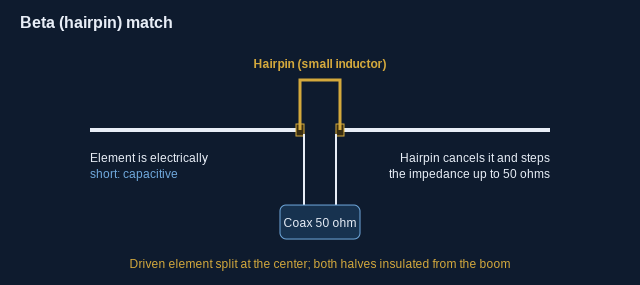
The driven element is split in the middle, with gold blocks showing that both halves are insulated from the boom. A hairpin loop bridges the two halves at the feed point and acts as an inductor. The coax connects to the same two points. The element is deliberately shorter than resonance, so it is capacitive, and the hairpin cancels that.
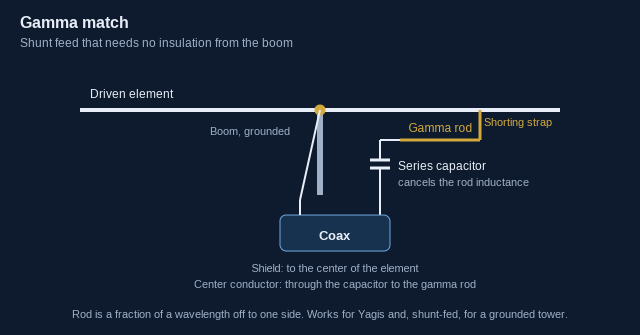
This is a teaching note. The hairpin is a shorted stub across the center of a split driven element, and the element halves are electrically separate, so they have to be insulated from the boom. By contrast, a gamma match is fed off to one side of a grounded center, so the element can be bonded to the boom.
A T-match is similar to a hairpin in that the element is split at the center, but the question is about the beta or hairpin.
Why the other choices are wrong
- A. A gamma match works with the driven element connected to the boom.
- C. Shunt feed is for grounded vertical structures such as towers.
- D. A T-match also uses a split element, but the pool's keyed answer is the beta or hairpin match.
Rule text checked against the official source on November 17, 2026. This is a study aid; the linked rule is what governs.