
ARSC Tech School

Amateur Extra E2C: Contest and DX operating

599 questions · pool July 1, 2024 to June 30, 2028 · the exam has 50 questions; 37 to pass

E2 · OPERATING PROCEDURES

Contest and DX operating; remote operation techniques; log data format; contact confirmation; RF network systems

12 questions in group E2C

One question from this group appears on each exam.

E2C01

What indicator is required to be used by US-licensed operators when operating a station via remote control and the remote transmitter is located in the US?

Show the answer and why

Answer D. No additional indicator is required

No additional indicator is required for remote operation of a US station.
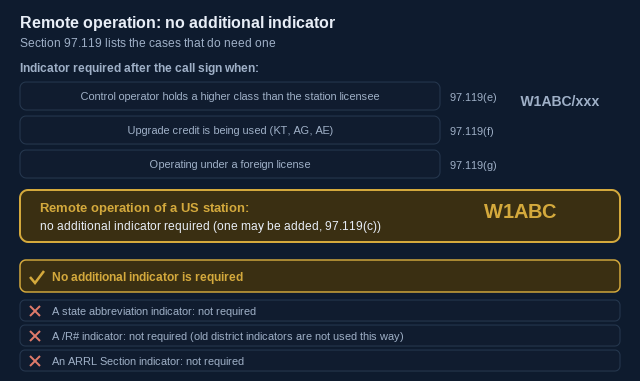
A list of cases that require a call sign indicator, with remote operation of a US station shown as needing none.
Describe this graphic in words

Three dimmed rows list when an indicator must follow the call sign: a control operator of higher class, upgrade credit, and a foreign license. A gold panel below says remote operation of a US station needs no additional indicator, though one may be added.

Section 97.119 lists the indicators that must follow the call sign, and they apply when the control operator holds a higher class license than the station, when upgrade credit is being used, or when operating under a foreign license. Remote control from within the US is not on that list.

Paragraph (c) says that indicators may be included, so you can add one if you like, but none is required for remote operation within the US.

Why the other choices are wrong

  • A. A state abbreviation indicator is not required.
  • B. A /R# indicator is not required; the old district indicators are not used this way.
  • C. An ARRL Section indicator is not required.

References

Rule text checked against the official source on November 17, 2026. This is a study aid; the linked rule is what governs.
E2C02

Which of the following file formats is used for exchanging amateur radio log data?

Show the answer and why

Answer C. ADIF

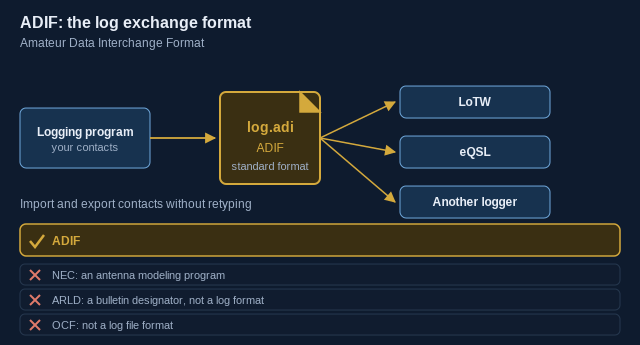
ADIF is the standard file format for exchanging amateur log data.

A logging program exports an ADIF file that LoTW, eQSL and another logger can import.
Describe this graphic in words

A logging program writes a file in ADIF, the Amateur Data Interchange Format. Arrows carry that same file to LoTW, eQSL and another logging program, so contacts move between them without retyping.

This is a teaching note. ADIF stands for Amateur Data Interchange Format. Logging programs, LoTW, eQSL and other services use it to import and export contacts without retyping.

NEC is antenna modeling software, and ARLD is a designator for ARRL bulletins. OCF is not a log format.

Why the other choices are wrong

  • A. NEC is an antenna modeling program.
  • B. ARLD is a bulletin designator, not a log format.
  • D. OCF is not a log file format.

Rule text checked against the official source on November 17, 2026. This is a study aid; the linked rule is what governs.
E2C03

From which of the following bands is amateur radio contesting generally excluded?

Show the answer and why

Answer A. 30 meters

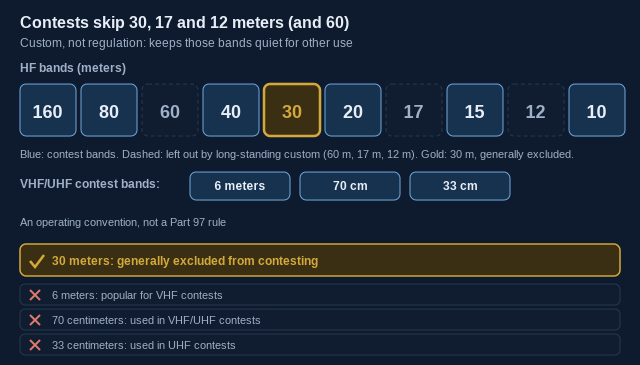
Contesting is generally excluded from the 30 meter band.

A row of HF band tiles with 30, 17, 12 and 60 meters marked as left out of contests.
Describe this graphic in words

Ten HF band tiles run from 160 to 10 meters. The 60, 17 and 12 meter tiles are dashed because contest sponsors traditionally leave them out, and 30 meters is highlighted in gold as the answer. A row below shows 6 meters, 70 cm and 33 cm as active contest bands.

This is a teaching note. Nothing in Part 97 bars contests on any band; this is an operating convention. Contest sponsors by long-standing custom leave out the 30, 17 and 12 meter bands (the WARC bands) and 60 meters, so those stay quiet for casual and emergency contacts.

The 6 meter, 70 cm and 33 cm bands all see contest activity.

Why the other choices are wrong

  • B. 6 meters is popular for VHF contests.
  • C. 70 centimeters is used in VHF/UHF contests.
  • D. 33 centimeters is used in UHF contests.

Rule text checked against the official source on November 17, 2026. This is a study aid; the linked rule is what governs.
E2C04

Which of the following frequencies can be used for amateur radio mesh networks?

Show the answer and why

Answer B. Frequencies shared with various unlicensed wireless data services

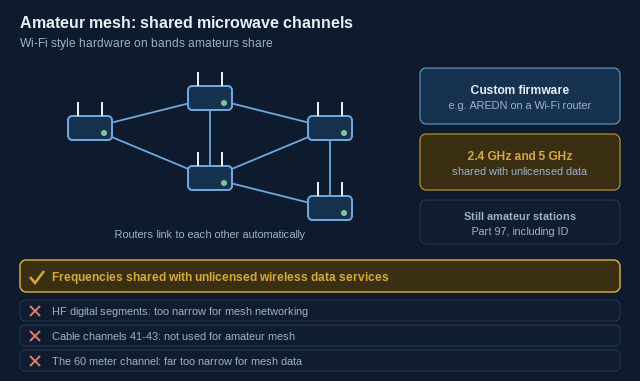
Amateur mesh networks use frequencies shared with unlicensed wireless data services.

A mesh of routers on 2.4 and 5 GHz channels shared with unlicensed wireless data services.
Describe this graphic in words

Five Wi-Fi style routers are connected in a mesh. Side boxes say the hardware uses custom firmware, runs on 2.4 GHz and 5 GHz channels shared with unlicensed data services (highlighted in gold), and that the stations are still amateur stations that must follow Part 97.

This is a teaching note. Mesh networks usually run on Wi-Fi style hardware, so they operate on channels in bands such as 2.4 GHz and 5 GHz that amateurs share with unlicensed data services. The stations are still amateur stations and must follow Part 97, including identification.

HF digital frequencies and the 60 meter channel cannot carry that kind of wideband data.

Why the other choices are wrong

  • A. HF digital segments are too narrow for mesh networking.
  • C. Cable channels 41-43 are not used for amateur mesh.
  • D. The 60 meter channel is far too narrow for mesh data.

Rule text checked against the official source on November 17, 2026. This is a study aid; the linked rule is what governs.
E2C05

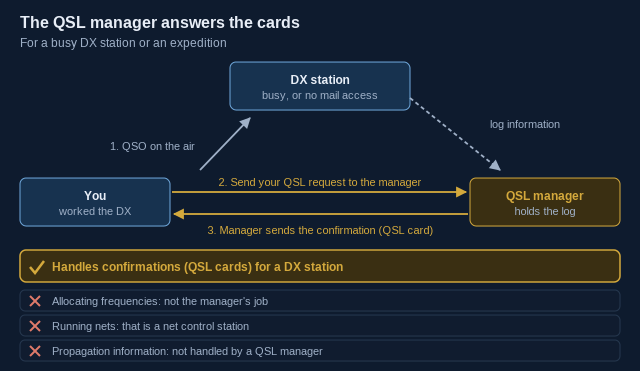
What is the function of a DX QSL Manager?

Show the answer and why

Answer B. Handle the receiving and sending of confirmations for a DX station

A DX QSL manager handles confirmations (QSL cards) for a DX station.

You send a QSL request to the manager of a DX station, who sends the confirmation back.
Describe this graphic in words

A DX station passes its log to a QSL manager. After a contact, you send your request to the manager and the manager sends the QSL confirmation back to you, so the DX operator does not have to.

This is a teaching note. A busy DX station or expedition may not have the time or mail access to answer every card. The QSL manager collects the log information, sends out confirmations, and handles incoming requests.

The manager does not assign frequencies, run nets or report on propagation.

Why the other choices are wrong

  • A. Allocating frequencies is not the manager's job.
  • C. A net control station runs nets, not a QSL manager.
  • D. Propagation information is not handled by a QSL manager.

Rule text checked against the official source on November 17, 2026. This is a study aid; the linked rule is what governs.
E2C06

During a VHF/UHF contest, in which band segment would you expect to find the highest level of SSB or CW activity?

Show the answer and why

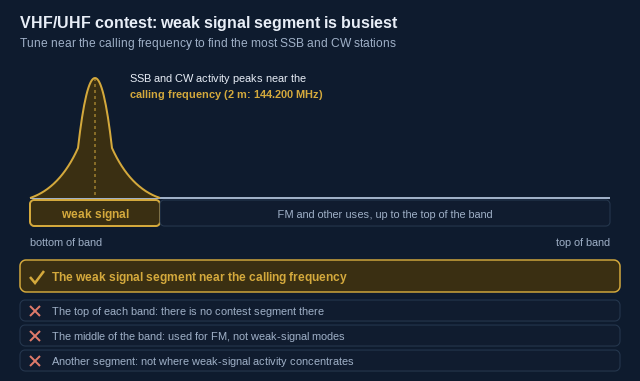
Answer C. In the weak signal segment of the band, with most of the activity near the calling frequency

The highest SSB and CW activity in a VHF/UHF contest is in the weak signal segment near the calling frequency.

A VHF band with a peak of SSB and CW activity in the weak signal segment near the calling frequency at the bottom of the band.
Describe this graphic in words

A horizontal bar represents a VHF band from bottom to top. A gold segment at the bottom is the weak signal segment, with an activity peak at the calling frequency, 144.200 MHz on 2 meters. The rest of the band up to the top is shown dimmed for FM and other uses.

This is a teaching note. Weak signal stations, using SSB and CW, gather in the bottom segment of each band, with most activity around the national calling frequency (for example 144.200 MHz on 2 meters). Contest participants tune around there to find the most stations.

The FM portions and the top of the band are for other uses.

Why the other choices are wrong

  • A. There is no contest segment at the top of each band.
  • B. The middle of the band is used for FM, not weak-signal modes.
  • D. This is not where weak-signal activity concentrates.

Rule text checked against the official source on November 17, 2026. This is a study aid; the linked rule is what governs.
E2C07

What is the Cabrillo format?

Show the answer and why

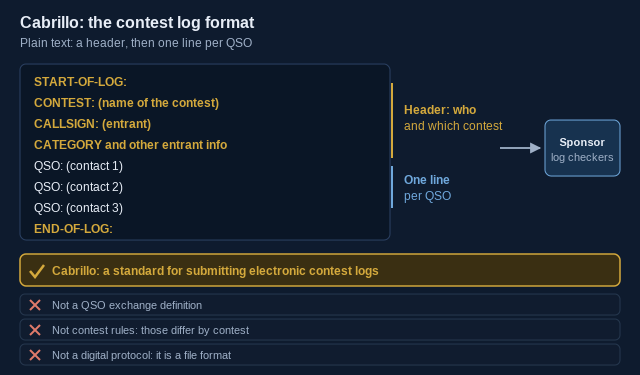
Answer A. A standard for submission of electronic contest logs

Cabrillo is a standard for submitting electronic contest logs.

A Cabrillo contest log: a text header identifying the entrant, then one line per contact.
Describe this graphic in words

A plain text file starts with header lines that identify the entrant and the contest, followed by one line for each contact. The file is submitted to the contest sponsor. Logging software creates it for you.

This is a teaching note. Most contest sponsors want logs in the Cabrillo format, a plain text file with a header that identifies the entrant and the contest, followed by one line per QSO. Logging software creates the file for you.

It is not a rule set, an exchange protocol or a digital mode.

Why the other choices are wrong

  • B. It does not define how information is exchanged in a QSO.
  • C. Rules differ with each contest and are not in Cabrillo.
  • D. It is a file format, not a digital protocol.

Rule text checked against the official source on November 17, 2026. This is a study aid; the linked rule is what governs.
E2C08

Which of the following contacts may be confirmed through the Logbook of The World (LoTW)?

Show the answer and why

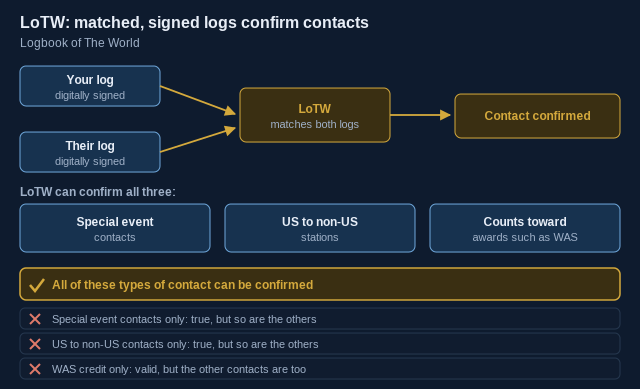
Answer D. All these choices are correct

LoTW can confirm all of these types of contact.

Two signed logs matched by LoTW to confirm contacts, including special event, US to non-US and award contacts.
Describe this graphic in words

Two digitally signed logs, yours and the other station's, are matched by Logbook of The World, which confirms the contact. Three boxes below show the kinds it can confirm: special event contacts, contacts between US and non-US stations, and contacts that count toward awards such as Worked All States.

This is a teaching note. Logbook of The World matches uploaded, digitally signed logs from both stations. It can confirm special event contacts, contacts between US and non-US stations, and contacts that count toward awards such as Worked All States.

As all three are valid, the all-inclusive choice is correct.

Why the other choices are wrong

  • A. Special event contacts can be confirmed, but so can the others.
  • B. US to non-US contacts can be confirmed, but so can the others.
  • C. WAS credit can be earned, but the other contacts are valid too.

Rule text checked against the official source on November 17, 2026. This is a study aid; the linked rule is what governs.
E2C09

What type of equipment is commonly used to implement an amateur radio mesh network?

Show the answer and why

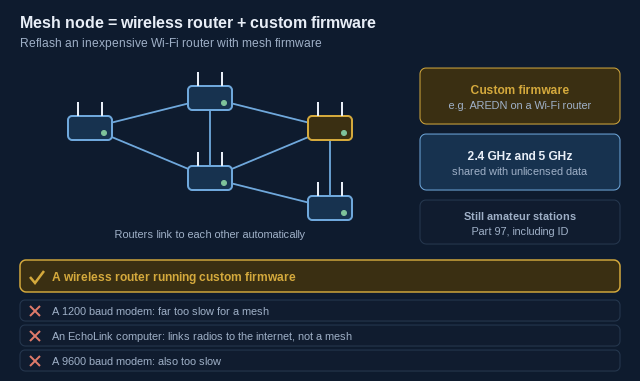
Answer C. A wireless router running custom firmware

A mesh network is commonly built from a wireless router running custom firmware.

A mesh network built from wireless routers running custom firmware.
Describe this graphic in words

Five routers are linked in a mesh. The router firmware, such as AREDN, is highlighted in gold as what makes an ordinary Wi-Fi router into a ham mesh node. The nodes connect automatically and run on 2.4 GHz and 5 GHz channels.

This is a teaching note. Hams reflash inexpensive Wi-Fi routers with mesh firmware such as AREDN. The routers connect to each other automatically and carry data, voice and video on microwave Wi-Fi style channels (2.4 GHz and 5 GHz are common).

A VHF or UHF transceiver with a slow modem, or an EchoLink computer, cannot provide a high speed mesh.

Why the other choices are wrong

  • A. A 1200 baud modem is far too slow for a mesh network.
  • B. EchoLink links radios to the internet, which is not mesh networking.
  • D. A 9600 baud modem is also too slow.

Rule text checked against the official source on November 17, 2026. This is a study aid; the linked rule is what governs.
E2C10

Why do DX stations often transmit and receive on different frequencies?

Show the answer and why

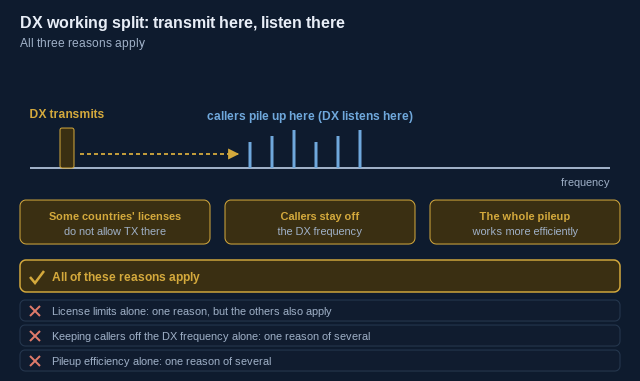
Answer D. All these choices are correct

DX stations often work split, and all of these reasons apply.

A DX station transmitting on one frequency while listening for callers on another, with three reasons for working split.
Describe this graphic in words

On a frequency line the DX station transmits at the left in gold, while a cluster of calling stations sits on a different frequency to the right, where the DX listens. Three boxes give the reasons: license limits in some countries, keeping callers off the DX frequency, and a more efficient pileup.

This is a teaching note. A DX station may use a frequency where some countries' licenses do not allow transmission, so it listens elsewhere. Splitting also keeps the callers off the DX frequency so the DX can be heard, and it makes the whole pileup more efficient.

Because each statement is a real reason, the all-inclusive choice is correct.

Why the other choices are wrong

  • A. This is one reason, but the others also apply.
  • B. This is one reason, but the others also apply.
  • C. This is one reason, but the others also apply.

Rule text checked against the official source on November 17, 2026. This is a study aid; the linked rule is what governs.
E2C11

How should you generally identify your station when attempting to contact a DX station during a contest or in a pileup?

Show the answer and why

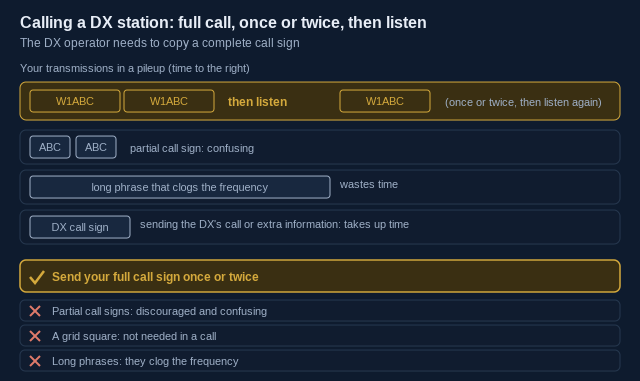
Answer A. Send your full call sign once or twice

Send your full call sign once or twice when calling a DX station.

A timeline of transmissions: your full call sign once or twice then listening, compared with poor habits.
Describe this graphic in words

The top row in gold shows your full call sign sent twice and then a listening gap. Three dimmed rows show poor habits: a partial call sign, a long phrase, and sending the DX station's own call sign or extra information.

This is a teaching note. In a pileup, the DX operator needs to copy a complete call sign. Send it once or twice and then listen, and do not repeat endlessly. Sending partial calls or long phrases wastes time and adds to the noise.

Do not send the DX call sign or extra information, which just takes up time.

Why the other choices are wrong

  • B. Partial call signs are discouraged and can be confusing.
  • C. A grid square is not needed in a call.
  • D. Long phrases clog the frequency and are not the practice.

Rule text checked against the official source on November 17, 2026. This is a study aid; the linked rule is what governs.

E2C12

What indicates the delay between a control operator action and the corresponding change in the transmitted signal?

Show the answer and why

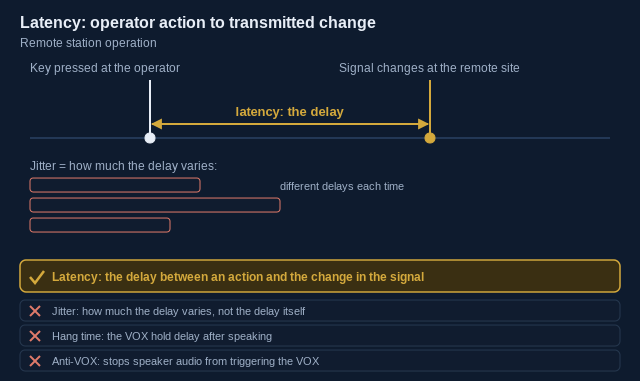
Answer C. Latency

Latency is the delay between an operator action and the change in the transmitted signal.

A timeline showing latency as the delay between pressing a key and the remote signal changing, with jitter as varying delays.
Describe this graphic in words

A key press on the left and a signal change at the remote site on the right are joined by a gold double arrow labeled latency. Three bars of different length below show jitter, which is the variation in that delay.

This is a teaching note. In remote operation, there is a lag between you pressing a key and the signal changing at the remote site. That lag is called latency, and it comes from the network and equipment.

Jitter is variation in delay, hang time is VOX holding time, and anti-VOX prevents speaker audio from keying the transmitter.

Why the other choices are wrong

  • A. Jitter is how much the delay varies, not the delay itself.
  • B. Hang time is the VOX hold delay after speaking.
  • D. Anti-VOX is a circuit that stops the VOX being triggered by speaker audio.

Rule text checked against the official source on November 17, 2026. This is a study aid; the linked rule is what governs.