What is a beam antenna?
Show the answer and why
Answer C. An antenna that concentrates signals in one direction
A beam antenna concentrates its signal in one direction.
Describe this graphic in words
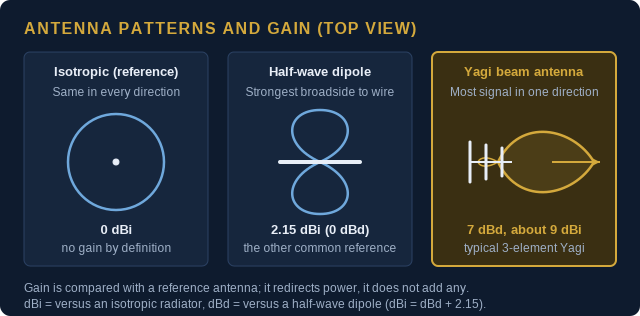
Three panels show antenna patterns looking down from above. The isotropic antenna is a circle with 0 dBi gain, the half-wave dipole is a figure-eight with 2.15 dBi (0 dBd) gain, and the Yagi, highlighted in gold, is one large lobe pointing forward from three vertical elements with a typical gain of 7 dBd, about 9 dBi. A note says gain is measured against a reference antenna and that dBi equals dBd plus 2.15.
A beam antenna is built to favor one direction. The common example is the Yagi: a driven element fed by the coax, a reflector behind it and one or more directors in front of it. The elements work together so the signals add up toward the front and cancel toward the back and sides.
The result is one strong main lobe instead of an even spread, so you can aim the antenna at a distant station and also reject interference from other directions. The name comes from that focused "beam" of radiation, not from the building material. This is a teaching note.
Why the other choices are wrong
- A. "Beam" describes the focused radiation pattern. The boom of a Yagi is often aluminum tubing, but square aluminum beams have nothing to do with the name.
- B. A beam is the opposite of omnidirectional, and the name does not honor a person called Beam. The classic Yagi design is named for its Japanese inventors, Yagi and Uda.
- D. A beam has one main lobe, usually with small side and rear lobes. It does not send out two intense rays.
Rule text checked against the official source on November 5, 2026. This is a study aid; the linked rule is what governs.