
ARSC Tech School

Technician T8C: Operating activities

409 questions · pool July 1, 2026 to June 30, 2030 · the exam has 35 questions; 26 to pass

T8 · SIGNALS AND EMISSIONS

Operating activities: radio direction finding, contests, linking over the internet, exchanging grid locators

11 questions in group T8C

One question from this group appears on each exam.

T8C01

Which of the following methods is used to locate sources of noise interference or jamming?

Show the answer and why

Answer C. Radio direction finding

Radio direction finding is used to locate noise sources and jammers.
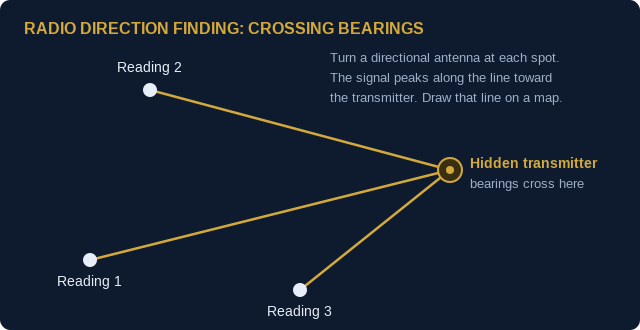
Three bearing lines from different spots crossing at a hidden transmitter.
Describe this graphic in words

Three observation points, labelled Reading 1, 2 and 3, each draw a gold bearing line toward the right. The three lines cross at a gold marker labelled hidden transmitter. A note says to turn a directional antenna at each spot, find where the signal peaks, and draw that line on a map.

Radio direction finding (RDF) uses a directional antenna to find the direction a signal is coming from. The signal is strongest, or weakest, when the antenna points a particular way, and that gives a bearing toward the source.

Taking bearings from two or three different places and drawing the lines on a map shows where they cross, which is where the noise source or jammer is. Hams use the same method for hidden-transmitter hunts. This is a teaching note.

Why the other choices are wrong

  • A. Echolocation uses sound reflected from objects, as bats do; it is not a radio method.
  • B. Doppler radar measures the speed of moving objects such as storms; it is not used to find noise sources.
  • D. Phase locking is a way of holding an oscillator on a frequency, not of finding a source.

Rule text checked against the official source on November 5, 2026. This is a study aid; the linked rule is what governs.
T8C02

Which of these items would be useful for a hidden transmitter hunt?

Show the answer and why

Answer B. A directional antenna

A directional antenna is the useful item for a transmitter hunt.

Three bearing lines from different spots crossing at a hidden transmitter.
Describe this graphic in words

Three observation points, labelled Reading 1, 2 and 3, each draw a gold bearing line toward the right. The three lines cross at a gold marker labelled hidden transmitter. A note says to turn a directional antenna at each spot, find where the signal peaks, and draw that line on a map.

A directional antenna, such as a small Yagi or a loop, is more sensitive in one direction than in others. As you turn it, the signal peaks when it points toward the hidden transmitter, so each reading gives you a line pointing at the target. Readings from two or three places cross at the transmitter.

An SWR meter and a directional wattmeter measure your own transmitter and feed line. They tell you nothing about where another signal is coming from, so only the directional antenna is useful. This is a teaching note.

Why the other choices are wrong

  • A. A calibrated SWR meter checks how well your own antenna is matched to your transmitter. It cannot show direction.
  • C. A directional wattmeter measures forward and reflected power in your own feed line, not the direction of another station.
  • D. Only the directional antenna helps, so "all of these" is wrong.

Rule text checked against the official source on November 5, 2026. This is a study aid; the linked rule is what governs.

T8C03

What operating activity involves contacting as many stations as possible during a specified period?

Show the answer and why

Answer D. Contesting

Contesting is contacting as many stations as possible in a set period.

A contest is a timed on-air competition in which stations try to make as many contacts as they can, often with certain stations or places that earn extra points. Each contact is a short, standard exchange, such as a call sign and a signal report or location. Scoring rules differ from contest to contest.

Contests are popular practice for operating skill and are a good way for a new ham to log many contacts quickly. This is a teaching note.

Why the other choices are wrong

  • A. Simulated emergency exercises practice emergency communications; they are not a contact race.
  • B. Net operations are organized on-air gatherings with a net control station, not a race for contacts.
  • C. Hidden transmitter hunts are about finding a transmitter by direction finding.

Rule text checked against the official source on November 5, 2026. This is a study aid; the linked rule is what governs.

T8C04

Which of the following is good practice when contacting another station in a contest?

Show the answer and why

Answer C. Sending only the minimum information needed for proper identification and the contest exchange

Send only the minimum information needed for identification and the contest exchange.

Contest contacts are fast, so every extra word slows both stations and costs both of you contacts. Good practice is to send your call sign and the contest exchange, nothing more, and move on.

Section 97.119(a) still requires each station to transmit its assigned call sign at the end of each communication and at least every 10 minutes during a communication. Because you send your full call sign in each exchange, you meet that requirement without extra words. This is a teaching note for the contest practice.

Why the other choices are wrong

  • A. Sending only part of your call sign is not a valid identification. Section 97.119(a) requires your assigned call sign.
  • B. A duplicate contact wastes time for both stations and normally does not count again.
  • D. "Please copy" adds nothing and slows the exchange.

References

Rule text checked against the official source on November 5, 2026. This is a study aid; the linked rule is what governs.

T8C05

What is a grid locator?

Show the answer and why

Answer A. A letter-number designator assigned to a geographic location

A grid locator is a letter-number designator assigned to a geographic location.

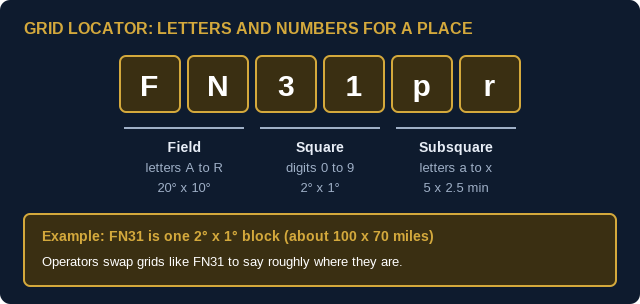
Breakdown of the grid locator FN31pr into field, square and subsquare.
Describe this graphic in words

Six gold boxes spell F, N, 3, 1, p, r. Brackets group them in pairs. The first pair, letters A to R, is the field, 20 by 10 degrees. The digits are the square, 2 by 1 degrees. The final letters are the subsquare, 5 by 2.5 minutes. A gold panel notes that FN31 is a block of about 100 by 70 miles and that operators swap grids to say roughly where they are.

The Maidenhead grid system divides the Earth into rectangles, each named by letters and numbers such as FN31. The first pair of letters is a large field, the two digits narrow it to a 2 degree by 1 degree square, and an optional final pair of letters narrows it to a subsquare. The longer the locator, the smaller the area it names.

Operators exchange grid locators in contests and weak-signal VHF/UHF work to say roughly where they are. A grid square names a place, not an antenna direction, and it is not a piece of test equipment. This is a teaching note.

Why the other choices are wrong

  • B. A grid locator names a place on the Earth, not an azimuth and elevation for pointing an antenna.
  • C. It is a name for a location, not an instrument for finding faults in amplifiers.
  • D. It is not a direction-finding instrument; direction finding uses a directional antenna and receiver.

Rule text checked against the official source on November 5, 2026. This is a study aid; the linked rule is what governs.

T8C06

How is over the air access to Internet Radio Linking Project (IRLP) nodes accomplished?

Show the answer and why

Answer B. By using Dual-Tone Multi-Frequency (DTMF) signals

IRLP nodes are accessed over the air with DTMF signals.

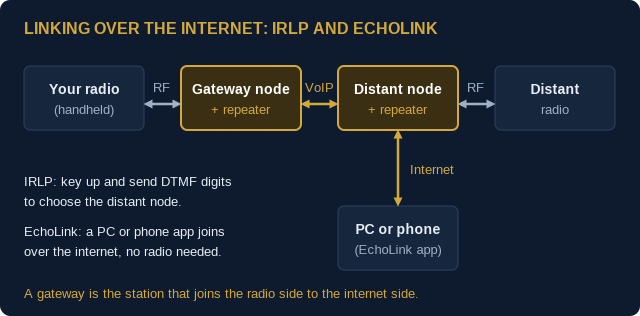
Your radio linked to a distant radio through two gateway nodes over the internet, plus an EchoLink PC.
Describe this graphic in words

A row of four boxes: your handheld, a gateway node with a repeater in gold, a distant gateway node with a repeater in gold, and a distant radio. Radio links are marked RF and the link between the gateways is marked VoIP. Below the distant node a PC or phone running EchoLink joins it over the internet. Notes say IRLP is reached by DTMF digits, EchoLink needs no radio, and a gateway joins the radio side to the internet side.

You key up the repeater that is linked to an IRLP node and press touch-tone (DTMF) digits on your radio's keypad. The node decodes the digits and uses them to choose the distant node, then connects the two systems over the internet.

The internet is what links the nodes to each other, but the way you reach one by radio is with DTMF, not with a password or CTCSS tone. This is a teaching note.

Why the other choices are wrong

  • A. A password sent by voice is not how IRLP is reached; the digits are DTMF tones.
  • C. The internet joins one node to another, but you do not enter an internet password to reach a node over the air.
  • D. CTCSS tones are used to open a repeater's receiver, not to choose an IRLP node.

Rule text checked against the official source on November 5, 2026. This is a study aid; the linked rule is what governs.

T8C07

What is Voice Over Internet Protocol (VoIP)?

Show the answer and why

Answer D. A method of delivering voice communications over the internet using digital techniques

VoIP delivers voice communications over the internet using digital techniques.

Your radio linked to a distant radio through two gateway nodes over the internet, plus an EchoLink PC.
Describe this graphic in words

A row of four boxes: your handheld, a gateway node with a repeater in gold, a distant gateway node with a repeater in gold, and a distant radio. Radio links are marked RF and the gold link between the gateways is marked VoIP, the voice carried over the internet. Below the distant node a PC or phone running EchoLink joins it over the internet.

Voice over Internet Protocol (VoIP) converts speech into digital data packets and sends them across the internet, where they are turned back into sound at the other end. Linking systems such as EchoLink and IRLP use VoIP to join distant amateur stations and repeaters.

Identification rules, DX spotting and modulation measurement are all separate matters. This is a teaching note.

Why the other choices are wrong

  • A. Station identification rules are in Part 97; they are not what VoIP is.
  • B. Spotting DX stations is done with separate internet services such as DX clusters.
  • C. VoIP carries voice. It is not a way of measuring transmitter modulation.

Rule text checked against the official source on November 5, 2026. This is a study aid; the linked rule is what governs.

T8C08

What is the Internet Radio Linking Project (IRLP)?

Show the answer and why

Answer A. A technique to connect amateur radio systems, such as repeaters, via the internet

IRLP connects amateur radio systems, such as repeaters, over the internet.

Your radio linked to a distant radio through two gateway nodes over the internet, plus an EchoLink PC.
Describe this graphic in words

A row of four boxes: your handheld, a gateway node with a repeater in gold, a distant gateway node with a repeater in gold, and a distant radio. Radio links are marked RF and the gold link between the gateways is marked VoIP. Notes say IRLP is reached by DTMF digits and a gateway joins the radio side to the internet side.

The Internet Radio Linking Project (IRLP) joins repeaters and nodes together using VoIP over the internet. A local user keys up a linked repeater and can then talk through a repeater in another city or country as if it were next door.

It is designed to link radio systems to each other, not to give radio access to websites, report DX or measure signals. This is a teaching note.

Why the other choices are wrong

  • B. IRLP does not give access to websites over amateur radio.
  • C. Real-time DX spotting is provided by other systems, not IRLP.
  • D. IRLP does not measure signal strength; it carries voice between radio systems.

Rule text checked against the official source on November 5, 2026. This is a study aid; the linked rule is what governs.

T8C09

Which of the following protocols enables an amateur station to transmit through a repeater without using a radio to initiate the transmission?

Show the answer and why

Answer D. EchoLink

EchoLink lets a station transmit through a repeater without a radio, such as from a computer or phone.

Your radio linked to a distant radio through two gateway nodes over the internet, plus an EchoLink PC.
Describe this graphic in words

A row of four boxes: your handheld, a gateway node with a repeater in gold, a distant gateway node with a repeater in gold, and a distant radio. Below the distant node a PC or phone running EchoLink joins that node over the internet, with the note that no radio is needed.

With EchoLink, a licensed amateur uses a computer or smartphone app to connect over the internet to an EchoLink node or repeater. No radio is needed to start the transmission: your voice goes from the computer to the node, and from there out over the air.

IRLP is reached by pressing DTMF digits on a radio, and D-STAR and DMR are digital voice systems whose users normally start from a radio. This is a teaching note.

Why the other choices are wrong

  • A. IRLP is normally accessed from a radio using DTMF digits.
  • B. D-STAR is a digital voice system whose users normally start from a radio.
  • C. DMR is a digital voice system whose users normally start from a radio.

Rule text checked against the official source on November 5, 2026. This is a study aid; the linked rule is what governs.

T8C10

What is required before using the EchoLink system?

Show the answer and why

Answer C. Register your call sign and provide proof of license

EchoLink requires registering your call sign and providing proof of license.

EchoLink is for licensed amateurs only, so before you can use it you register your call sign and provide proof of your license. The system checks it and then gives you access.

No training course, no purchase and no General class license is needed; a Technician can use it, and the software is free. This is a teaching note.

Why the other choices are wrong

  • A. No EchoLink training is required.
  • B. The EchoLink software is free; there is no license to buy.
  • D. Any licensed amateur, including a Technician, can use EchoLink.

Rule text checked against the official source on November 5, 2026. This is a study aid; the linked rule is what governs.

T8C11

What is an amateur radio station that connects other amateur stations to the internet?

Show the answer and why

Answer A. A gateway

A gateway is a station that connects other amateur stations to the internet.

Your radio linked to a distant radio through two gateway nodes over the internet, plus an EchoLink PC.
Describe this graphic in words

A row of four boxes: your handheld, a gateway node with a repeater in gold, a distant gateway node with a repeater in gold, and a distant radio. The two gateways are linked by a gold VoIP connection over the internet, and a footer says a gateway is the station that joins the radio side to the internet side.

A gateway passes traffic between the radio side and the internet side, as an EchoLink or IRLP node does. Signals from a radio user go into the gateway, across the internet, and out through another gateway to a distant user.

The other choices do different jobs on the radio side only. This is a teaching note.

Why the other choices are wrong

  • B. A repeater retransmits a signal by radio on another frequency; it does not connect to the internet by itself.
  • C. A digipeater relays packet radio by radio.
  • D. A beacon only transmits an identifying or status signal.

Rule text checked against the official source on November 5, 2026. This is a study aid; the linked rule is what governs.