What can you do if you are told your FM handheld or mobile transceiver is over-deviating?
Show the answer and why
Answer D. Talk farther away from the microphone
Talking farther from the microphone reduces over-deviation.
Describe this graphic in words
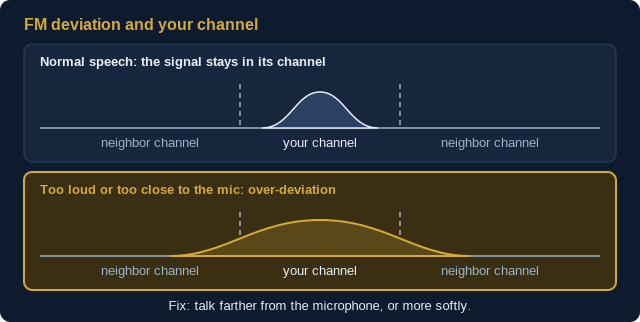
Two stacked panels each show a bell-shaped signal on a frequency line with dashed lines marking your channel and neighbor channels on either side. In the top panel, normal speech stays inside the dashed channel edges. In the gold lower panel, over-deviation from talking too loud or too close makes the signal wider than the channel so it spills into both neighbors. A caption gives the fix: talk farther from the microphone, or more softly.
In FM, your voice makes the carrier frequency swing back and forth. That swing is the deviation, and louder audio means a bigger swing. Each channel is only so wide, so if you talk too loudly or too close to the microphone the signal swings past its channel edges and splatters onto the neighboring channels. Listeners then hear a distorted, wide signal, and other stations are interfered with.
The cure is to lower the audio level going into the transmitter: speak more softly or hold the microphone farther away (or, on some radios, reduce the microphone gain setting). The rules require emissions to stay within the bandwidth necessary for the signal and not to cause splatter on adjacent frequencies, which is exactly what over-deviation violates.
Why the other choices are wrong
- A. Talking louder increases the deviation, which makes over-deviation worse.
- B. Heat is not the cause of over-deviation. Letting the radio cool off will not change how far the audio swings the carrier.
- C. Transmit power level does not set deviation. Deviation is set by the audio level. More power would just spread the splatter farther.
References
- FCC rule47 CFR § 97.307, Emission standards — Paragraphs (a) and (b): no more bandwidth than necessary, and no splatter on adjacent frequencies.
Rule text checked against the official source on November 5, 2026. This is a study aid; the linked rule is what governs.