
ARSC Tech School

Technician T8B: Amateur satellite operation

409 questions · pool July 1, 2026 to June 30, 2030 · the exam has 35 questions; 26 to pass

T8 · SIGNALS AND EMISSIONS

Amateur satellite operation: Doppler shift, basic orbits, operating protocols, modulation mode selection, transmitter power considerations, telemetry, satellite tracking programs, beacons, uplink and downlink mode definitions, spin fading, definition of “LEO”, setting uplink power

12 questions in group T8B

One question from this group appears on each exam.

T8B01

What telemetry information is typically transmitted by satellite beacons?

Show the answer and why

Answer C. Health and status of the satellite

Satellite beacons typically send telemetry on the health and status of the satellite.
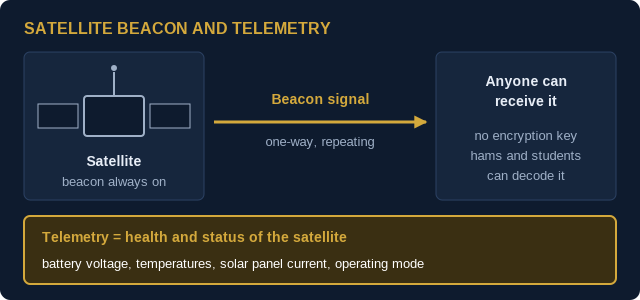
A satellite sending a one-way beacon with health and status telemetry that anyone can receive.
Describe this graphic in words

A satellite on the left sends a gold arrow labelled beacon signal, one-way and repeating, to a panel on the right that says anyone can receive it, with no encryption key. A gold panel along the bottom says telemetry is the health and status of the satellite: battery voltage, temperatures, solar panel current and operating mode.

Section 97.3 defines space telemetry as "a one-way transmission from a space station of measurements made from the measuring instruments in a spacecraft, including those relating to the functioning of the spacecraft." A beacon repeats those measurements over and over, typically battery voltage, temperatures, solar panel current and the operating mode. Ground stations use them to confirm that the satellite is alive and healthy.

A beacon does not report how strongly the satellite hears you, because it is a one-way broadcast that knows nothing about any one listener. It is also not a precise time source. Only the health and status choice is correct, so "all of these" fails.

Why the other choices are wrong

  • A. The beacon reports the satellite's own measurements. It does not report how strongly the satellite hears ground stations.
  • B. Beacons are not a precision time source; time accurate to a tenth of a second is not telemetry.
  • D. Only health and status is correct, so "all of these" cannot be.

References

Rule text checked against the official source on November 5, 2026. This is a study aid; the linked rule is what governs.
T8B02

What is the impact of using excessive effective radiated power on a satellite uplink?

Show the answer and why

Answer B. Blocking access by other users

Excessive uplink power can block access by other users.

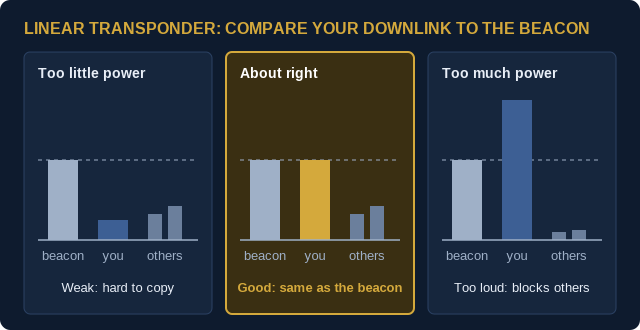
Three downlink level charts comparing uplink power too low, about right and too high.
Describe this graphic in words

Three panels each show a beacon bar, your bar and two small bars for other users. When your power is too low your bar is much shorter than the beacon. When it is about right, highlighted in gold, your bar matches the beacon. When it is too high your bar towers over the beacon and the other users' bars shrink to almost nothing, with the note too loud: blocks others.

A linear transponder amplifies every signal in its passband at once, and its output power is limited by what the solar panels and batteries can supply. That power is shared among all the signals. A very strong uplink signal takes more than its share, which weakens the other stations on the downlink and can push the transponder into distortion, so other users are effectively blocked.

The fix is to use only enough power to hear your own downlink about as strong as the satellite's beacon. This is a teaching note.

Why the other choices are wrong

  • A. Normal uplink power does not command the satellite; commanding is done with separate telecommand signals from the control stations.
  • C. A strong uplink signal does not overload the satellite batteries.
  • D. A strong uplink does not reboot the control computer. The harm is to other users sharing the transponder.

Rule text checked against the official source on November 5, 2026. This is a study aid; the linked rule is what governs.
T8B03

Which of the following are provided by satellite tracking programs?

Show the answer and why

Answer D. All these choices are correct

Tracking programs provide all of these: maps, pass times, and Doppler-corrected frequency.

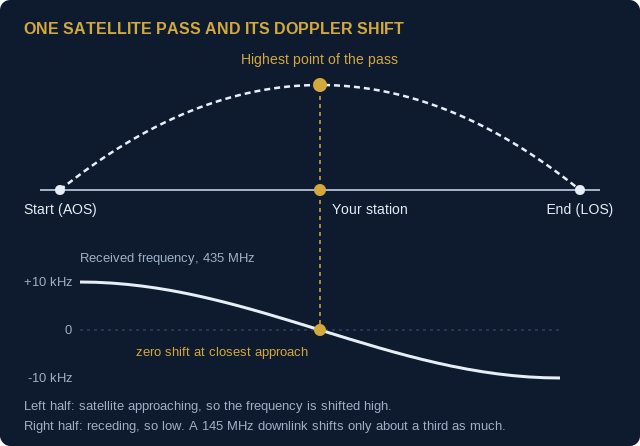
A satellite pass from start to end above the horizon with the matching Doppler frequency curve.
Describe this graphic in words

The top half shows a dashed arc rising from the horizon at the start of the pass (AOS) to a highest point above your station and down to the end of the pass (LOS). The bottom half graphs the received frequency of a 435 MHz downlink. It starts about 10 kHz high, falls through zero at the closest approach directly above your station, and ends about 10 kHz low. Captions explain approaching and receding.

Tracking programs use the satellite's orbital data, your location and your computer clock to work out where the satellite is. They draw its ground track on a map, list the time, azimuth and elevation at the start, the highest point and the end of each pass, and show the frequency you should hear after Doppler shift.

Each of the first three choices is something a tracking program does, so the correct answer is "all of these". This is a teaching note.

Why the other choices are wrong

  • A. Maps are provided, but so are pass data and Doppler-corrected frequencies.
  • B. Pass times, azimuth and elevation are provided, but so are maps and Doppler-corrected frequencies.
  • C. Doppler-corrected frequency is provided, but so are maps and pass data.

Rule text checked against the official source on November 5, 2026. This is a study aid; the linked rule is what governs.
T8B04

What mode of transmission is commonly used by amateur radio satellites?

Show the answer and why

Answer D. All these choices are correct

Amateur satellites use SSB, FM and CW/data, so all of these are correct.

Amateur satellites carry several kinds of payload. FM satellites work like a repeater in the sky and handle one conversation at a time. Linear transponders retransmit a whole slice of spectrum, so many SSB and CW stations can use them at once. Beacons and digital satellites send CW, telemetry or packet data.

Which mode you use depends on the satellite you are working, so each choice is correct and "all of these" is the answer. This is a teaching note.

Why the other choices are wrong

  • A. SSB is used on linear transponders, but FM and CW/data are used too.
  • B. FM is used on repeater-style satellites, but SSB and CW/data are used too.
  • C. CW and data are used by beacons and digital satellites, but SSB and FM are used too.

Rule text checked against the official source on November 5, 2026. This is a study aid; the linked rule is what governs.

T8B05

What is a satellite beacon?

Show the answer and why

Answer D. A transmission from a satellite that contains status information

A satellite beacon is a transmission that contains status information.

A satellite sending a one-way beacon with health and status telemetry that anyone can receive.
Describe this graphic in words

A satellite on the left sends a gold arrow labelled beacon signal, one-way and repeating, to a panel on the right that says anyone can receive it, with no encryption key. A gold panel along the bottom says telemetry is the health and status of the satellite: battery voltage, temperatures, solar panel current and operating mode.

Section 97.3 defines space telemetry as measurements "including those relating to the functioning of the spacecraft." A beacon transmits that telemetry continuously so ground stations can check the satellite's health and know whether it is working.

A beacon is therefore a transmission, not a piece of hardware: not an antenna, not a pointing light and not a reflector. It is also a handy signal to tune to while tracking, because it is always there.

Why the other choices are wrong

  • A. The beacon is a transmission, not the antenna that sends it.
  • B. A beacon is not an indicator light and does not help you aim.
  • C. A reflective surface is not a beacon; beacons are radio signals.

References

Rule text checked against the official source on November 5, 2026. This is a study aid; the linked rule is what governs.

T8B06

Which of the following are inputs to a satellite tracking program?

Show the answer and why

Answer B. The Keplerian elements

Keplerian elements are the orbital data a tracking program needs.

Keplerian elements describe a satellite's orbit: its size and shape, its tilt, where it crosses the equator, and where it is along the orbit at a known moment (the epoch). They are usually distributed as a two-line element set (TLE). A tracking program combines them with your location and the clock to predict every pass.

The satellite's transmitted power has nothing to do with where it is. The program calculates the Doppler shift itself, so you never enter the time of the last zero shift. Only the Keplerian elements are correct. This is a teaching note.

Why the other choices are wrong

  • A. Transmitted power is not needed to predict where the satellite is.
  • C. The program calculates Doppler shift; you do not supply the last observed zero-shift time.
  • D. Only the Keplerian elements are an input, so "all of these" is wrong.

Rule text checked against the official source on November 5, 2026. This is a study aid; the linked rule is what governs.

T8B07

What is Doppler shift in reference to satellite communications?

Show the answer and why

Answer C. An observed change in signal frequency caused by relative motion between the satellite and Earth station

Doppler shift is a change in observed frequency caused by relative motion between satellite and station.

A satellite pass from start to end above the horizon with the matching Doppler frequency curve.
Describe this graphic in words

The top half shows a dashed arc rising from the horizon at the start of the pass to a highest point above your station and down to the end of the pass. The bottom half graphs the received frequency of a 435 MHz downlink. It starts about 10 kHz high, falls through zero at the closest approach, and ends about 10 kHz low. A caption says a 145 MHz downlink shifts only about a third as much.

As a satellite moves toward you, the waves reach you slightly more often and you hear a higher frequency. As it moves away, you hear a lower one. The shift is the transmitted frequency times the speed toward or away from you divided by the speed of light.

For example, at about 7 km/s on a 435 MHz downlink: 435 MHz x 7 / 300,000 is about 10 kHz. The signal starts roughly 10 kHz high, crosses the true frequency at the closest approach, and ends about 10 kHz low. A 145 MHz downlink shifts only about a third as much. This is a teaching note.

Why the other choices are wrong

  • A. Doppler shift does not change the orbit; it is a change in the frequency you receive.
  • B. That describes a cross-band (uplink on one band, downlink on another) mode, not Doppler shift.
  • D. Doppler shift is a physical effect of motion, not a digital communications mode.

Rule text checked against the official source on November 5, 2026. This is a study aid; the linked rule is what governs.

T8B08

What does it mean if a satellite is operating in U/V mode?

Show the answer and why

Answer B. The satellite uplink is in the 70-centimeter band and the downlink is in the 2-meter band

U/V mode means an uplink on the 70 centimeter (UHF) band and downlink on 2 meters (VHF).

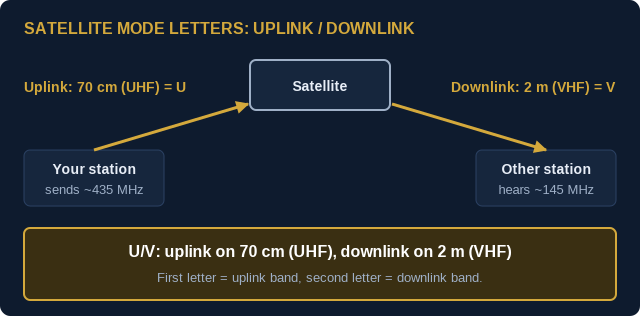
Diagram of a U/V satellite mode with a 70 cm uplink and a 2 m downlink.
Describe this graphic in words

Your station on the left sends about 435 MHz up to a satellite in the middle top, labelled uplink 70 cm (UHF) = U. The satellite sends about 145 MHz down to another station on the right, labelled downlink 2 m (VHF) = V. A gold panel states that U/V is uplink on 70 cm and downlink on 2 m, with the first letter the uplink band and the second the downlink band.

The first letter names the uplink band and the second names the downlink band. U stands for UHF (70 cm) and V for VHF (2 m), so U/V means you transmit on 70 centimeters and listen on 2 meters. A typical uplink is around 435 MHz and the matching downlink around 145 MHz.

Ultraviolet has nothing to do with it. This is a teaching note.

Why the other choices are wrong

  • A. A pair of HF bands such as 15 and 10 meters would use a different pair of mode letters.
  • C. U stands for UHF, not ultraviolet. Amateur satellites do not use ultraviolet frequencies.
  • D. Mode letters name fixed bands. Within them the satellite's frequencies are set, not variable.

Rule text checked against the official source on November 5, 2026. This is a study aid; the linked rule is what governs.

T8B09

What causes spin fading of satellite signals?

Show the answer and why

Answer B. Rotation of the satellite and its antennas

Spin fading is caused by the rotation of the satellite and its antennas.

Many satellites spin to keep themselves stable. As the satellite turns, its antennas swing toward and away from you and the polarization of the signal sweeps past your antenna, so the signal you receive rises and falls in a regular rhythm, often every few seconds.

A circularly polarized receiving antenna reduces the effect because it does not care how the satellite's antenna is turned. This is a teaching note.

Why the other choices are wrong

  • A. Noise from the sun is not the cause of a regular rhythmic fade.
  • C. Doppler shift changes the frequency of the signal, not its strength.
  • D. Interference on the uplink would not fade the downlink in a regular rhythm.

Rule text checked against the official source on November 5, 2026. This is a study aid; the linked rule is what governs.

T8B10

What does the term LEO mean in reference to communication satellites?

Show the answer and why

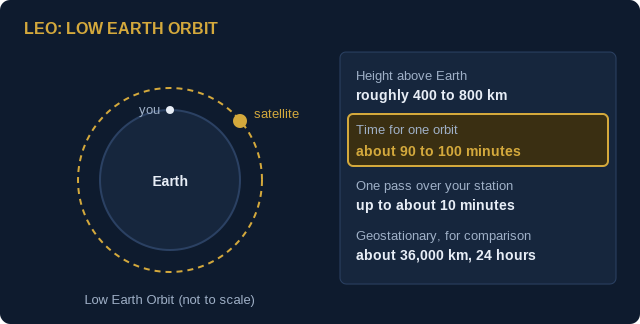
Answer D. Low Earth Orbit, which has a period of around 100 minutes

LEO means Low Earth Orbit, with a period of around 100 minutes.

Diagram of a satellite in low Earth orbit with its orbit time and pass length.
Describe this graphic in words

A circle for the Earth is surrounded by a dashed gold ring for a low orbit with a satellite on it and your station at the top, labelled not to scale. A panel lists the height above Earth as roughly 400 to 800 km, the time for one orbit as about 90 to 100 minutes in gold, one pass over your station as up to about 10 minutes, and, for comparison, a geostationary orbit at about 36,000 km with a 24 hour period.

LEO stands for Low Earth Orbit, an orbit a few hundred kilometers above the surface. At that height a satellite is moving at about 7.5 km/s and circles the Earth in roughly 90 to 100 minutes (the International Space Station takes about 92). Orbits as low as that give a short orbit time, so you get several chances per day to hear a satellite.

Each pass is brief, up to about 10 minutes from horizon to horizon, which is why tracking and Doppler correction matter. This is a teaching note.

Why the other choices are wrong

  • A. LEO is about altitude, not about saving energy or battery power.
  • B. LEO means close to the Earth, not low in the sky from your station.
  • C. There is no "equilibrium orbit" term in this sense; orbit period is determined by altitude.

Rule text checked against the official source on November 5, 2026. This is a study aid; the linked rule is what governs.

T8B11

Who is permitted to receive telemetry from an amateur radio satellite?

Show the answer and why

Answer A. Anyone

Anyone may receive amateur satellite telemetry.

A satellite sending a one-way beacon with health and status telemetry that anyone can receive.
Describe this graphic in words

A satellite on the left sends a gold arrow labelled beacon signal, one-way and repeating, to a panel on the right that says anyone can receive it, with no encryption key, and that hams and students can decode it. A gold panel along the bottom says telemetry is the health and status of the satellite.

Space telemetry is a one-way transmission from the satellite (§ 97.3). Section 97.211(b) says a telecommand station "may transmit special codes intended to obscure the meaning of telecommand messages" to the satellite. That exception covers commands going up, not telemetry coming down, so telemetry is not encrypted and anyone can receive it.

That is why hobbyists and students everywhere decode beacons and share what they hear.

Why the other choices are wrong

  • B. Telemetry is not restricted to the control operator.
  • C. No encryption key is needed to receive telemetry, because telemetry is not encrypted.
  • D. AMSAT does not issue keys for receiving telemetry; none are needed.

References

Rule text checked against the official source on November 5, 2026. This is a study aid; the linked rule is what governs.

T8B12

Which of the following is a way to determine whether your satellite uplink power into a linear transponder satellite is neither too low nor too high?

Show the answer and why

Answer C. Your signal strength on the downlink should be about the same as the beacon

Your downlink signal should be about as strong as the satellite's beacon.

Three downlink level charts comparing uplink power too low, about right and too high.
Describe this graphic in words

Three panels each show a beacon bar, your bar and two small bars for other users. When your power is too low your bar is much shorter than the beacon. When it is about right, highlighted in gold, your bar matches the beacon. When it is too high your bar towers over the beacon and the other users' bars shrink to almost nothing.

A linear transponder shares its limited output power among every station using it. If your downlink is about as strong as the beacon, you are using a fair share without hogging the transponder, and you are strong enough to be heard.

If you are much weaker than the beacon, your uplink power is too low. If you are stronger than the beacon, you are taking more than your share and other stations suffer. This is a teaching note.

Why the other choices are wrong

  • A. Telemetry does not report the signal strength of your uplink.
  • B. Distortion can mean you are too strong, but its absence does not tell you whether you are too weak. Matching the beacon works in both directions.
  • D. Comparing yourself with others only tells you how you compare with them, not whether you are within the transponder's limits.

Rule text checked against the official source on November 5, 2026. This is a study aid; the linked rule is what governs.