What type of radiation are radio signals?
Show the answer and why
Answer D. Non-ionizing radiation
Radio signals are non-ionizing radiation.
Describe this graphic in words
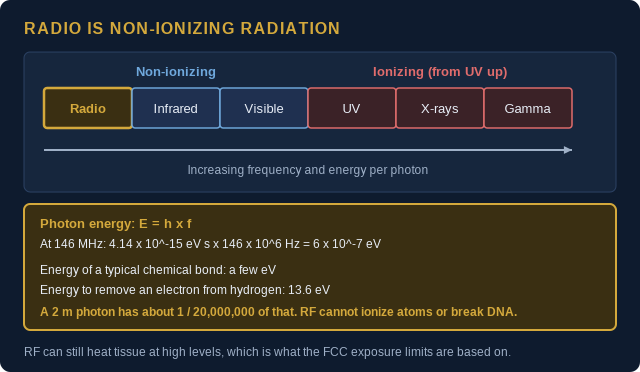
A strip shows six regions from low to high frequency: radio (highlighted in gold), infrared, visible, UV, X-rays and gamma. The first three are labeled non-ionizing and the last three ionizing from UV up. A gold panel works out the photon energy at 146 MHz as 6 x 10^-7 eV, compared with a few eV for a chemical bond and 13.6 eV to remove an electron from hydrogen, about 1 over 20 million. A note says RF can still heat tissue at high levels.
Radio waves at amateur frequencies carry far too little energy per photon to knock electrons off atoms, so they are non-ionizing. Gamma rays and alpha particles are ionizing radiation. The EPA describes non-ionizing radiation, such as radio waves, as able to move atoms around but not remove electrons from them.
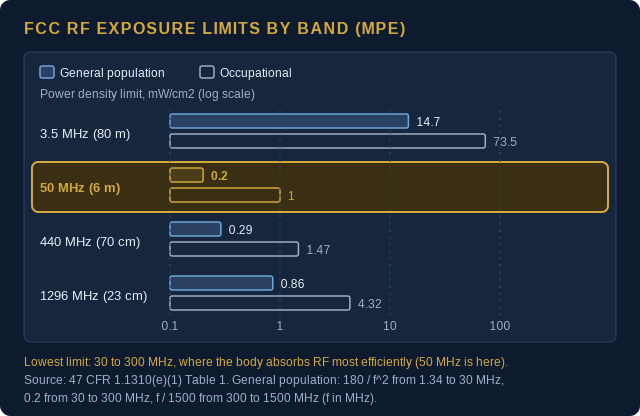
That is why the FCC exposure limits in 47 CFR 1.1310 are based on heating effects (specific absorption rate and power density), not on ionization. Worked example: a 146 MHz photon has E = h x f = 4.14 x 10^-15 eV s x 146 x 10^6 Hz = about 6 x 10^-7 eV, millions of times too small to ionize an atom (hydrogen needs 13.6 eV).
Why the other choices are wrong
- A. Gamma rays are ionizing and have a vastly higher frequency than radio waves.
- B. Radio signals lack the energy to ionize atoms, so they are not ionizing radiation.
- C. Alpha radiation is made of particles from radioactive decay, not radio waves.
References
- FCC rule47 CFR § 1.1310, Radiofrequency radiation exposure limits — MPE and SAR limits, averaging times, and the pointer to OET Bulletin 65.
- AgencyU.S. EPA, Radiation Basics — Non-ionizing radiation (such as radio waves) can move atoms around but cannot remove electrons from them; ionizing radiation can.
- AgencyNIST CODATA, Planck constant in eV/Hz — h = 4.135667696 x 10^-15 eV per Hz, used for photon energy E = h x f.
Rule text checked against the official source on November 5, 2026. This is a study aid; the linked rule is what governs.