
ARSC Tech School

Technician T1F: Station identification

409 questions · pool July 1, 2026 to June 30, 2030 · the exam has 35 questions; 26 to pass

T1 · COMMISSION’S RULES

Station identification; Repeaters; Third-party communications; Club stations; FCC inspection

11 questions in group T1F

One question from this group appears on each exam.

T1F01FCC rule 97.103(c)

When must the station licensee make the station and the station records available for inspection?

Show the answer and why

Answer B. At any time upon request by an FCC representative

FCC rule 97.103(c)

The station licensee must make the station and the station records available for inspection at any time upon request by an FCC representative.

Section 97.103(c) says: "The station licensee must make the station and the station records available for inspection upon request by an FCC representative." It sets no advance-notice period and does not wait for a warrant. The obligation comes with the license.

That is one reason to keep your records, such as who you designated as control operator, in order.

Why the other choices are wrong

  • A. There is no ten-day notice period in the rule.
  • C. There is no written-notification requirement in the rule.
  • D. The rule does not require a warrant.

References

Rule text checked against the official source on November 5, 2026. This is a study aid; the linked rule is what governs.
T1F02FCC rule 97.119(a)

How often must you identify with your FCC-assigned call sign when using tactical call signs such as “Race Headquarters”?

Show the answer and why

Answer C. At least every 10 minutes during and at the end of a communication

FCC rule 97.119(a)

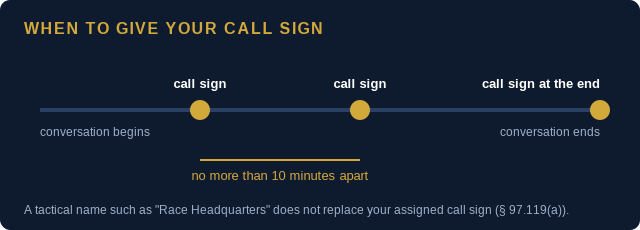
Even with a tactical call sign, you must give your FCC-assigned call sign at least every 10 minutes during a communication and at the end of it.

Timeline of a conversation showing the call sign given at least every 10 minutes and at the end.
Describe this graphic in words

A timeline of one communication. Your call sign is given at least every 10 minutes during the communication, and again at the end of it. A note says a tactical call sign does not replace your assigned call sign.

Section 97.119(a) says each amateur station "must transmit its assigned call sign on its transmitting channel at the end of each communication, and at least every 10 minutes during a communication." A tactical name such as "Race Headquarters" is not an assigned call sign, so it does not satisfy the requirement. You can use the tactical call for convenience and still identify with your own call sign on schedule.

The purpose, as the rule puts it, is "clearly making the source of the transmissions from the station known to those receiving the transmissions."

Why the other choices are wrong

  • A. A tactical call is not an assigned call sign, so it is not enough.
  • B. Once an hour is not frequent enough; the limit is 10 minutes.
  • D. You do not have to identify at the end of every transmission, only at the end of each communication and every 10 minutes during one.

References

Rule text checked against the official source on November 5, 2026. This is a study aid; the linked rule is what governs.

T1F03FCC rule 97.119(a)

When are you required to transmit your assigned call sign?

Show the answer and why

Answer D. At least every 10 minutes during and at the end of a communication

FCC rule 97.119(a)

At least every 10 minutes during a communication, and at the end of the communication.

Timeline of a conversation showing the call sign given at least every 10 minutes and at the end.
Describe this graphic in words

A timeline of one communication. Your call sign is given at least every 10 minutes during the communication, and again at the end of it. A note says a tactical call sign does not replace your assigned call sign.

Section 97.119(a) is the rule: each station "must transmit its assigned call sign on its transmitting channel at the end of each communication, and at least every 10 minutes during a communication." There is no requirement to identify at the beginning, though many operators do.

A "communication" is the whole conversation, not each push of the microphone button.

Why the other choices are wrong

  • A. Identifying at the start is not what the rule requires; it requires every 10 minutes and at the end.
  • B. Once per transmission is not the rule.
  • C. Fifteen minutes is too long. The limit is 10 minutes.

References

Rule text checked against the official source on November 5, 2026. This is a study aid; the linked rule is what governs.

T1F04FCC rule 97.119(b)(2)

What language must you use for identification when using a phone emission?

Show the answer and why

Answer C. English

FCC rule 97.119(b)(2)

When identifying by phone you must use English.

Section 97.119(b)(2) says the call sign may be sent "by a phone emission in the English language." The rule does not allow other languages, even widely recognized ones, for identification.

You can chat in any language the rules otherwise allow, but the call sign identification itself must be in English.

Why the other choices are wrong

  • A. The rule does not accept any language recognized by the United Nations.
  • B. The rule does not accept any language recognized by the ITU.
  • D. French and Spanish are not allowed for the phone identification.

References

Rule text checked against the official source on November 5, 2026. This is a study aid; the linked rule is what governs.

T1F05FCC rule 97.119(b)(2)

What method of call sign identification is required for a station transmitting phone signals?

Show the answer and why

Answer B. Send the call sign using a CW or phone emission

FCC rule 97.119(b)(2)

A station transmitting phone signals may identify using either CW or phone.

Section 97.119(b) says the call sign "must be transmitted with an emission authorized for the transmitting channel in one of the following ways," and lists, among others, (1) by CW emission and (2) by a phone emission in English. So the call sign can go out by either method, as long as the emission is authorized on the channel you are using.

No special suffix such as RPT or R is required.

Why the other choices are wrong

  • A. The indicator RPT is not required.
  • C. The indicator R is not required.
  • D. Phone is not the only method; CW is also listed in 97.119(b)(1).

References

Rule text checked against the official source on November 5, 2026. This is a study aid; the linked rule is what governs.

T1F06FCC rule 97.119(c)

Which of the following self-assigned indicators are acceptable when using a phone transmission?

Show the answer and why

Answer D. All these choices are correct

FCC rule 97.119(c)

"Stroke," "slant" and "slash" are all acceptable ways to say the slant mark in a self-assigned indicator.

Section 97.119(c) says each indicator "must be separated from the call sign by the slant mark (/) or by any suitable word that denotes the slant mark." Stroke, slant and slash each denote the slant mark, so all three are acceptable.

A self-assigned indicator must go before, after, or both before and after the call sign, and it may not conflict with any other indicator or prefix.

Why the other choices are wrong

  • A. Correct, but not the only acceptable word.
  • B. Correct, but not the only acceptable word.
  • C. Correct, but not the only acceptable word. Since all three work, D is the answer.

References

Rule text checked against the official source on November 5, 2026. This is a study aid; the linked rule is what governs.

T1F07FCC rule 97.115(a)(2)

Which of the following restrictions apply when a non-licensed person speaks to a foreign amateur radio station via a station under the control of an FCC-licensed amateur radio operator?

Show the answer and why

Answer B. The foreign station must be in a country with which the U.S. has a third-party agreement

FCC rule 97.115(a)(2)

The foreign station must be in a country with which the U.S. has a third-party agreement (or the message must be for an emergency or disaster relief).

Section 97.115(a)(2) allows third-party messages to a station in a foreign country only when the traffic is "emergency or disaster relief communications" or "any station within the jurisdiction of any foreign government whose administration has made arrangements with the United States to allow amateur stations to be used for transmitting international communications on behalf of third parties." It continues: "No station shall transmit messages for a third party to any station within the jurisdiction of any foreign government whose administration has not made such an arrangement."

That restriction does not apply to a third party who is eligible to be a control operator of the station.

Why the other choices are wrong

  • A. The rule does not require the third party to be a U.S. citizen.
  • C. The rule does not say the licensed control operator must do the station identification.
  • D. "All these choices" fails because A and C are not required.

References

Rule text checked against the official source on November 5, 2026. This is a study aid; the linked rule is what governs.

T1F08FCC rule 97.3(a)(47)

What is the definition of third-party communications?

Show the answer and why

Answer A. A message from a control operator to another amateur station control operator on behalf of another person

FCC rule 97.3(a)(47)

Third-party communications are messages from a control operator to another amateur station's control operator on behalf of another person.

Section 97.3(a)(47) defines it: "A message from the control operator (first party) of an amateur station to another amateur station control operator (second party) on behalf of another person (third party)." The first and second parties are the two control operators. The third party is whoever the message is for or from, such as a friend at your station who wants to say hello.

Third-party rules are in 97.115. The word "third" does not mean three stations talking.

Why the other choices are wrong

  • B. It is about a third person, not a third station.
  • C. Operating equipment licensed to someone else is a different matter.
  • D. Third-party communications do not give an unlicensed person authority to transmit for experiments.

References

Rule text checked against the official source on November 5, 2026. This is a study aid; the linked rule is what governs.

T1F09FCC rule 97.3(a)(40)

What type of amateur station simultaneously retransmits the signal of another amateur station on a different channel or channels?

Show the answer and why

Answer C. Repeater station

FCC rule 97.3(a)(40)

A repeater station simultaneously retransmits the signal of another amateur station on a different channel or channels.

Section 97.3(a)(40) defines it: "Repeater. An amateur station that simultaneously retransmits the transmission of another amateur station on a different channel or channels." The word to remember is simultaneously: it receives on one channel while retransmitting on another.

A beacon sends its own signal, a remote control station manipulates another station, and a message forwarding station stores and forwards messages.

Why the other choices are wrong

  • A. A beacon transmits its own signal and does not retransmit another's.
  • B. A remote control station is where the control operator manipulates a station through a link.
  • D. A message forwarding station relays messages by storing them, not by simultaneous retransmission.

References

Rule text checked against the official source on November 5, 2026. This is a study aid; the linked rule is what governs.

T1F10FCC rule 97.205(g)

Who is accountable if a repeater inadvertently retransmits communications that violate the FCC rules?

Show the answer and why

Answer A. The control operator of the originating station

FCC rule 97.205(g)

The control operator of the originating station is accountable if a repeater inadvertently retransmits communications that violate the rules.

Section 97.205(g) says: "The control operator of a repeater that retransmits inadvertently communications that violate the rules in this part is not accountable for the violative communications." The repeater's control operator is not held responsible for relaying something by accident.

The accountability stays with the station that actually made the transmission, so the control operator of the originating station answers for it.

Why the other choices are wrong

  • B. The rule says the control operator of the repeater is not accountable for inadvertent retransmissions.
  • C. The repeater owner is not named as accountable in 97.205(g).
  • D. Not both; the repeater side is excused.

References

Rule text checked against the official source on November 5, 2026. This is a study aid; the linked rule is what governs.

T1F11FCC rule 97.5(b)(2)

Which of the following is a requirement for the issuance of a club station license grant?

Show the answer and why

Answer B. The club must have at least four members

FCC rule 97.5(b)(2)

A club station license requires that the club have at least four members (persons).

Section 97.5(b)(2) says: "A club station license grant may be held only by the person who is the license trustee designated by an officer of the club. The trustee must be a person who holds an operator/primary station license grant. The club must be composed of at least four persons and must have a name, a document of organization, management, and a primary purpose devoted to amateur service activities consistent with this part."

The trustee needs a license, but any class will do. The trustee does not need to be Amateur Extra, and the club does not need to be registered with the ARRL.

Why the other choices are wrong

  • A. The trustee must hold an operator/primary station license grant, but not necessarily Amateur Extra.
  • C. ARRL registration is not a requirement in the rule.
  • D. "All these choices" fails because A and C are not requirements.

References

Rule text checked against the official source on November 5, 2026. This is a study aid; the linked rule is what governs.