
ARSC Tech School

Technician T1A: Purpose and permissible use of the Amateur Radio Service

409 questions · pool July 1, 2026 to June 30, 2030 · the exam has 35 questions; 26 to pass

T1 · COMMISSION’S RULES

Purpose and permissible use of the Amateur Radio Service; Operator/primary station license grant; Meanings of basic terms used in FCC rules; Interference; RACES rules; Phonetics; Frequency Coordinator; Beacon

11 questions in group T1A

One question from this group appears on each exam.

T1A01FCC rule 97.1

Which of the following is part of the Basis and Purpose of the Amateur Radio Service?

Show the answer and why

Answer C. Advancing skills in the technical and communication phases of the radio art

FCC rule 97.1

Part 97 says the amateur service exists in part to encourage and improve it by advancing skills in both the communication and technical phases of the radio art.
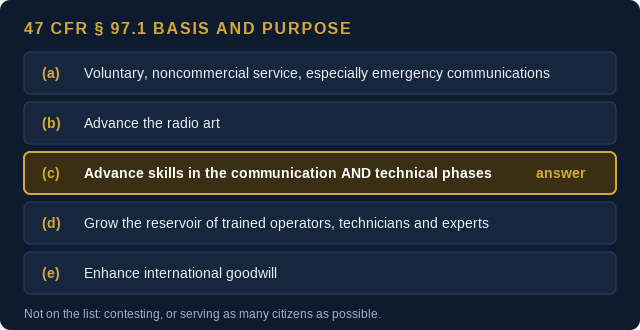
Diagram of the five principles in 47 CFR 97.1, (a) through (e), with principle (c) highlighted.
Describe this graphic in words

A list of the five principles of 97.1. (a) A voluntary, noncommercial service, especially for emergency communications. (b) Advance the radio art. (c) Advance skills in the communication and technical phases of the art; this is the answer. (d) Expand the reservoir of trained operators, technicians and electronics experts. (e) Enhance international goodwill.

The first rule in Part 97, section 97.1, is called "Basis and purpose." It lists five principles the rules are designed to serve: (a) the value of the amateur service to the public as a voluntary, noncommercial communication service, especially for emergency communications; (b) advancing the radio art; (c) encouraging and improving the service by advancing skills in both the communication and technical phases of the art; (d) expanding the pool of trained operators, technicians and electronics experts; and (e) enhancing international goodwill.

Choice C restates principle (c) almost word for word. That is the pattern to remember: this question tests whether you recognize the wording of 97.1, not a calculation.

Why the other choices are wrong

  • A. Nothing in 97.1 aims at serving as many citizens as possible. The service is described as a voluntary, noncommercial one for trained operators.
  • B. Contesting is not among the five principles. International goodwill is, but that is not the same as contesting.
  • D. "All these choices" fails because A and B are not in 97.1.

References

Rule text checked against the official source on November 5, 2026. This is a study aid; the linked rule is what governs.
T1A02FCC rule 97.1

Which agency regulates and enforces the rules for the Amateur Radio Service in the United States?

Show the answer and why

Answer C. The FCC

FCC rule 97.1

The Federal Communications Commission writes and enforces the amateur service rules, which are Part 97 of Title 47 of the Code of Federal Regulations.

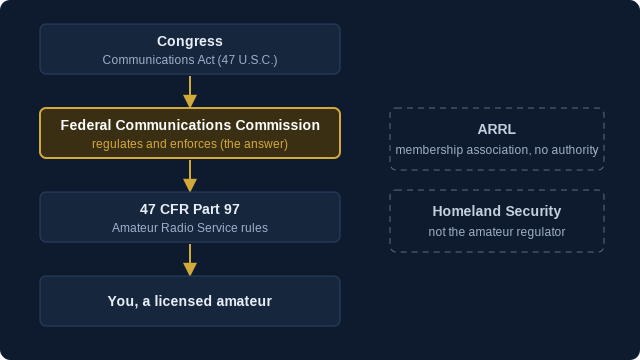
Diagram showing Congress creating the FCC, which issues Part 97 rules that apply to licensed amateurs, with the ARRL and Homeland Security shown outside that chain.
Describe this graphic in words

A vertical chain: Congress and the Communications Act create the Federal Communications Commission, which issues 47 CFR Part 97, the Amateur Radio Service rules, which apply to you as a licensed amateur. To one side, the ARRL is marked as a membership association with no regulatory power, and the Department of Homeland Security is marked as not the regulator.

Congress created the FCC in the Communications Act to regulate interstate and foreign communication by wire and radio. The FCC's rules for the Amateur Radio Service are published as 47 CFR Part 97, and the FCC is the agency that licenses amateurs and enforces those rules.

The ARRL is a membership organization that supports amateurs and speaks for them, but it makes no rules and has no enforcement power. The Department of Homeland Security is not the regulator of the amateur service either.

Why the other choices are wrong

  • A. The ARRL advocates and supports amateurs. It does not regulate or enforce.
  • B. Homeland Security does not write or enforce Part 97.
  • D. "All these choices" is wrong because only the FCC regulates the service.

References

Rule text checked against the official source on November 5, 2026. This is a study aid; the linked rule is what governs.
T1A03FCC rule 97.119(b)(2)

What do the FCC rules state regarding the use of a phonetic alphabet for station identification in the Amateur Radio Service?

Show the answer and why

Answer B. It is encouraged when using phone emissions

FCC rule 97.119(b)(2)

On phone, the rules encourage using a phonetic alphabet to help identify your station, but they never require it.

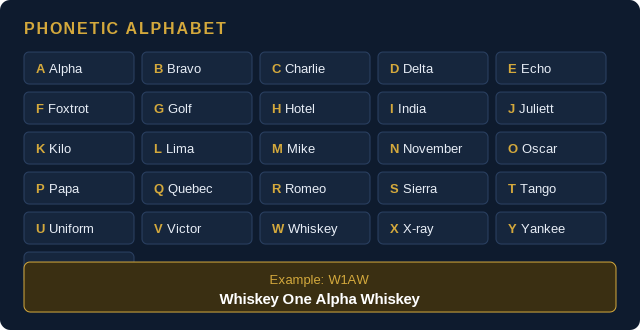
Chart of the standard phonetic alphabet, Alpha to Zulu, with a W1AW call sign example.
Describe this graphic in words

A chart of the 26 standard phonetic alphabet words: Alpha, Bravo, Charlie, Delta, Echo, Foxtrot, Golf, Hotel, India, Juliett, Kilo, Lima, Mike, November, Oscar, Papa, Quebec, Romeo, Sierra, Tango, Uniform, Victor, Whiskey, X-ray, Yankee and Zulu. Below it, the call sign W1AW is spoken as Whiskey One Alpha Whiskey.

Section 97.119(b)(2) covers identifying by voice. The call sign must be sent "by a phone emission in the English language," and then: "Use of a phonetic alphabet as an aid for correct station identification is encouraged." Encouraged is the key word. The rule gives you a good habit, not an obligation.

Using the standard words (Whiskey, One, Alpha, Whiskey for W1AW) helps another station copy your call sign correctly through noise or a weak signal.

Why the other choices are wrong

  • A. The rule does not require it during emergency messages or at any other time.
  • C. Contact with a foreign station does not make a phonetic alphabet mandatory.
  • D. "All these choices" fails because A and C are not what the rule says.

References

Rule text checked against the official source on November 5, 2026. This is a study aid; the linked rule is what governs.
T1A04FCC rule 97.23

How do you receive official notification of your new license and call sign after passing the exam?

Show the answer and why

Answer A. Email from the FCC with a link to download the license grant

FCC rule 97.23

After you pass, the FCC emails you a link to download your license grant; it does not come from the examiners or by paper mail.

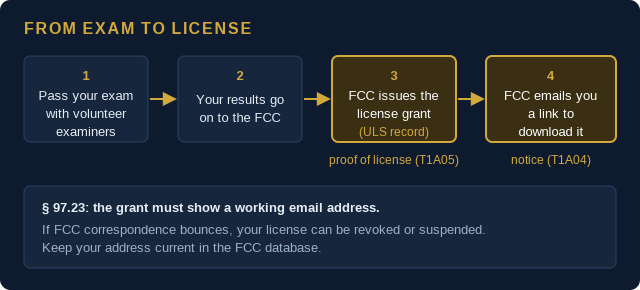
Four-step flow from passing the exam to the FCC emailing you a link to your license grant, with a note about the email address required by 97.23.
Describe this graphic in words

Step 1: you pass your exam with volunteer examiners. Step 2: your results go on to the FCC. Step 3: the FCC issues the license grant, which appears as a record in the Universal Licensing System; this is the proof of your license. Step 4: the FCC emails you a link to download it. A note says section 97.23 requires a working email address on the grant, and that your license can be revoked or suspended if FCC correspondence bounces.

Volunteer examiners give you the exam and send your results on, but they do not grant the license. The FCC does. When your license is granted, the FCC notifies you by email with a link to download the grant.

That is why section 97.23, the rule this question cites, matters: each license grant must show your mailing address and an email address "where the grantee can receive electronic correspondence." If FCC correspondence comes back undeliverable because the address is wrong, the station license can be revoked or the operator license suspended. Keep your email address current.

The emailed download link itself is FCC procedure rather than wording you will find in Part 97. The rule's point is that the FCC must be able to reach you electronically.

Why the other choices are wrong

  • B. The FCC does not send the grant by First-Class Mail. The rule centers on an email address you can actually receive.
  • C. The lead volunteer examiner administers the exam. The examiners do not issue the license or notify you of the grant.
  • D. Not by mail, and not from the examiners.

References

Rule text checked against the official source on November 5, 2026. This is a study aid; the linked rule is what governs.
T1A05FCC rule 97.7

What proves that the FCC has issued an operator/primary license grant?

Show the answer and why

Answer C. The license appears in the FCC ULS database

FCC rule 97.7

Your license grant appearing in the FCC's Universal Licensing System (ULS) database is what proves the license has been issued.

Four-step flow from passing the exam to the FCC emailing you a link to your license grant, with the ULS record marked as proof of your license.
Describe this graphic in words

Step 1: you pass your exam with volunteer examiners. Step 2: your results go on to the FCC. Step 3: the FCC issues the license grant, which appears as a record in the Universal Licensing System; this is the proof of your license. Step 4: the FCC emails you a link to download it.

Section 97.7 says each station needs a control operator, and the control operator must be a person "for whom an amateur operator/primary station license grant appears on the ULS consolidated licensee database." The record in the FCC's database is the authority. Everything else is a pointer to it.

A certificate showing you passed an exam is evidence that you passed, not that the FCC has issued a license. And the FCC, not the NCVEC, grants licenses.

Why the other choices are wrong

  • A. A certificate of successful completion shows you passed an exam. It is not the license grant.
  • B. The NCVEC does not grant licenses. The FCC does.
  • D. "All these choices" fails because A and B are not proof of a grant.

References

Rule text checked against the official source on November 5, 2026. This is a study aid; the linked rule is what governs.
T1A06FCC rule 97.203(d)

On which of the following HF frequencies can automatically controlled amateur propagation beacons be found?

Show the answer and why

Answer D. On ten meters, between 28.200 MHz and 28.300 MHz

FCC rule 97.203(d)

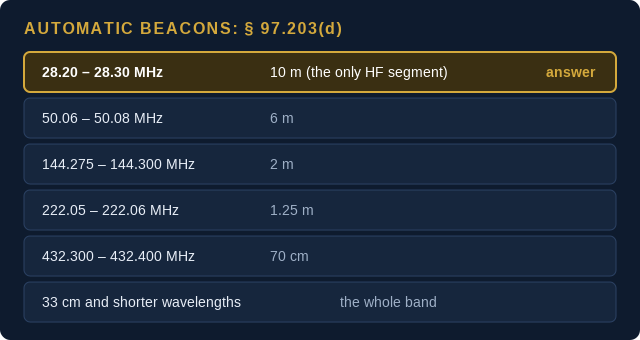
Of the HF bands, automatic beacons are allowed only on 10 meters, between 28.20 and 28.30 MHz.

Table of the frequency segments where automatically controlled beacons may operate, with 28.20 to 28.30 MHz highlighted as the only HF segment.
Describe this graphic in words

A list of the segments in 97.203(d): 28.20 to 28.30 MHz on 10 meters, which is the only HF segment and the answer; 50.06 to 50.08 MHz on 6 meters; 144.275 to 144.300 MHz on 2 meters; 222.05 to 222.06 MHz on 1.25 meters; 432.300 to 432.400 MHz on 70 centimeters; and the whole of the 33 centimeter and shorter wavelength bands.

Section 97.203(d) says a beacon "may be automatically controlled while it is transmitting on the 28.20-28.30 MHz, 50.06-50.08 MHz, 144.275-144.300 MHz, 222.05-222.06 MHz or 432.300-432.400 MHz segments, or on the 33 cm and shorter wavelength bands."

Only the first of those segments is on HF, so the HF answer is 28.200 to 28.300 MHz on ten meters. The other segments are on VHF and UHF.

Other beacon rules in the same section: transmitter power must not exceed 100 W, and a beacon may transmit one-way communications.

Why the other choices are wrong

  • A. Automatic control is not allowed across the whole 10-meter band, only in the 28.20 to 28.30 MHz segment.
  • B. The rule lists segments. Registration with the FCC is not what permits automatic control.
  • C. Of the HF bands, only one segment is listed, not a portion of each.

References

Rule text checked against the official source on November 5, 2026. This is a study aid; the linked rule is what governs.

T1A07FCC rule 97.3(a)(41)

What is the FCC Part 97 definition of a space station?

Show the answer and why

Answer C. An amateur station located more than 50 km above Earth's surface

FCC rule 97.3(a)(41)

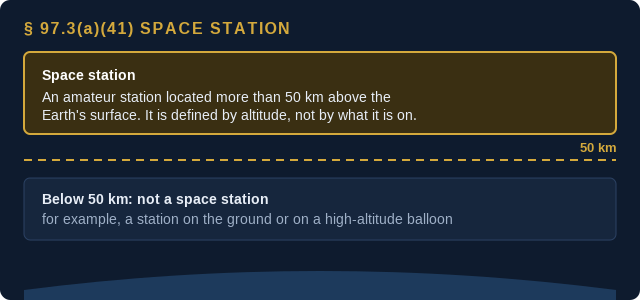
A space station is an amateur station located more than 50 km above the Earth's surface.

Diagram of a dashed line at 50 km altitude: above it, an amateur station is a space station; below it, it is not.
Describe this graphic in words

A boxed definition says a space station is an amateur station located more than 50 km above the Earth's surface, defined by altitude and not by what it is on. A dashed line marks 50 km. Below the line, a station is not a space station, for example one on the ground or on a high-altitude balloon.

Section 97.3(a)(41) defines it in one sentence: "Space station. An amateur station located more than 50 km above the Earth's surface." The definition is about altitude. It does not require a satellite, a crew, or any particular kind of relay.

A station on a satellite is a space station if it is that high. A station that merely uses a satellite to relay signals is not one by this definition, because it is on the ground.

Why the other choices are wrong

  • A. A satellite is not automatically an amateur station, and the definition does not say "any satellite."
  • B. Crew is not part of the definition.
  • D. Using a satellite to relay signals does not make a ground station a space station. The altitude does.

References

Rule text checked against the official source on November 5, 2026. This is a study aid; the linked rule is what governs.

T1A08FCC rule 97.3(a)(22)

Who recommends transmit/receive channels for repeater and auxiliary stations?

Show the answer and why

Answer B. A Volunteer Frequency Coordinator recognized by local amateurs

FCC rule 97.3(a)(22)

A volunteer frequency coordinator, recognized by local amateurs, recommends the transmit and receive channels for repeater and auxiliary stations.

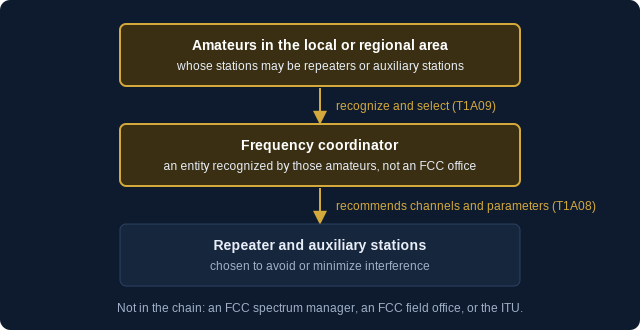
Chain showing local amateurs recognizing a frequency coordinator, who recommends channels to repeater and auxiliary stations.
Describe this graphic in words

Amateurs in the local or regional area whose stations may be repeaters or auxiliary stations recognize and select a frequency coordinator. The coordinator, an entity recognized by those amateurs and not an FCC office, recommends channels and operating parameters to repeater and auxiliary stations so that interference is avoided or minimized. An FCC spectrum manager, an FCC field office and the ITU are not in the chain.

Section 97.3(a)(22) defines a frequency coordinator as "an entity, recognized in a local or regional area by amateur operators whose stations are eligible to be auxiliary or repeater stations, that recommends transmit/receive channels and associated operating and technical parameters for such stations in order to avoid or minimize potential interference."

So the answer is in the definition itself: the coordinator is recognized by the amateurs in the area, and it recommends the channels. The purpose is to keep repeaters from interfering with each other.

Why the other choices are wrong

  • A. The definition does not describe an FCC-appointed spectrum manager. The coordinator is recognized by the amateurs in the area.
  • C. An FCC field office is not the entity the definition names.
  • D. The ITU is not the entity the definition names.

References

Rule text checked against the official source on November 5, 2026. This is a study aid; the linked rule is what governs.

T1A09FCC rule 97.3(a)(22)

Who selects a Frequency Coordinator?

Show the answer and why

Answer C. Amateur operators in a local or regional area whose stations are eligible to be repeater or auxiliary stations

FCC rule 97.3(a)(22)

The amateurs in the local or regional area whose stations are eligible to be repeater or auxiliary stations recognize and select the frequency coordinator.

Chain showing local amateurs recognizing a frequency coordinator, who recommends channels to repeater and auxiliary stations.
Describe this graphic in words

Amateurs in the local or regional area whose stations may be repeaters or auxiliary stations recognize and select a frequency coordinator. The coordinator, an entity recognized by those amateurs and not an FCC office, recommends channels and operating parameters to repeater and auxiliary stations so that interference is avoided or minimized. An FCC spectrum manager, an FCC field office and the ITU are not in the chain.

The definition in section 97.3(a)(22) describes a frequency coordinator as an entity "recognized in a local or regional area by amateur operators whose stations are eligible to be auxiliary or repeater stations." Those operators are the ones who choose it, so the coordinator is a volunteer body, not a government appointment.

That is the same definition behind T1A08: the amateurs in the area recognize the coordinator, and the coordinator recommends channels for their repeaters.

Why the other choices are wrong

  • A. The definition does not name an FCC office as the one that selects the coordinator.
  • B. "Office of National Council of Independent Frequency Coordinators" is not in the definition, and it is not a body the rule recognizes.
  • D. An FCC Regional Field Office is not named in the definition.

References

Rule text checked against the official source on November 5, 2026. This is a study aid; the linked rule is what governs.

T1A10FCC rule 97.407(a)

Besides an FCC-issued amateur operator license, what is required to be the control operator of a Radio Amateur Civil Emergency Service (RACES) Station?

Show the answer and why

Answer C. Certification of current enrollment by a civil defense organization

FCC rule 97.407(a)

To be a RACES control operator you need your FCC amateur license and certification from a civil defense organization that you are enrolled in it.

Section 97.407(a) says that no person may be the control operator of an amateur station transmitting in RACES "unless that person holds a FCC-issued amateur operator license and is certified by a civil defense organization as enrolled in that organization." RACES, the Radio Amateur Civil Emergency Service, is operated under a civil defense organization's authority.

The rule asks for two things: your license, and enrollment certified by the civil defense organization. Membership in an amateur-run group is not part of that requirement.

Why the other choices are wrong

  • A. 97.407 does not ask for a recommendation from the ARRL Emergency Coordinator.
  • B. 97.407 requires enrollment in a civil defense organization. It does not mention ARES membership.
  • D. Something is required beyond the license: certification of enrollment by a civil defense organization.

References

Rule text checked against the official source on November 5, 2026. This is a study aid; the linked rule is what governs.

T1A11FCC rule 97.101(d)

Which of the following is prohibited?

Show the answer and why

Answer B. Willful or malicious interference

FCC rule 97.101(d)

Willfully or maliciously interfering with any radio communication or signal is prohibited.

Section 97.101(d) is short: "No amateur operator shall willfully or maliciously interfere with or cause interference to any radio communication or signal." The wording covers any communication or signal, not only other amateurs.

The other choices describe things the rules allow. Section 97.111(a)(1) permits exchanging messages with stations in other countries, except those whose administration has notified the ITU that it objects. Section 97.115 permits third-party communications, with conditions, and says that an automatically controlled station may carry third-party traffic only in RTTY or data modes.

Why the other choices are wrong

  • A. International communication is allowed, except with countries that have notified the ITU that they object (97.111(a)(1)). VHF and higher is not singled out.
  • C. Third-party traffic is allowed under 97.115, with conditions, and 97.115(c) specifically addresses data modes.
  • D. "All these choices" fails because A and C are permitted.

References

Rule text checked against the official source on November 5, 2026. This is a study aid; the linked rule is what governs.