
ARSC Tech School

Technician T5B: Math for electronics

409 questions · pool July 1, 2026 to June 30, 2030 · the exam has 35 questions; 26 to pass

T5 · ELECTRICAL PRINCIPLES

Math for electronics: conversion of electrical units, decibels

13 questions in group T5B

One question from this group appears on each exam.

T5B01

How many milliamperes is 1.5 amperes?

Show the answer and why

Answer C. 1500 milliamperes

1.5 amperes equals 1500 milliamperes.
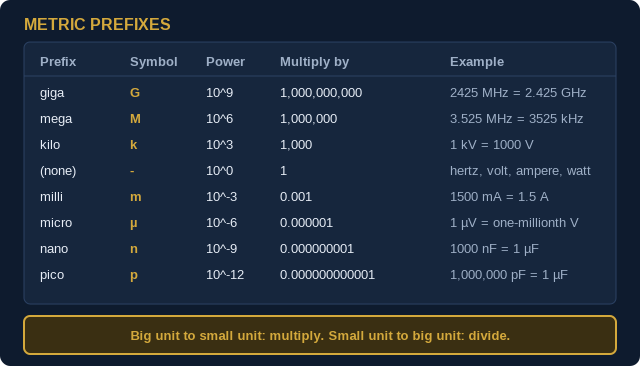
Table of metric prefixes from giga to pico with powers of ten and examples.
Describe this graphic in words

A table gives each prefix, its symbol, power of ten and multiplier: giga G 10^9 (1,000,000,000), mega M 10^6, kilo k 10^3 (1,000), the plain unit 10^0, milli m 10^-3 (0.001), micro 10^-6 (0.000001), nano n 10^-9 and pico p 10^-12. Examples include 2425 MHz = 2.425 GHz, 1 kV = 1000 V, 1500 mA = 1.5 A and 1,000,000 pF = 1 microfarad. A gold bar says to multiply going from a big unit to a small unit and divide going from small to big.

Milli means one-thousandth, so one ampere is 1000 milliamperes. To go from the larger unit (amperes) to the smaller one (milliamperes), multiply by 1000: 1.5 A x 1000 = 1500 mA.

A quick sanity check: converting to a smaller unit always gives a bigger number, because it takes more small units to make the same amount. The wrong answers shift the decimal point the wrong way or by the wrong amount. This is a teaching note.

Why the other choices are wrong

  • A. 0.0000015 would divide by a million, which is the wrong direction and the wrong size.
  • B. 0.0015 divides by 1000 instead of multiplying, making the number smaller when it should be larger.
  • D. 1,500,000 multiplies by a million, which would be microamperes, not milliamperes.

Rule text checked against the official source on November 5, 2026. This is a study aid; the linked rule is what governs.
T5B02

Which is equal to 1,500,000 hertz?

Show the answer and why

Answer A. 1500 kHz

1,500,000 hertz equals 1500 kHz.

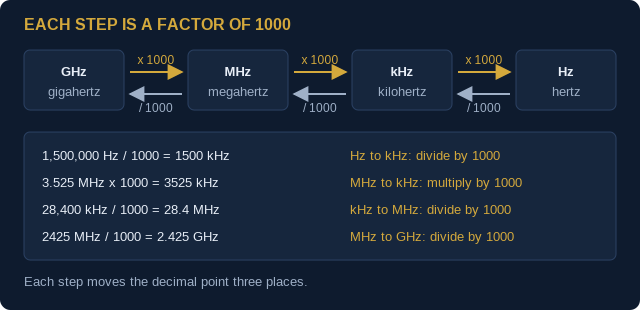
A ladder of frequency units from gigahertz down to hertz, each step a factor of 1000.
Describe this graphic in words

Four boxes in a row show GHz, MHz, kHz and Hz. Gold arrows pointing right between them are labeled x 1000 and gray arrows pointing left are labeled / 1000. Four worked examples follow: 1,500,000 Hz / 1000 = 1500 kHz, 3.525 MHz x 1000 = 3525 kHz, 28,400 kHz / 1000 = 28.4 MHz and 2425 MHz / 1000 = 2.425 GHz, each with its direction. A note says each step moves the decimal point three places.

Kilo means 1000, so divide hertz by 1000 to get kilohertz: 1,500,000 Hz / 1000 = 1500 kHz. Converting to a larger unit gives a smaller number.

The same frequency is 1.5 MHz, because mega is another factor of 1000. The other choices are far too large (1500 MHz and 15 GHz) or ten times too small (150 kHz). This is a teaching note.

Why the other choices are wrong

  • B. 1500 MHz is 1,500,000,000 Hz, a thousand times too big.
  • C. 15 GHz is 15,000,000,000 Hz, far too big.
  • D. 150 kHz is 150,000 Hz, ten times too small.

Rule text checked against the official source on November 5, 2026. This is a study aid; the linked rule is what governs.

T5B03

Which is equal to one kilovolt?

Show the answer and why

Answer C. One thousand volts

One kilovolt is one thousand volts.

Table of metric prefixes from giga to pico with powers of ten and examples.
Describe this graphic in words

A table gives each prefix, its symbol, power of ten and multiplier: giga G 10^9 (1,000,000,000), mega M 10^6, kilo k 10^3 (1,000), the plain unit 10^0, milli m 10^-3 (0.001), micro 10^-6 (0.000001), nano n 10^-9 and pico p 10^-12. Examples include 2425 MHz = 2.425 GHz, 1 kV = 1000 V, 1500 mA = 1.5 A and 1,000,000 pF = 1 microfarad. A gold bar says to multiply going from a big unit to a small unit and divide going from small to big.

Kilo means one thousand, so 1 kV = 1000 V. A 2.5 kV power supply, for example, produces 2500 V.

Remember that kilo, mega and giga step up from the base unit by factors of 1000, while milli, micro and pico step down. This is a teaching note.

Why the other choices are wrong

  • A. One one-thousandth of a volt is a millivolt.
  • B. One hundred volts is not a standard prefix value; kilo is 1000, not 100.
  • D. One million volts is a megavolt.

Rule text checked against the official source on November 5, 2026. This is a study aid; the linked rule is what governs.

T5B04

Which is equal to one microvolt?

Show the answer and why

Answer A. One one-millionth of a volt

One microvolt is one one-millionth of a volt.

Table of metric prefixes from giga to pico with powers of ten and examples.
Describe this graphic in words

A table gives each prefix, its symbol, power of ten and multiplier: giga G 10^9 (1,000,000,000), mega M 10^6, kilo k 10^3 (1,000), the plain unit 10^0, milli m 10^-3 (0.001), micro 10^-6 (0.000001), nano n 10^-9 and pico p 10^-12. Examples include 2425 MHz = 2.425 GHz, 1 kV = 1000 V, 1500 mA = 1.5 A and 1,000,000 pF = 1 microfarad. A gold bar says to multiply going from a big unit to a small unit and divide going from small to big.

Micro means one-millionth (0.000001, or 10^-6), so one microvolt is one one-millionth of a volt. Receiver sensitivity and very weak radio signals are often quoted in microvolts.

Compare the neighbors: a millivolt is one-thousandth of a volt, and a microvolt is a thousand times smaller than that. This is a teaching note.

Why the other choices are wrong

  • B. One million volts is a megavolt, an enormous voltage rather than a tiny one.
  • C. One thousand kilovolts is one million volts, again a megavolt.
  • D. One one-thousandth of a volt is a millivolt, a thousand times larger than a microvolt.

Rule text checked against the official source on November 5, 2026. This is a study aid; the linked rule is what governs.

T5B05

Which is equal to 500 milliwatts?

Show the answer and why

Answer B. 0.5 watts

500 milliwatts equals 0.5 watts.

Table of metric prefixes from giga to pico with powers of ten and examples.
Describe this graphic in words

A table gives each prefix, its symbol, power of ten and multiplier: giga G 10^9 (1,000,000,000), mega M 10^6, kilo k 10^3 (1,000), the plain unit 10^0, milli m 10^-3 (0.001), micro 10^-6 (0.000001), nano n 10^-9 and pico p 10^-12. Examples include 2425 MHz = 2.425 GHz, 1 kV = 1000 V, 1500 mA = 1.5 A and 1,000,000 pF = 1 microfarad. A gold bar says to multiply going from a big unit to a small unit and divide going from small to big.

Milli means one-thousandth, so divide milliwatts by 1000 to get watts: 500 mW / 1000 = 0.5 W. Moving to a larger unit makes the number smaller.

A quick check: 1000 mW is one watt, so 500 mW is half a watt, a typical low-power setting on a handheld radio. This is a teaching note.

Why the other choices are wrong

  • A. 5 watts would be 5000 mW, ten times too large.
  • C. 500,000 watts would be 500 kilowatts, enormously too large.
  • D. 500,000,000 watts would be 500 megawatts, absurdly large.

Rule text checked against the official source on November 5, 2026. This is a study aid; the linked rule is what governs.

T5B06

Which is equal to 3000 milliamperes?

Show the answer and why

Answer D. 3 amperes

3000 milliamperes equals 3 amperes.

Table of metric prefixes from giga to pico with powers of ten and examples.
Describe this graphic in words

A table gives each prefix, its symbol, power of ten and multiplier: giga G 10^9 (1,000,000,000), mega M 10^6, kilo k 10^3 (1,000), the plain unit 10^0, milli m 10^-3 (0.001), micro 10^-6 (0.000001), nano n 10^-9 and pico p 10^-12. Examples include 2425 MHz = 2.425 GHz, 1 kV = 1000 V, 1500 mA = 1.5 A and 1,000,000 pF = 1 microfarad. A gold bar says to multiply going from a big unit to a small unit and divide going from small to big.

Milli means one-thousandth, so 1000 milliamperes make one ampere. Divide by 1000 to get amperes: 3000 mA / 1000 = 3 A.

Because you are going to a bigger unit, the number must get smaller. The wrong answers move the decimal point the wrong way or by the wrong amount. This is a teaching note.

Why the other choices are wrong

  • A. 0.003 A is only 3 mA, off by a factor of a thousand.
  • B. 0.3 A is 300 mA, not 3000 mA.
  • C. 3,000,000 A multiplies by 1000 instead of dividing, making the number far too large.

Rule text checked against the official source on November 5, 2026. This is a study aid; the linked rule is what governs.

T5B07

Which is equal to 3.525 MHz?

Show the answer and why

Answer C. 3525 kHz

3.525 MHz equals 3525 kHz.

A ladder of frequency units from gigahertz down to hertz, each step a factor of 1000.
Describe this graphic in words

Four boxes in a row show GHz, MHz, kHz and Hz. Gold arrows pointing right between them are labeled x 1000 and gray arrows pointing left are labeled / 1000. Four worked examples follow: 1,500,000 Hz / 1000 = 1500 kHz, 3.525 MHz x 1000 = 3525 kHz, 28,400 kHz / 1000 = 28.4 MHz and 2425 MHz / 1000 = 2.425 GHz, each with its direction. A note says each step moves the decimal point three places.

One megahertz is 1000 kilohertz, so converting from megahertz to kilohertz means multiplying by 1000: 3.525 MHz x 1000 = 3525 kHz. Moving the decimal point three places to the right does the same thing.

Going from a larger unit to a smaller one gives a bigger number, so 3525 makes sense. This frequency is in the 80-meter band. This is a teaching note.

Why the other choices are wrong

  • A. 0.003525 kHz is far too small; it is only 3.525 Hz.
  • B. 35.25 kHz is a hundred times too small.
  • D. 3,525,000 kHz is a thousand times too large; it would be 3.525 GHz.

Rule text checked against the official source on November 5, 2026. This is a study aid; the linked rule is what governs.

T5B08

Which is equal to 1,000,000 picofarads?

Show the answer and why

Answer B. 1 microfarad

1,000,000 picofarads equals 1 microfarad.

Table of metric prefixes from giga to pico with powers of ten and examples.
Describe this graphic in words

A table gives each prefix, its symbol, power of ten and multiplier: giga G 10^9 (1,000,000,000), mega M 10^6, kilo k 10^3 (1,000), the plain unit 10^0, milli m 10^-3 (0.001), micro 10^-6 (0.000001), nano n 10^-9 and pico p 10^-12. Examples include 2425 MHz = 2.425 GHz, 1 kV = 1000 V, 1500 mA = 1.5 A and 1,000,000 pF = 1 microfarad. A gold bar says to multiply going from a big unit to a small unit and divide going from small to big.

Pico is 10^-12 and micro is 10^-6, so a microfarad is a million picofarads. To go from the smaller unit (picofarads) to the larger (microfarads), divide: 1,000,000 pF / 1,000,000 = 1 uF.

You can also do it in two steps: pico to nano is a division by 1000, and nano to micro is another division by 1000. Capacitors in radio circuits are marked in pF and uF, so these conversions come up often. This is a teaching note.

Why the other choices are wrong

  • A. 0.001 uF is only 1000 pF.
  • C. 1000 uF is a thousand times too large.
  • D. 1,000,000,000 uF is vastly too large.

Rule text checked against the official source on November 5, 2026. This is a study aid; the linked rule is what governs.

T5B09

Which decibel value most closely represents a power increase from 5 watts to 10 watts?

Show the answer and why

Answer B. 3 dB

Doubling power is about +3 dB.

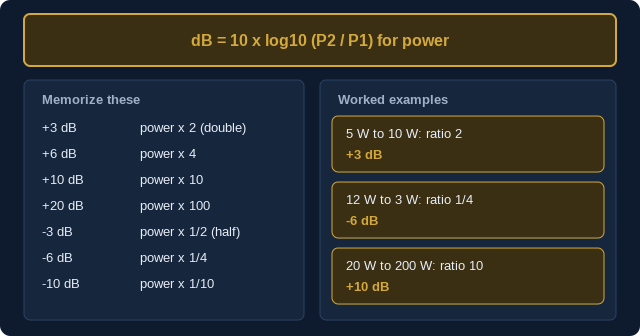
Decibel quick table with power ratios and three worked examples.
Describe this graphic in words

The top shows the power formula dB = 10 x log10 (P2 / P1). A table lists +3 dB as power times 2, +6 dB as times 4, +10 dB as times 10, +20 dB as times 100, -3 dB as times 1/2, -6 dB as times 1/4 and -10 dB as times 1/10. Three gold boxes work examples: 5 W to 10 W is a ratio of 2, +3 dB; 12 W to 3 W is a ratio of 1/4, -6 dB; 20 W to 200 W is a ratio of 10, +10 dB.

For power, decibels are 10 x log10(P2 / P1). From 5 W to 10 W the ratio is 10 / 5 = 2, and 10 x log10(2) is about 3 dB. Any doubling of power is about +3 dB, whether it goes from 5 W to 10 W or from 50 W to 100 W.

That makes 3 dB worth memorizing along with +10 dB for a tenfold increase. The wrong answers match other ratios: 2 dB is about 1.6 times the power, 5 dB is about 3.2 times, and 10 dB is ten times. This is a teaching note.

Why the other choices are wrong

  • A. 2 dB is a power ratio of about 1.6, not 2.
  • C. 5 dB is a power ratio of about 3.2.
  • D. 10 dB is a ratio of 10, a tenfold increase.

Rule text checked against the official source on November 5, 2026. This is a study aid; the linked rule is what governs.

T5B10

Which decibel value most closely represents a power decrease from 12 watts to 3 watts?

Show the answer and why

Answer C. -6 dB

Cutting power from 12 W to 3 W is about -6 dB.

Decibel quick table with power ratios and three worked examples.
Describe this graphic in words

The top shows the power formula dB = 10 x log10 (P2 / P1). A table lists +3 dB as power times 2, +6 dB as times 4, +10 dB as times 10, +20 dB as times 100, -3 dB as times 1/2, -6 dB as times 1/4 and -10 dB as times 1/10. Three gold boxes work examples: 5 W to 10 W is a ratio of 2, +3 dB; 12 W to 3 W is a ratio of 1/4, -6 dB; 20 W to 200 W is a ratio of 10, +10 dB.

The ratio is 3 W / 12 W = 1/4. Halving power is about -3 dB, so quartering it is two halvings: 2 x (-3 dB) = -6 dB. Checking with the formula, 10 x log10(0.25) is about -6.0 dB.

The negative sign shows that the power went down. -3 dB would be a drop to half (12 W to 6 W), and -9 dB would be a drop to about one-eighth (12 W to 1.5 W). This is a teaching note.

Why the other choices are wrong

  • A. -1 dB is only about a 20 percent drop in power.
  • B. -3 dB is a halving (12 W to 6 W), not a quartering.
  • D. -9 dB would be a drop to about one-eighth of the power.

Rule text checked against the official source on November 5, 2026. This is a study aid; the linked rule is what governs.

T5B11

Which decibel value represents a power increase from 20 watts to 200 watts?

Show the answer and why

Answer A. 10 dB

A tenfold power increase, 20 W to 200 W, is 10 dB.

Decibel quick table with power ratios and three worked examples.
Describe this graphic in words

The top shows the power formula dB = 10 x log10 (P2 / P1). A table lists +3 dB as power times 2, +6 dB as times 4, +10 dB as times 10, +20 dB as times 100, -3 dB as times 1/2, -6 dB as times 1/4 and -10 dB as times 1/10. Three gold boxes work examples: 5 W to 10 W is a ratio of 2, +3 dB; 12 W to 3 W is a ratio of 1/4, -6 dB; 20 W to 200 W is a ratio of 10, +10 dB.

The ratio is 200 W / 20 W = 10, and 10 x log10(10) = 10 dB. Every tenfold increase in power adds exactly 10 dB.

Two tenfold steps, a factor of 100, would be 20 dB. The other choices correspond to ratios of about 16 (12 dB), 63 (18 dB) and 630 (28 dB), none of which is 10. This is a teaching note.

Why the other choices are wrong

  • B. 12 dB would be a power ratio of about 16.
  • C. 18 dB would be a power ratio of about 63.
  • D. 28 dB would be a power ratio of about 630.

Rule text checked against the official source on November 5, 2026. This is a study aid; the linked rule is what governs.

T5B12

Which is equal to 28400 kHz?

Show the answer and why

Answer D. 28.400 MHz

28400 kHz equals 28.400 MHz.

A ladder of frequency units from gigahertz down to hertz, each step a factor of 1000.
Describe this graphic in words

Four boxes in a row show GHz, MHz, kHz and Hz. Gold arrows pointing right between them are labeled x 1000 and gray arrows pointing left are labeled / 1000. Four worked examples follow: 1,500,000 Hz / 1000 = 1500 kHz, 3.525 MHz x 1000 = 3525 kHz, 28,400 kHz / 1000 = 28.4 MHz and 2425 MHz / 1000 = 2.425 GHz, each with its direction. A note says each step moves the decimal point three places.

A megahertz is 1000 kilohertz, so divide kilohertz by 1000 to get megahertz: 28,400 kHz / 1000 = 28.4 MHz. Moving the decimal point three places to the left does the same thing.

That frequency is in the 10-meter band. The result is a smaller number because the megahertz unit is larger. This is a teaching note.

Why the other choices are wrong

  • A. 28.400 kHz is only 28.4 kHz, a thousand times too small.
  • B. 2.800 MHz is about a tenth of the right value, with different digits.
  • C. 284.00 MHz is ten times too large.

Rule text checked against the official source on November 5, 2026. This is a study aid; the linked rule is what governs.

T5B13

Which is equal to 2425 MHz?

Show the answer and why

Answer C. 2.425 GHz

2425 MHz equals 2.425 GHz.

A ladder of frequency units from gigahertz down to hertz, each step a factor of 1000.
Describe this graphic in words

Four boxes in a row show GHz, MHz, kHz and Hz. Gold arrows pointing right between them are labeled x 1000 and gray arrows pointing left are labeled / 1000. Four worked examples follow: 1,500,000 Hz / 1000 = 1500 kHz, 3.525 MHz x 1000 = 3525 kHz, 28,400 kHz / 1000 = 28.4 MHz and 2425 MHz / 1000 = 2.425 GHz, each with its direction. A note says each step moves the decimal point three places.

A gigahertz is 1000 megahertz, so divide megahertz by 1000 to get gigahertz: 2425 MHz / 1000 = 2.425 GHz. Moving the decimal point three places to the left does the same thing.

The wrong answers are off by factors of 10 or 1000. This is a teaching note.

Why the other choices are wrong

  • A. 0.002425 GHz is only 2.425 MHz, a thousand times too small.
  • B. 24.25 GHz is ten times too large.
  • D. 242.5 GHz is a hundred times too large.

Rule text checked against the official source on November 5, 2026. This is a study aid; the linked rule is what governs.