
ARSC Tech School

Technician T1B: Frequency allocations

409 questions · pool July 1, 2026 to June 30, 2030 · the exam has 35 questions; 26 to pass

T1 · COMMISSION’S RULES

Frequency allocations; Emission modes; Spectrum sharing; Transmissions near band edges; Contacting the International Space Station; Power output

12 questions in group T1B

One question from this group appears on each exam.

T1B01FCC rule 97.301(e)

Which of the following frequency ranges are available for phone operation by Technician licensees?

Show the answer and why

Answer C. 28.300 MHz to 28.500 MHz

FCC rule 97.301(e)

Technicians have phone privileges on 10 meters from 28.300 MHz to 28.500 MHz.
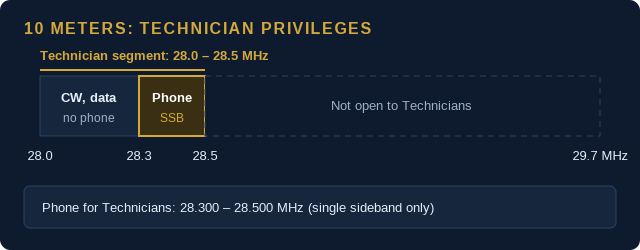
Chart of the 10-meter band showing the Technician segment from 28.0 to 28.5 MHz, split into CW and data below 28.3 MHz and phone from 28.3 to 28.5 MHz.
Describe this graphic in words

A horizontal strip from 28.0 to 29.7 MHz. The Technician segment runs from 28.0 to 28.5 MHz. Within it, 28.0 to 28.3 MHz allows CW, RTTY and data; 28.3 to 28.5 MHz allows phone and image, and is marked as the answer. Above 28.5 MHz, the strip is marked as not available to Technicians.

Two rules combine here. Section 97.301(e) gives Novice and Technician Class operators the 10-meter segment 28.0 to 28.5 MHz. Section 97.305(c) then says which emissions may be used where: in the 10-meter band, 28.0 to 28.3 MHz is for RTTY and data, and 28.3 to 28.5 MHz is for phone and image.

Technicians' phone privileges on 10 meters are therefore 28.300 to 28.500 MHz. Below 28.3 MHz you can use CW and digital modes, but not voice.

Why the other choices are wrong

  • A. 28.050 to 28.150 MHz is in the RTTY and data segment, so it is not open to phone.
  • B. 28.100 to 28.300 MHz is also in the RTTY and data segment, below the 28.3 MHz phone boundary.
  • D. 28.500 to 28.600 MHz is above the Technician segment, which ends at 28.5 MHz.

References

Rule text checked against the official source on November 5, 2026. This is a study aid; the linked rule is what governs.
T1B02FCC rule 97.301, 97.207(c)

Which of the following U.S. amateur radio operators are allowed to contact the International Space Station (ISS) on VHF bands?

Show the answer and why

Answer B. Any amateur with a Technician class or higher license

FCC rule 97.301, 97.207(c)

Any amateur with a Technician or higher license can contact the ISS on the VHF amateur bands. No special approval is required.

Section 97.207(c) says space stations may transmit in several amateur segments, including 144 to 146 MHz, part of the 2-meter band. Section 97.301(a) gives Technician, General, Advanced and Amateur Extra operators the entire 2-meter band, so a Technician can transmit in that segment and work the space station.

Neither rule asks for NASA approval or a higher license class. The ISS amateur station is an amateur station like any other, and being allowed on the band is enough.

Why the other choices are wrong

  • A. A General license is not required. Technicians already have the 2-meter band under 97.301(a).
  • C. No part of Part 97 requires a General license plus NASA approval.
  • D. Part 97 does not require NASA approval from the amateur operator.

References

Rule text checked against the official source on November 5, 2026. This is a study aid; the linked rule is what governs.

T1B03FCC rule 97.301(a)

Which frequency is in the 6-meter amateur band?

Show the answer and why

Answer B. 52.525 MHz

FCC rule 97.301(a)

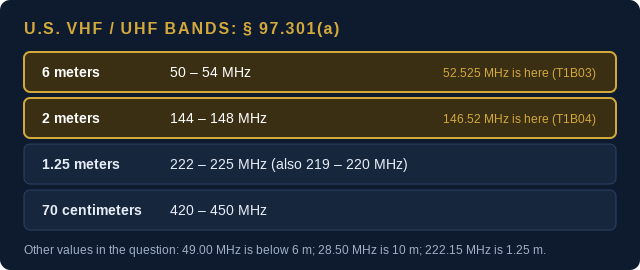
The 6-meter band is 50 to 54 MHz in the United States, so 52.525 MHz is in it.

Table of the 6 m, 2 m, 1.25 m and 70 cm amateur bands with their frequency ranges, and the example frequencies from this and the next question placed on it.
Describe this graphic in words

A table of the VHF and UHF amateur bands in the United States: 6 meters is 50 to 54 MHz, 2 meters is 144 to 148 MHz, 1.25 meters is 222 to 225 MHz (and 219 to 220 MHz), and 70 centimeters is 420 to 450 MHz. The frequencies 52.525 MHz and 146.52 MHz are marked in the 6 meter and 2 meter rows.

The band table in 97.301(a) lists 6 m as 50 to 54 MHz for ITU Region 2, which includes the United States. 52.525 MHz falls inside that range.

A quick way to remember band edges: the wavelength in meters is roughly 300 divided by the frequency in MHz, so 6 m is about 50 MHz.

Why the other choices are wrong

  • A. 49.00 MHz is just below the bottom of the 6-meter band at 50 MHz.
  • C. 28.50 MHz is the top of the Technician segment of the 10-meter band.
  • D. 222.15 MHz is in the 1.25-meter band (222 to 225 MHz).

References

Rule text checked against the official source on November 5, 2026. This is a study aid; the linked rule is what governs.

T1B04FCC rule 97.301(a)

Which amateur band includes 146.52 MHz?

Show the answer and why

Answer D. 2 meters

FCC rule 97.301(a)

146.52 MHz is in the 2-meter band, which runs from 144 to 148 MHz in the United States.

Table of the 6 m, 2 m, 1.25 m and 70 cm amateur bands with their frequency ranges, and the example frequencies from this and the previous question placed on it.
Describe this graphic in words

A table of the VHF and UHF amateur bands in the United States: 6 meters is 50 to 54 MHz, 2 meters is 144 to 148 MHz, 1.25 meters is 222 to 225 MHz (and 219 to 220 MHz), and 70 centimeters is 420 to 450 MHz. The frequencies 52.525 MHz and 146.52 MHz are marked in the 6 meter and 2 meter rows.

In 97.301(a), the 2 m band is 144 to 148 MHz for ITU Region 2. 146.52 MHz sits in the middle of it. It is widely used as a simplex calling frequency, which is why you will see it often.

The other choices do not reach it: 6 m is 50 to 54 MHz, 20 m is a different (HF) band, and 70 cm is 420 to 450 MHz.

Why the other choices are wrong

  • A. 6 meters is 50 to 54 MHz.
  • B. 20 meters is an HF band around 14 MHz.
  • C. 70 centimeters is 420 to 450 MHz.

References

Rule text checked against the official source on November 5, 2026. This is a study aid; the linked rule is what governs.

T1B05FCC rule 97.301, 97.305

Which of the following bands include frequencies where Technicians are authorized to use digital modes such as FT8?

Show the answer and why

Answer D. All these choices are correct

FCC rule 97.301, 97.305

Technicians can use digital modes such as FT8 on 10 meters, 6 meters and 2 meters, so all of the choices are correct.

Section 97.305(c) lists RTTY and data emissions, which cover modes like FT8, in each of these places a Technician can operate: 28.0 to 28.3 MHz on 10 meters, 50.1 to 54.0 MHz on 6 meters, and 144.1 to 148.0 MHz on 2 meters.

Technician access to 10 meters comes from 97.301(e) (28.0 to 28.5 MHz), and to 6 m and 2 m from 97.301(a).

Why the other choices are wrong

  • A. Correct, but not the only band: 10 meters is one of three.
  • B. Correct, but 6 meters is one of three.
  • C. Correct, but 2 meters is one of three. All three are right, so D is the best answer.

References

Rule text checked against the official source on November 5, 2026. This is a study aid; the linked rule is what governs.

T1B06FCC rule 97.301(e), 97.305

On which HF bands does a Technician class operator have phone privileges?

Show the answer and why

Answer B. 10-meter band only

FCC rule 97.301(e), 97.305

Technicians have HF phone privileges on the 10-meter band only.

Chart of the 10-meter band showing the Technician segment from 28.0 to 28.5 MHz, split into CW and data below 28.3 MHz and phone from 28.3 to 28.5 MHz.
Describe this graphic in words

A horizontal strip from 28.0 to 29.7 MHz. The Technician segment runs from 28.0 to 28.5 MHz. Within it, 28.0 to 28.3 MHz allows CW, RTTY and data; 28.3 to 28.5 MHz allows phone and image, and is marked as the answer. Above 28.5 MHz, the strip is marked as not available to Technicians.

Section 97.301(e) gives Technicians segments on 80, 40, 15 and 10 meters. Section 97.305(c) says phone is allowed on 10 meters from 28.3 to 28.5 MHz. In the Technician segments on 80, 40 and 15 meters, the phone sections of the band (for example 3.6 MHz and up on 80 m) fall outside what 97.301(e) gives Technicians, so no phone is allowed there.

Section 97.307(f)(10) adds that a Technician may transmit phone only as single-sideband emissions (J3E and R3E).

Why the other choices are wrong

  • A. Technicians do have phone privileges on 10 meters.
  • C. On 80, 40 and 15 meters, the Technician segments are limited to CW and data, not phone.
  • D. Technicians do not have access to 30 meters.

References

Rule text checked against the official source on November 5, 2026. This is a study aid; the linked rule is what governs.

T1B07FCC rule 97.305(a), (c)

Which of the following VHF/UHF band segments are limited to CW only?

Show the answer and why

Answer A. 50.0 MHz to 50.1 MHz and 144.0 MHz to 144.1 MHz

FCC rule 97.305(a), (c)

50.0 to 50.1 MHz and 144.0 to 144.1 MHz are the segments limited to CW only.

Section 97.305(a) lets a station send CW on any frequency authorized to the control operator. Section 97.305(c) then lists the other emission types, and the phone, data and other modes on 6 meters start at 50.1 MHz and on 2 meters at 144.1 MHz. The first 100 kHz of each band, 50.0 to 50.1 MHz and 144.0 to 144.1 MHz, is therefore CW only.

The phone, data and other emission types in the 6-meter and 2-meter tables begin at 50.1 MHz and 144.1 MHz, which is what leaves the segments below them CW only.

Why the other choices are wrong

  • B. 219 to 220 MHz is for digital message forwarding (data), and 420.0 to 420.1 MHz is not a CW-only segment; the 70 cm band allows many emission types.
  • C. 902.0 to 902.1 MHz is not a CW-only segment; the 33 cm band allows many emission types.
  • D. Only the first pair of segments is limited to CW.

References

Rule text checked against the official source on November 5, 2026. This is a study aid; the linked rule is what governs.

T1B08FCC rule 97.303

How are US amateurs restricted in segments of bands where the Amateur Radio Service is secondary?

Show the answer and why

Answer A. U.S. amateurs may find non-amateur stations in those segments, and must avoid interfering with them

FCC rule 97.303

Where amateur radio is a secondary service, you may find non-amateur stations and you must avoid interfering with them.

Section 97.303 explains it directly: "A station in a secondary service must not cause harmful interference to, and must accept interference from, stations in a primary service." In a band segment where amateurs are secondary, the primary users have priority.

For example, 97.303(b) says amateur stations on the 70 cm band must not cause harmful interference to, and must accept interference from, U.S. Government radiolocation stations.

Why the other choices are wrong

  • B. The sharing rule is about primary and secondary services, not about priority for foreign amateur stations.
  • C. International communication is not restricted by secondary status.
  • D. Digital transmissions are not banned in secondary segments.

References

Rule text checked against the official source on November 5, 2026. This is a study aid; the linked rule is what governs.

T1B09FCC rule 97.101(a), 97.301(a-e)

Why should you not set your transmit frequency to be exactly at the edge of an amateur band or sub-band?

Show the answer and why

Answer D. All these choices are correct

FCC rule 97.101(a), 97.301(a-e)

Do not park exactly on a band edge: your display may be off, your signal may drift, and your sidebands extend beyond the carrier frequency.

Section 97.101(a) says that where the rules are silent, "each amateur station must be operated in accordance with good engineering and good amateur practice." Operating right at a band or sub-band edge leaves no room for error.

Three real effects apply together: the frequency display on a radio may be slightly off, the transmitter may drift as it warms up, and a modulated signal occupies bandwidth on either side of the displayed carrier frequency. Staying a little inside the edge keeps the whole signal inside the band. All three choices are correct reasons.

Why the other choices are wrong

  • A. True, but only one of the three reasons.
  • B. True, but only one of the three reasons.
  • C. True, but only one of the three reasons. Since each one holds, D is the best answer.

References

Rule text checked against the official source on November 5, 2026. This is a study aid; the linked rule is what governs.

T1B10FCC rule 97.305(c)

Where may SSB phone be used in amateur bands above 50 MHz?

Show the answer and why

Answer C. In at least some segment of all these bands

FCC rule 97.305(c)

Above 50 MHz, SSB phone can be used in at least some segment of all the amateur bands.

The emission table in 97.305(c) allows phone on 6 meters (50.1 to 54.0 MHz), 2 meters (144.1 to 148.0 MHz), 1.25 meters (222 to 225 MHz), and the whole of 70 cm and the bands above it. Phone includes single sideband. There is no General-class restriction on these segments.

The one exception inside a band is 219 to 220 MHz, which is limited to data, but the 1.25-meter band as a whole still has a phone segment.

Why the other choices are wrong

  • A. These segments are open to Technicians as well. There is no General-or-higher restriction.
  • B. SSB is not limited to repeaters.
  • D. There is no 25-watt limit for SSB on those bands.

References

Rule text checked against the official source on November 5, 2026. This is a study aid; the linked rule is what governs.

T1B11FCC rule 97.313

What is the maximum peak envelope power output for Technician class operators in their HF band segments?

Show the answer and why

Answer A. 200 watts

FCC rule 97.313

Technician operators are limited to 200 watts PEP in their HF band segments.

Section 97.313(c)(2) says no station may transmit with more than 200 W PEP "on the 3.525-3.60 MHz, 7.025-7.125 MHz, 21.025-21.20 MHz, and 28.0-28.5 MHz segment when the control operator is a Novice Class operator or a Technician Class operator." Those are exactly the Technician HF segments in 97.301(e).

PEP, peak envelope power, is the average power during one radio-frequency cycle at the crest of the modulation envelope. Higher limits apply to other license classes and to other bands.

Why the other choices are wrong

  • B. 100 watts is not the limit in the rule.
  • C. 50 watts is not the limit in the rule.
  • D. 10 watts is not the limit in the rule.

References

Rule text checked against the official source on November 5, 2026. This is a study aid; the linked rule is what governs.

T1B12FCC rule 97.313(b)

Except for some specific restrictions, what is the maximum peak envelope power output for Technician class operators using frequencies above 30 MHz?

Show the answer and why

Answer D. 1500 watts

FCC rule 97.313(b)

Above 30 MHz, Technician operators can use up to 1500 watts PEP, subject to a few specific limits.

Section 97.313(b) says "No station may transmit with a transmitter power exceeding 1.5 kW PEP." The special 200 W limit for Technicians in 97.313(c)(2) applies only to the HF segments, so above 30 MHz the general 1.5 kW limit is what applies.

Specific exceptions still apply. For instance, 97.313(h) limits the 219 to 220 MHz segment to 50 W PEP, and 97.313(f) and (g) limit power near certain military facilities. Section 97.313(a) also tells every operator to use "the minimum transmitter power necessary to carry out the desired communications," which is why you rarely need anything close to the maximum.

Why the other choices are wrong

  • A. 50 W is the limit for some specific areas and segments, not the general limit above 30 MHz.
  • B. 100 W is not the limit in the rule.
  • C. 500 W is not the limit in the rule.

References

Rule text checked against the official source on November 5, 2026. This is a study aid; the linked rule is what governs.