
ARSC Tech School

Technician T3A: Radio wave characteristics

409 questions · pool July 1, 2026 to June 30, 2030 · the exam has 35 questions; 26 to pass

T3 · RADIO WAVE PROPAGATION

Radio wave characteristics: how a radio signal travels, fading, multipath, polarization, wavelength vs absorption; Antenna orientation

12 questions in group T3A

One question from this group appears on each exam.

T3A01

Why do VHF signal strengths sometimes vary greatly when the antenna is moved only a few feet?

Show the answer and why

Answer C. Multipath propagation cancels or reinforces signals

Multipath: the same signal arrives by several reflected paths, which cancel or reinforce each other depending on exact position.
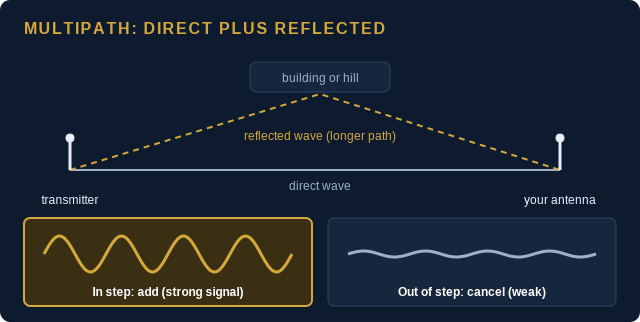
Direct and reflected waves reaching an antenna, which add when in step and cancel when out of step.
Describe this graphic in words

A transmitter on the left sends a direct wave in a straight line to your antenna on the right and a longer reflected wave that bounces off a building or hill. Two panels below show the result: when the two arrive in step they add and give a strong signal (a tall gold wave), and when they arrive out of step they cancel and give a weak signal (a nearly flat wave). Moving the antenna a few feet changes the length of the reflected path and so changes which case you get.

Waves can be reflected, absorbed, refracted, diffracted or scattered by objects they meet. On VHF, buildings, hills and vehicles reflect the signal, so your antenna receives the direct wave plus reflected copies that traveled different distances.

At VHF the wavelength is short (about 2 meters on the 2-meter band, so half a wavelength is only about 1 meter). Moving the antenna a few feet changes how the copies line up. Where they arrive in step they add; where they arrive out of step they cancel, so the signal strength jumps up and down over a very short distance.

Why the other choices are wrong

  • A. Water vapor does not change signal strength over a few feet of antenna movement. Humidity changes act over much longer distances.
  • B. VHF signals normally travel by line of sight rather than by the ionosphere, so ionospheric effects cannot explain changes over a few feet.
  • D. Doppler shift is a small frequency change from motion. It does not cause the fades you see by moving an antenna a few feet.

References

Rule text checked against the official source on November 5, 2026. This is a study aid; the linked rule is what governs.
T3A02

How does vegetation affect UHF and microwave signals?

Show the answer and why

Answer B. Absorbs signals, leading to poor reception of weak signals

Vegetation absorbs UHF and microwave signals, so weak signals are received poorly.

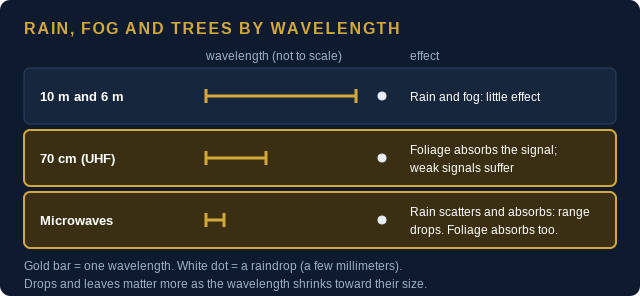
Rain, fog and foliage affect shorter wavelengths more, shown by a raindrop compared with wavelength bars.
Describe this graphic in words

Three rows compare a gold bar for one wavelength with a white dot for a raindrop. At 10 and 6 meters the wavelength is very long and rain and fog have little effect. At 70 centimeters (UHF) foliage absorbs the signal and weak signals suffer, and for microwaves, with the shortest bar, rain scatters and absorbs energy so range drops and foliage absorbs too. A note says the drawing is not to scale.

NASA notes that when a wave meets an object, whether it is transmitted, reflected, absorbed or scattered depends on the object's composition and on the wavelength. Leaves and wet foliage contain water and absorb energy at UHF and microwave wavelengths.

The loss grows as the wavelength gets shorter, so a path through trees that works on 2 meters can fail on 70 centimeters or in the microwave bands. This is why weak-signal UHF and microwave links need a clear path. This is a teaching note.

Why the other choices are wrong

  • A. Knife-edge diffraction is bending around an edge, such as a ridge. It is not the effect of foliage and does not distort voice peaks.
  • C. Vegetation does not amplify signals; it removes energy from them.
  • D. Trees do affect these frequencies, by absorption, so "no effect" is wrong.

References

Rule text checked against the official source on November 5, 2026. This is a study aid; the linked rule is what governs.
T3A03

What antenna polarization is normally used for long-distance CW and SSB contacts on the VHF and UHF bands?

Show the answer and why

Answer C. Horizontal

Horizontal polarization is normally used for long-distance CW and SSB on VHF and UHF.

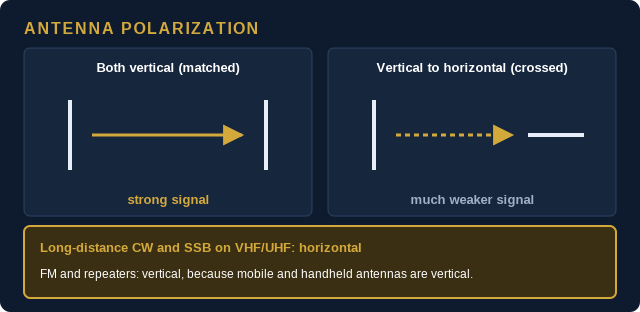
Two matched vertical antennas give a strong signal; a vertical and a horizontal antenna give a much weaker one.
Describe this graphic in words

The left panel shows two vertical antennas with a solid gold arrow between them labelled strong signal. The right panel shows a vertical antenna and a horizontal antenna with a dashed arrow labelled much weaker signal. A gold panel says long-distance CW and SSB on VHF and UHF use horizontal polarization, while FM and repeaters use vertical because mobile and handheld antennas are vertical.

Polarization is the alignment of a wave's electric field. Weak-signal operators (CW and SSB, for example on 6 meters, 2 meters and 70 centimeters) have agreed to use horizontal polarization, so everyone's antennas match each other.

FM repeater and local work uses vertical polarization instead, because mobile and handheld antennas are vertical. The weak-signal choice is a convention, not a rule.

Why the other choices are wrong

  • A. Circular polarization is used for some satellite work, not for ordinary long-distance CW and SSB.
  • B. Left-hand circular is likewise a satellite choice, not the weak-signal norm.
  • D. Vertical is the norm for FM and repeaters, not for long-distance CW and SSB.

References

Rule text checked against the official source on November 5, 2026. This is a study aid; the linked rule is what governs.
T3A04

What is the effect of antenna cross-polarization over a line-of-sight VHF or UHF path?

Show the answer and why

Answer B. Received signal strength is reduced

Cross-polarized antennas receive a weaker signal.

Two matched vertical antennas give a strong signal; a vertical and a horizontal antenna give a much weaker one.
Describe this graphic in words

The left panel shows two vertical antennas with a solid gold arrow between them labelled strong signal. The right panel shows a vertical antenna and a horizontal antenna with a dashed arrow labelled much weaker signal. A gold panel says long-distance CW and SSB on VHF and UHF use horizontal polarization, while FM and repeaters use vertical because mobile and handheld antennas are vertical.

NASA describes polarization with a Frisbee thrown at a picket fence: in one orientation it passes through, in another it is rejected. A vertical antenna responds best to a vertically polarized wave. If the other station's antenna is horizontal, much of the signal is not matched and the received strength drops.

Over a short line-of-sight path the loss can be large. Match your antenna's polarization to the other station's. When you change a handheld from upright to sideways, the signal meter often falls noticeably.

Why the other choices are wrong

  • A. Polarization mismatch does not invert sidebands. Sideband inversion is a matter of the receiver's mode setting.
  • C. An echo effect comes from multiple paths, not from cross-polarization.
  • D. The loss is significant, so "nothing significant" is wrong.

References

Rule text checked against the official source on November 5, 2026. This is a study aid; the linked rule is what governs.

T3A05

When using a directional antenna, how might your station be able to communicate with a distant repeater if buildings or obstructions are blocking the direct line of sight path?

Show the answer and why

Answer B. Try to find a path that reflects signals to the repeater

Try to find a path that reflects signals to the repeater.

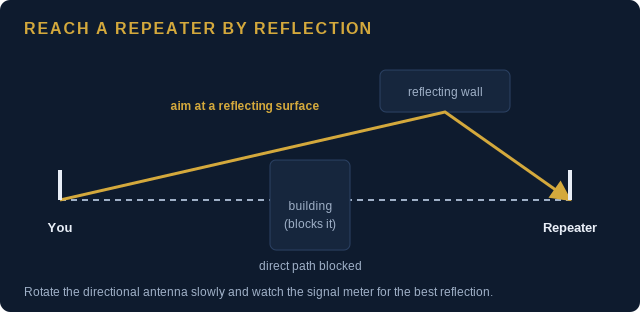
A directional antenna aimed at a reflecting wall to reach a repeater around a blocking building.
Describe this graphic in words

A dashed grey direct line from You to the Repeater is blocked by a building. A gold path instead goes from You up to a reflecting wall and back down to the Repeater. Labels say to aim at a reflecting surface, and a note says to rotate the directional antenna slowly and watch the signal meter for the best reflection.

Waves bounce off buildings, hills and other large objects (NASA lists reflection and diffraction among the ways waves behave). If a building blocks the direct path, point the directional antenna at a nearby structure and look for the direction where the reflected signal is strongest.

The best heading may be well off the line toward the repeater, so rotate the antenna slowly while watching the signal meter.

Why the other choices are wrong

  • A. Changing polarization does not clear an obstruction and usually weakens the signal.
  • C. The long path is a reverse-direction path used on HF, not a fix for a blocked VHF or UHF path.
  • D. A higher SWR means more of your power is reflected back in the feed line, so it makes things worse.

References

Rule text checked against the official source on November 5, 2026. This is a study aid; the linked rule is what governs.

T3A06

What is the meaning of the term “picket fencing”?

Show the answer and why

Answer B. Rapid flutter on mobile signals due to multipath propagation

Picket fencing is the rapid flutter on mobile signals caused by multipath.

A moving vehicle passes through places where reflected and direct signals add and cancel (see T3A01). At driving speed the received signal fades in and out rapidly, which sounds like a fast flutter. The name comes from the regular fence-post-like "pickets" of fading you pass along the way.

It is most noticeable on VHF and UHF FM from a moving car. Stopping, or moving the antenna a short distance, changes the pattern.

Why the other choices are wrong

  • A. Taking turns in a net is not called picket fencing.
  • C. A ground system for a vertical antenna is a radial system, not picket fencing.
  • D. Interference from cable TV is a different problem and does not involve fading of mobile signals.

References

Rule text checked against the official source on November 5, 2026. This is a study aid; the linked rule is what governs.

T3A07

What weather condition might decrease range at microwave frequencies?

Show the answer and why

Answer C. Precipitation

Precipitation can decrease range at microwave frequencies.

Rain, fog and foliage affect shorter wavelengths more, shown by a raindrop compared with wavelength bars.
Describe this graphic in words

Three rows compare a gold bar for one wavelength with a white dot for a raindrop. At 10 and 6 meters the wavelength is very long and rain and fog have little effect. At 70 centimeters (UHF) foliage absorbs the signal and weak signals suffer, and for microwaves, with the shortest bar, rain scatters and absorbs energy so range drops and foliage absorbs too. A note says the drawing is not to scale.

NASA notes that scattering and absorption depend on the wavelength compared with the size of the object. A raindrop is tiny compared with a VHF wavelength, but microwave wavelengths are short enough, down to a few centimeters or less, that raindrops scatter and absorb a significant part of the energy. Rain therefore shortens microwave range.

Wind, low pressure and cold are not the usual causes of reduced microwave range.

Why the other choices are wrong

  • A. High winds do not absorb microwave energy.
  • B. Low barometric pressure does not reduce microwave range.
  • D. Colder temperatures do not reduce range in the way rain does.

References

Rule text checked against the official source on November 5, 2026. This is a study aid; the linked rule is what governs.

T3A08

What is a likely cause of irregular fading of signals propagated by the ionosphere?

Show the answer and why

Answer D. Random combining of signals arriving via different paths

Irregular fading of ionospheric signals comes from signals arriving by different paths combining at random.

The ionosphere's density and structure keep changing (the NOAA Space Weather Prediction Center describes these changes modifying the path of HF signals). Parts of the signal take different paths through it and reach you at slightly different times.

Those copies add or cancel at random, so the signal strength rises and falls irregularly. Lightning and intermodulation produce noise and distortion, not this fading.

Why the other choices are wrong

  • A. Faraday rotation changes polarization, but it is not the usual reason for irregular fading.
  • B. Thunderstorms produce static, not fading of the signal.
  • C. Intermodulation distortion comes from nonlinear equipment, not the ionosphere.

References

Rule text checked against the official source on November 5, 2026. This is a study aid; the linked rule is what governs.

T3A09

Which of the following results from the fact that signals propagated by the ionosphere are elliptically polarized?

Show the answer and why

Answer B. Either vertically or horizontally polarized antennas may be used for transmission or reception

Because ionospheric signals are elliptically polarized, either vertical or horizontal antennas can be used.

Polarization is the alignment of a wave's electric field (NASA). Passing through and reflecting from the ionosphere changes it, so the wave arrives elliptically polarized, with a mix of orientations.

That is why either a vertical or a horizontal antenna works for HF contacts via the ionosphere, unlike a line-of-sight VHF path where matching polarization matters (see T3A04).

Why the other choices are wrong

  • A. Digital modes work on ionospheric paths.
  • C. FM voice works on ionospheric paths.
  • D. The antennas do not need to be the same polarization on ionospheric paths, because the wave arrives with a mix of orientations.

References

Rule text checked against the official source on November 5, 2026. This is a study aid; the linked rule is what governs.

T3A10

What effect does multi-path propagation have on data transmissions?

Show the answer and why

Answer D. Error rates are likely to increase

Multipath propagation is likely to increase the error rate of data transmissions.

With multipath, copies of each data symbol arrive at slightly different times. The delayed copies smear into the next symbol, so the receiver is more likely to read a bit wrongly.

Slowing the data down can help, because each symbol then lasts longer than the delays, but there is no fixed factor tied to the number of paths.

Why the other choices are wrong

  • A. There is no rule that rates must be increased by the number of paths; higher speeds make multipath worse.
  • B. There is no rule that rates must be decreased by the number of paths, although slowing down can help.
  • C. FM does not make the problem go away. Multipath affects every mode.

References

Rule text checked against the official source on November 5, 2026. This is a study aid; the linked rule is what governs.

T3A11

Which region of the atmosphere can reflect HF radio waves?

Show the answer and why

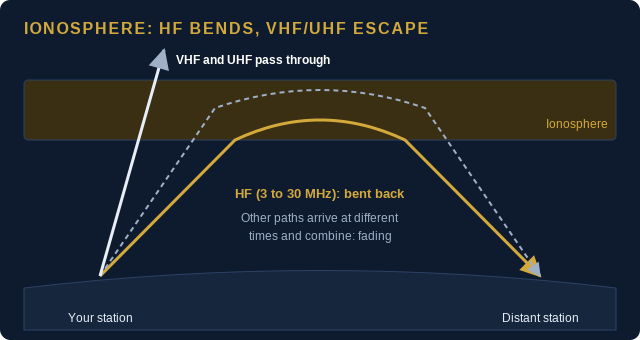
Answer C. The ionosphere

The ionosphere can reflect HF radio waves.

HF signals are bent back to Earth by the ionosphere while VHF and UHF signals pass through; other HF paths cause fading.
Describe this graphic in words

A band across the top is the ionosphere. A gold HF path leaves your station, bends back in the ionosphere and returns to a distant station, while a white VHF and UHF path goes straight up through it and out. A second, dashed grey HF path takes a different route to the same station, and a label says that paths arriving at different times combine to cause fading.

NOAA's Space Weather Prediction Center explains that at 1 to 30 MHz (HF) the ionosphere's density and structure shape the path of the signal. Layers of ionized gas bend (refract) HF waves back toward Earth, which is how HF contacts reach beyond the horizon.

VHF and UHF signals mostly pass through the ionosphere and out to space. The stratosphere and troposphere do not play this role for HF, and "electrosphere" is not an atmospheric region.

Why the other choices are wrong

  • A. The stratosphere does not reflect HF waves.
  • B. The troposphere affects VHF and UHF (for example by ducting), not HF reflection.
  • D. There is no region called the electrosphere.

References

Rule text checked against the official source on November 5, 2026. This is a study aid; the linked rule is what governs.

T3A12

What effect does fog or rain have on 10-meter and 6-meter band signals?

Show the answer and why

Answer B. Little effect

Fog and rain have little effect on 10-meter and 6-meter signals.

How much a wave is scattered depends on its wavelength compared with the size of the object (NASA). Raindrops and fog droplets are tiny compared with a wavelength of 6 or 10 meters, so they hardly affect those signals.

The same drops matter at microwave wavelengths, which are much shorter (see T3A07).

Why the other choices are wrong

  • A. Absorption by rain is a microwave problem, not a 6-meter or 10-meter problem.
  • C. Rain and fog do not deflect signals at these wavelengths.
  • D. Rain and fog do not increase range.

References

Rule text checked against the official source on November 5, 2026. This is a study aid; the linked rule is what governs.