
ARSC Tech School

Technician T5C: Capacitance and inductance terminology and units

409 questions · pool July 1, 2026 to June 30, 2030 · the exam has 35 questions; 26 to pass

T5 · ELECTRICAL PRINCIPLES

Capacitance and inductance terminology and units; Radio frequency definition and units; Impedance definition and units; Calculating power

12 questions in group T5C

One question from this group appears on each exam.

T5C01

What describes the ability to store energy in an electric field?

Show the answer and why

Answer D. Capacitance

Capacitance is the ability to store energy in an electric field.
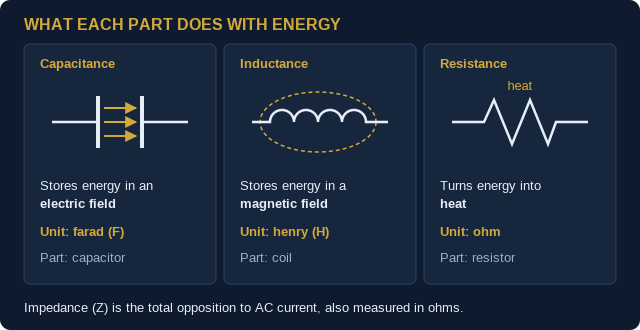
Three panels comparing capacitance, inductance and resistance and what each does with energy.
Describe this graphic in words

Three side-by-side panels. Capacitance stores energy in an electric field between two plates; unit farad (F); part: capacitor. Inductance stores energy in a magnetic field around a coil; unit henry (H); part: coil. Resistance turns energy into heat; unit ohm; part: resistor. A line below says impedance (Z) is the total opposition to AC current, also measured in ohms.

A capacitor is two conductive plates separated by an insulator. When a voltage is applied, charge builds up on the plates and the energy is held in the electric field between them. That ability to store energy in an electric field is capacitance.

Inductance is the matching property for a magnetic field, and resistance simply turns energy into heat. Frequency is a rate of repetition, not a way of storing energy. This is a teaching note.

Why the other choices are wrong

  • A. Inductance stores energy in a magnetic field around a coil, not in an electric field.
  • B. Resistance opposes current and turns electrical energy into heat; it does not store it.
  • C. Frequency is how many cycles occur each second; it is not a property of a component.

Rule text checked against the official source on November 5, 2026. This is a study aid; the linked rule is what governs.
T5C02

What is the unit of capacitance?

Show the answer and why

Answer A. Farad

The unit of capacitance is the farad.

Three panels comparing capacitance, inductance and resistance and what each does with energy.
Describe this graphic in words

Three side-by-side panels. Capacitance stores energy in an electric field between two plates; unit farad (F); part: capacitor. Inductance stores energy in a magnetic field around a coil; unit henry (H); part: coil. Resistance turns energy into heat; unit ohm; part: resistor. A line below says impedance (Z) is the total opposition to AC current, also measured in ohms.

The farad (F) is the unit of capacitance. One farad is a very large capacitance, so circuits use much smaller units: microfarads (millionths of a farad) and picofarads (millionth-millionths).

Capacitors in radio circuits typically range from a few picofarads to a few hundred microfarads. The other choices are units of resistance, voltage and inductance. This is a teaching note.

Why the other choices are wrong

  • B. The ohm is the unit of resistance and impedance.
  • C. The volt is the unit of potential difference.
  • D. The henry is the unit of inductance.

Rule text checked against the official source on November 5, 2026. This is a study aid; the linked rule is what governs.
T5C03

What describes the ability to store energy in a magnetic field?

Show the answer and why

Answer D. Inductance

Inductance is the ability to store energy in a magnetic field.

Three panels comparing capacitance, inductance and resistance and what each does with energy.
Describe this graphic in words

Three side-by-side panels. Capacitance stores energy in an electric field between two plates; unit farad (F); part: capacitor. Inductance stores energy in a magnetic field around a coil; unit henry (H); part: coil. Resistance turns energy into heat; unit ohm; part: resistor. A line below says impedance (Z) is the total opposition to AC current, also measured in ohms.

When current flows through a coil of wire it creates a magnetic field around the coil, and that field holds energy. The ability to store energy in a magnetic field is inductance, and the coil resists changes in current because of it.

Capacitance stores energy in an electric field, and resistance dissipates energy as heat, so only inductance matches this question. This is a teaching note.

Why the other choices are wrong

  • A. Admittance is how easily AC flows, the inverse of impedance; it does not describe storing energy in a magnetic field.
  • B. Capacitance stores energy in an electric field, not a magnetic one.
  • C. Resistance dissipates energy as heat rather than storing it.

Rule text checked against the official source on November 5, 2026. This is a study aid; the linked rule is what governs.

T5C04

What is the unit of inductance?

Show the answer and why

Answer C. Henry

The unit of inductance is the henry.

Three panels comparing capacitance, inductance and resistance and what each does with energy.
Describe this graphic in words

Three side-by-side panels. Capacitance stores energy in an electric field between two plates; unit farad (F); part: capacitor. Inductance stores energy in a magnetic field around a coil; unit henry (H); part: coil. Resistance turns energy into heat; unit ohm; part: resistor. A line below says impedance (Z) is the total opposition to AC current, also measured in ohms.

The henry (H) is the unit of inductance. A henry is a large inductance, so RF coils are usually rated in microhenries or millihenries.

The other choices measure different things: the coulomb is electric charge, the farad is capacitance, and the ohm is resistance and impedance. This is a teaching note.

Why the other choices are wrong

  • A. The coulomb is the unit of electric charge.
  • B. The farad is the unit of capacitance.
  • D. The ohm is the unit of resistance and impedance.

Rule text checked against the official source on November 5, 2026. This is a study aid; the linked rule is what governs.

T5C05

What is the unit of impedance?

Show the answer and why

Answer D. Ohm

The unit of impedance is the ohm.

Impedance is the total opposition a circuit offers to alternating current, combining resistance and reactance. Like resistance, it is measured in ohms, because it plays the same role in Ohm's law for AC: voltage divided by current.

A common antenna and coax impedance is 50 ohms. The other choices are units of potential difference, current and charge. This is a teaching note.

Why the other choices are wrong

  • A. The volt is the unit of potential difference.
  • B. The ampere is the unit of current.
  • C. The coulomb is the unit of electric charge.

Rule text checked against the official source on November 5, 2026. This is a study aid; the linked rule is what governs.

T5C06

What is the abbreviation for kilohertz?

Show the answer and why

Answer A. kHz

The abbreviation for kilohertz is kHz.

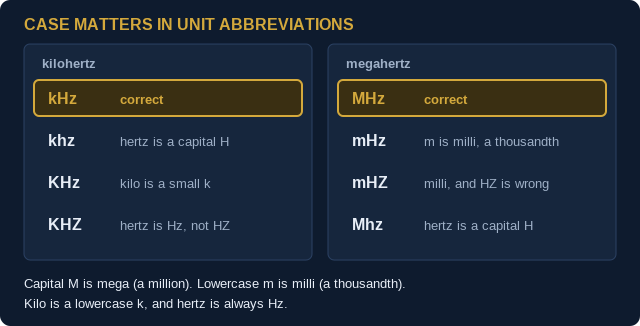
Correct and incorrect abbreviations for kilohertz and megahertz, with the reason each wrong one fails.
Describe this graphic in words

Two panels list four versions each. For kilohertz, kHz is correct (highlighted in gold); khz fails because hertz has a capital H, KHz because kilo is a small k, and KHZ because hertz is Hz, not HZ. For megahertz, MHz is correct; mHz means milli, a thousandth; mHZ is milli with a wrong Z; and Mhz has hertz in the wrong case. Text says capital M is mega and lowercase m is milli.

Unit abbreviations are case sensitive. Kilo is a lowercase k, and hertz is written Hz with a capital H (the unit is named for Heinrich Hertz) and a lowercase z. So kilohertz is kHz.

Each of the other versions breaks the pattern in one letter: a lowercase h, a capital K, or a capital Z. Case matters because a wrong prefix letter can mean a very different size. This is a teaching note.

Why the other choices are wrong

  • B. khz uses a lowercase h; hertz is capitalized because it is named for a person.
  • C. KHz uses a capital K; the kilo prefix is a lowercase k.
  • D. KHZ puts the z in capitals; the unit is Hz, with a lowercase z.

Rule text checked against the official source on November 5, 2026. This is a study aid; the linked rule is what governs.

T5C07

What is the abbreviation for megahertz?

Show the answer and why

Answer D. MHz

The abbreviation for megahertz is MHz.

Correct and incorrect abbreviations for kilohertz and megahertz, with the reason each wrong one fails.
Describe this graphic in words

Two panels list four versions each. For kilohertz, kHz is correct (highlighted in gold); khz fails because hertz has a capital H, KHz because kilo is a small k, and KHZ because hertz is Hz, not HZ. For megahertz, MHz is correct; mHz means milli, a thousandth; mHZ is milli with a wrong Z; and Mhz has hertz in the wrong case. Text says capital M is mega and lowercase m is milli.

A capital M means mega (a million) and a lowercase m means milli (a thousandth), so case matters. Hertz is Hz, so megahertz is MHz.

Written as mHz, the same number would be a thousandth of a hertz, a tiny fraction rather than millions of cycles per second. Always check that the prefix capitalization is right. This is a teaching note.

Why the other choices are wrong

  • A. mHz would be millihertz, a thousandth of a hertz.
  • B. mHZ is millihertz with the unit also wrongly capitalized.
  • C. Mhz has the right prefix but writes the hertz unit wrongly; it should be Hz.

Rule text checked against the official source on November 5, 2026. This is a study aid; the linked rule is what governs.

T5C08

What formula is used to calculate electrical power (P) in a DC circuit?

Show the answer and why

Answer A. P = I x E

DC power is current times voltage: P = I x E.

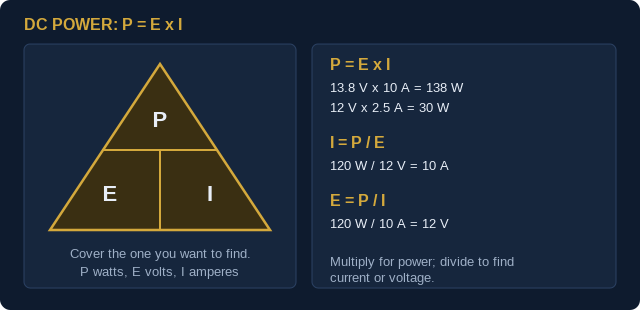
Power triangle with P on top and E and I below, with formulas and worked examples.
Describe this graphic in words

A triangle has P at the top and E and I side by side below; covering one letter shows the formula for it. A panel gives P = E x I with the examples 13.8 V x 10 A = 138 W and 12 V x 2.5 A = 30 W, I = P / E with 120 W / 12 V = 10 A, and E = P / I with 120 W / 10 A = 12 V. A note says to multiply for power and divide to find current or voltage.

In a DC circuit, electrical power in watts equals voltage in volts times current in amperes: P = E x I, which is the same as P = I x E. Because the two are multiplied, either a higher voltage or a higher current means more power.

Example: a device on 12 V that draws 2 A uses 12 x 2 = 24 W. Dividing the quantities gives other things, not watts. This is a teaching note.

Why the other choices are wrong

  • B. E / I is Ohm's law for resistance (ohms), not power.
  • C. I squared times E mixes two formulas; power is I x E, or I squared times R, or E squared divided by R.
  • D. I / E is conductance, the inverse of resistance, not power.

Rule text checked against the official source on November 5, 2026. This is a study aid; the linked rule is what governs.

T5C09

How much power is delivered by a voltage of 13.8 volts DC and a current of 10 amperes?

Show the answer and why

Answer A. 138 watts

13.8 V at 10 A delivers 138 watts.

Power triangle with P on top and E and I below, with formulas and worked examples.
Describe this graphic in words

A triangle has P at the top and E and I side by side below; covering one letter shows the formula for it. A panel gives P = E x I with the examples 13.8 V x 10 A = 138 W and 12 V x 2.5 A = 30 W, I = P / E with 120 W / 12 V = 10 A, and E = P / I with 120 W / 10 A = 12 V. A note says to multiply for power and divide to find current or voltage.

Use P = E x I. Multiply 13.8 V by 10 A to get 138 W. That is similar to the DC input power of a mobile radio while it transmits.

Check the units: volts times amperes gives watts. The wrong answers come from using the wrong operation on the same numbers. This is a teaching note.

Why the other choices are wrong

  • B. 0.7 W comes from dividing 10 by 13.8, the wrong operation.
  • C. 23.8 W comes from adding the numbers, which does not give power.
  • D. 3.8 W comes from subtracting the numbers, which does not give power.

Rule text checked against the official source on November 5, 2026. This is a study aid; the linked rule is what governs.

T5C10

How much power is delivered by a voltage of 12 volts DC and a current of 2.5 amperes?

Show the answer and why

Answer B. 30 watts

12 V at 2.5 A delivers 30 watts.

Power triangle with P on top and E and I below, with formulas and worked examples.
Describe this graphic in words

A triangle has P at the top and E and I side by side below; covering one letter shows the formula for it. A panel gives P = E x I with the examples 13.8 V x 10 A = 138 W and 12 V x 2.5 A = 30 W, I = P / E with 120 W / 12 V = 10 A, and E = P / I with 120 W / 10 A = 12 V. A note says to multiply for power and divide to find current or voltage.

Use P = E x I. Multiply 12 V by 2.5 A to get 30 W.

A quick check: 2 A at 12 V would be 24 W and 3 A would be 36 W, so 2.5 A must land between them, at 30 W. This is a teaching note.

Why the other choices are wrong

  • A. 4.8 W comes from dividing 12 by 2.5, the wrong operation.
  • C. 14.5 W comes from adding the numbers.
  • D. 0.208 W comes from dividing 2.5 by 12.

Rule text checked against the official source on November 5, 2026. This is a study aid; the linked rule is what governs.

T5C11

How much current is required to deliver 120 watts at a voltage of 12 volts DC?

Show the answer and why

Answer B. 10 amperes

120 W at 12 V requires 10 amperes.

Power triangle with P on top and E and I below, with formulas and worked examples.
Describe this graphic in words

A triangle has P at the top and E and I side by side below; covering one letter shows the formula for it. A panel gives P = E x I with the examples 13.8 V x 10 A = 138 W and 12 V x 2.5 A = 30 W, I = P / E with 120 W / 12 V = 10 A, and E = P / I with 120 W / 10 A = 12 V. A note says to multiply for power and divide to find current or voltage.

Rearrange P = E x I to I = P / E. Divide 120 W by 12 V to get 10 A. Check: 12 V x 10 A = 120 W.

This is the same calculation you do when choosing a power supply, fuse or wire size for a radio: divide the power by the voltage. This is a teaching note.

Why the other choices are wrong

  • A. 0.1 A comes from dividing 12 by 120, which is the division upside down.
  • C. 12 A just repeats the voltage number.
  • D. 132 A comes from adding the numbers.

Rule text checked against the official source on November 5, 2026. This is a study aid; the linked rule is what governs.

T5C12

What is impedance?

Show the answer and why

Answer A. The opposition to AC current flow

Impedance is the opposition to AC current flow.

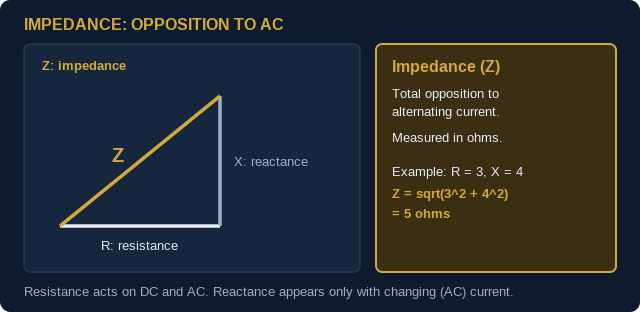
Impedance shown as the long side of a right triangle made from resistance and reactance.
Describe this graphic in words

A right triangle has a horizontal side for resistance (R), a vertical side for reactance (X) and the long gold side for impedance (Z). A gold panel says impedance is the total opposition to alternating current, measured in ohms, with an example: R = 3 and X = 4 gives Z equals the square root of (3 squared plus 4 squared), which is 5 ohms. A note says resistance acts on DC and AC while reactance appears only with changing current.

Impedance is the total opposition a circuit offers to alternating current. It combines resistance, which opposes both DC and AC, with reactance, which appears only with changing current (from capacitors and inductors). Like resistance, impedance is measured in ohms.

Picture resistance and reactance as two sides of a right triangle, with impedance as the long side: with 3 ohms of resistance and 4 ohms of reactance, the impedance is the square root of (3 squared plus 4 squared), or 5 ohms. This is a teaching note.

Why the other choices are wrong

  • B. The inverse of resistance is conductance, not impedance.
  • C. The inverse of reactance is susceptance, not impedance.
  • D. Power handling is a rating in watts for how much power a component can safely take, not impedance.

Rule text checked against the official source on November 5, 2026. This is a study aid; the linked rule is what governs.