Which of the following is good practice when installing ground wires on a tower for lightning protection?
Show the answer and why
Answer C. Ensure that connections are short and direct
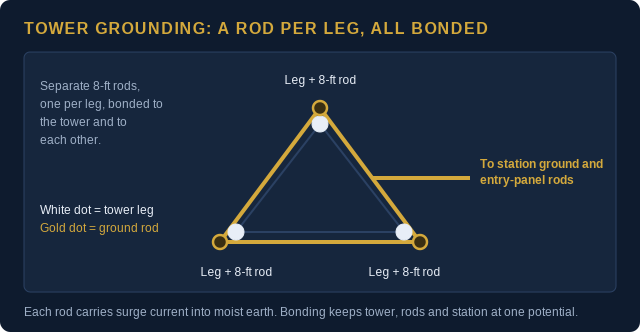
Keep lightning ground connections short and direct.
Describe this graphic in words
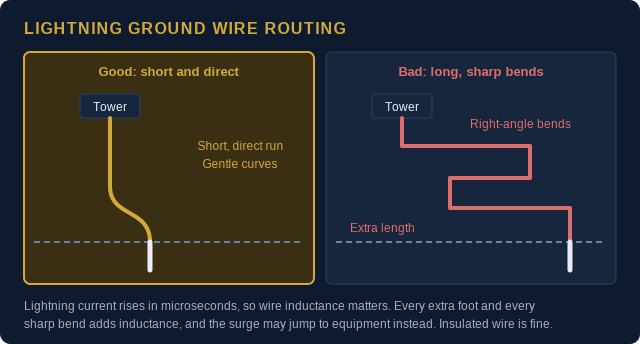
Two panels show a tower leg connected to a ground rod. The left panel, in gold and labeled good: short and direct, shows a short wire running nearly straight down with a gentle curve to the rod. The right panel, in red and labeled bad: long, sharp bends, shows a long wire with several right-angle bends and extra length. A note explains that lightning current rises in microseconds, so every extra foot and sharp bend adds inductance.
A lightning surge changes current extremely fast, so the inductance of the ground wire matters as much as its resistance. A short, straight path to ground has the lowest inductance and the lowest impedance. Long runs, loops and sharp bends add inductance, and the surge then looks for easier paths, such as through your equipment.
Illustrative numbers: a straight wire has roughly 1 microhenry per meter. If the current rises 10,000 A in one microsecond, one meter of wire develops V = L x di/dt = 1 uH x 10 kA/us = 10 kV. A drip loop lengthens the path and a right-angle bend raises inductance, so both work against good grounding. This is a teaching note.
Why the other choices are wrong
- A. A drip loop adds wire length and inductance. It keeps water off connections but does not help lightning grounding.
- B. Right-angle bends raise inductance and encourage arcing. Gentle curves are better.
- D. Only one statement is correct, so "all of these" fails.
Rule text checked against the official source on November 5, 2026. This is a study aid; the linked rule is what governs.