
ARSC Tech School

Technician T2C: Public service

409 questions · pool July 1, 2026 to June 30, 2030 · the exam has 35 questions; 26 to pass

T2 · OPERATING PROCEDURES

Public service: emergency operations, applicability of FCC rules, RACES and ARES, net and traffic procedures, operating restrictions during emergencies, use of phonetics in message handling

12 questions in group T2C

One question from this group appears on each exam.

T2C01FCC rule 97.103(a)

When do the FCC Part 97 Amateur Radio Service rules NOT apply to the operation of an amateur station?

Show the answer and why

Answer D. FCC rules always apply

FCC rule 97.103(a)

FCC Part 97 rules always apply to an amateur station, including during RACES, ARES or FEMA activities.

Section 97.103(a) says "The station licensee is responsible for the proper operation of the station in accordance with the FCC Rules." Taking part in RACES, ARES or an agency plan does not suspend that. RACES itself is a service defined inside Part 97 (§ 97.407), so its operation is governed by those same rules.

There are narrow provisions for real emergencies. Section 97.403 says no rule prevents using "any means of radiocommunication" for essential communication needs involving the immediate safety of life and property when normal systems are not available. That is an exception built into the rules for a genuine emergency, not an exemption you gain by joining an organization.

Why the other choices are wrong

  • A. RACES operation is governed by Part 97 (§ 97.407). It is a service within the rules, not an exception to them.
  • B. FEMA rules do not replace Part 97 for an amateur station. Working with FEMA does not remove your licensee responsibility.
  • C. ARES is a volunteer group. It has no power to exempt a station from Part 97.

References

Rule text checked against the official source on November 5, 2026. This is a study aid; the linked rule is what governs.
T2C02

Which of the following are typical duties of a Net Control Station?

Show the answer and why

Answer C. Call the net to order and direct communications between stations checking in

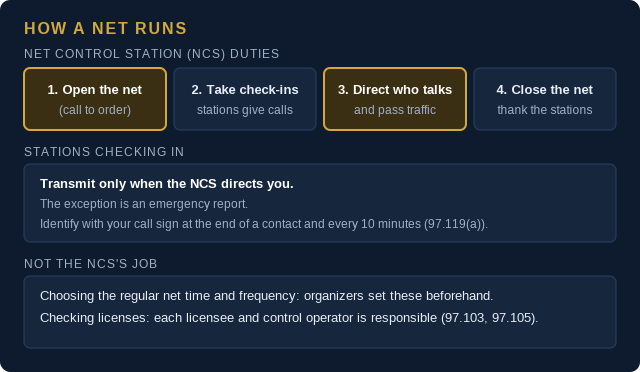
A Net Control Station typically calls the net to order and directs communications between the stations checking in.

The steps of a net run by a net control station, and what check-in stations and the NCS do and do not do.
Describe this graphic in words

Four boxes in a row show the net control station opening the net, taking check-ins, directing who talks and passing traffic, and closing the net, with opening and directing highlighted in gold. A panel says stations checking in transmit only when the NCS directs, except for an emergency report, and identify at the end of a contact and every 10 minutes. A last panel lists what is not the NCS's job: choosing the net time and frequency, which organizers set beforehand, and checking licenses, which is each licensee's and control operator's responsibility.

The net control station (NCS) runs the net while it is on the air: it opens the net, takes check-ins, decides who speaks and when, and closes it. Calling the net to order and directing communications between stations are the typical duties.

The meeting time and frequency are normally chosen by the organizers beforehand, not by the NCS during the net. Checking licenses is not an NCS duty either. Under § 97.105(a) the control operator of each station "must ensure the immediate proper operation of the station," and § 97.103(a) puts responsibility on each station licensee. This is a teaching note on net practice.

Why the other choices are wrong

  • A. Net time and frequency are normally set in advance by the net organizers, not chosen by the NCS as a running duty.
  • B. Each station's licensee and control operator is responsible for having authority to operate (§ 97.103(a), § 97.105). The NCS does not verify licenses.
  • D. Only the call-to-order and directing duty is typical, so "all of these" is wrong.

References

Rule text checked against the official source on November 5, 2026. This is a study aid; the linked rule is what governs.
T2C03

What technique is used to ensure that voice messages containing unusual words are received correctly?

Show the answer and why

Answer C. Spell the words using a standard phonetic alphabet

Spell unusual words with a standard phonetic alphabet.

On voice, letters like B, D, P and T sound alike, especially over a weak or noisy signal. Spelling a word with a phonetic alphabet (Alpha, Bravo, Charlie, and so on) makes each letter unmistakable. For example, DALE becomes Delta Alpha Lima Echo.

Part 97 itself encourages this for call signs: § 97.119(b)(2) says that for phone, "Use of a phonetic alphabet as an aid for correct station identification is encouraged." The same habit works for any unusual word in a message.

Why the other choices are wrong

  • A. Sending the words by voice and Morse code at the same time is not a standard technique and is not practical on one transmitter.
  • B. "QSR" is not the code for asking someone to repeat words back, so it would not do what the choice claims.
  • D. "All of these" fails because the other two choices are not valid techniques.

References

Rule text checked against the official source on November 5, 2026. This is a study aid; the linked rule is what governs.
T2C04

What is RACES?

Show the answer and why

Answer D. An FCC Part 97 amateur radio service for civil defense communications during national emergencies

RACES is an FCC Part 97 amateur radio service for civil defense communications during national emergencies.

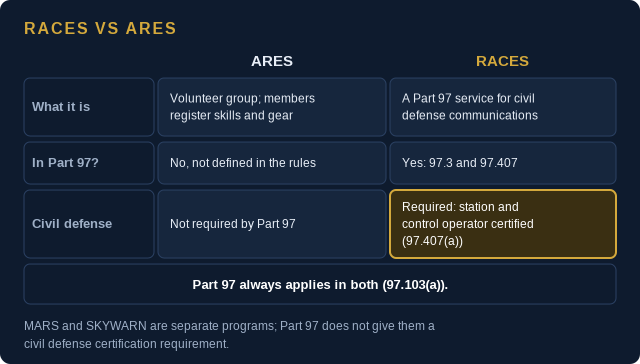
A comparison table of ARES and RACES.
Describe this graphic in words

A table with ARES and RACES columns. ARES is a volunteer group whose members register skills and gear, is not defined in Part 97, and has no civil defense certification requirement. RACES is a Part 97 service for civil defense communications (97.3 and 97.407) and, highlighted in gold, requires the station and control operator to be certified by a civil defense organization (97.407(a)). A bar says Part 97 always applies in both, and a note says MARS and SKYWARN are separate programs without a civil defense certification requirement under Part 97.

Section 97.3 defines RACES as "a radio service using amateur stations for civil defense communications during periods of local, regional or national civil emergencies." Its operating rules are in § 97.407.

To transmit in RACES, a station must be certified by a civil defense organization as registered with that organization, and the control operator must be certified as enrolled in it (§ 97.407(a)). That link to civil defense is what sets RACES apart from a volunteer group such as ARES.

Why the other choices are wrong

  • A. RACES uses amateur stations and frequencies only. It does not combine amateur and citizens band.
  • B. RACES is a communications service, not an international radio experimentation society.
  • C. A radio contest held in a short period is a "sprint". That is not RACES.

References

Rule text checked against the official source on November 5, 2026. This is a study aid; the linked rule is what governs.
T2C05

What does the term “traffic” refer to in net operation?

Show the answer and why

Answer A. Formal messages exchanged by net stations

In net operation, "traffic" means formal messages exchanged by net stations.

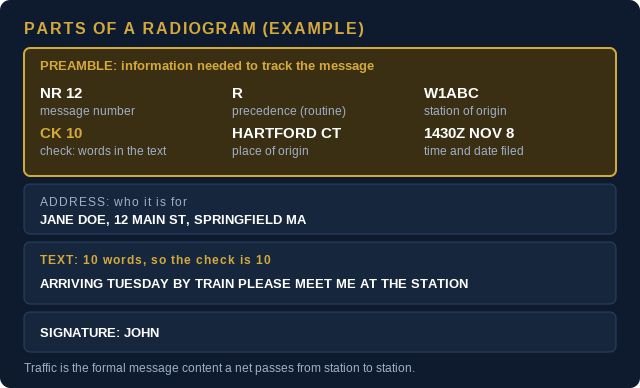
Traffic is the message content a net handles, such as a formal written message (a radiogram) passed from one station to another. The net control station directs who sends and who receives it, so that each message is passed accurately.

It does not mean the count of check-ins, mobile operation, or how often the net runs. This is a teaching note.

Why the other choices are wrong

  • B. The number of stations checking in and out is a net count, not traffic.
  • C. Mobile or portable operation describes how a station is set up, not what traffic means.
  • D. A count of net activations is a record of how often a net ran, not traffic.

Rule text checked against the official source on November 5, 2026. This is a study aid; the linked rule is what governs.

T2C06

What is the Amateur Radio Emergency Service (ARES)?

Show the answer and why

Answer A. A group of licensed amateurs who have voluntarily registered their qualifications and equipment for communications duty in the public service

ARES is a group of licensed amateurs who voluntarily registered their qualifications and equipment for public-service communications duty.

ARES is a volunteer organization, run through the ARRL, whose members register their skills and equipment so they can be called on to support served agencies in emergencies. It is not part of the military, and it is not a licensing course.

Do not confuse it with RACES. RACES is a service defined in Part 97 and requires certification by a civil defense organization (§ 97.407(a)). ARES is not defined in the rules at all. This is a teaching note about ARES.

Why the other choices are wrong

  • B. ARES members are civilian volunteers, not a military group. The military has its own separate programs.
  • C. ARES is not a licensing course. It is for already licensed amateurs.
  • D. ARES does not certify operators for RACES. A civil defense organization does that.

References

Rule text checked against the official source on November 5, 2026. This is a study aid; the linked rule is what governs.

T2C07

Which of the following is standard practice when you participate in a net?

Show the answer and why

Answer C. Unless you are reporting an emergency, transmit only when directed by the net control station

Unless you are reporting an emergency, transmit only when the net control station directs you.

A net works because one station controls the order. If everyone talks at once, nothing is understood, so you transmit when the net control station calls on you. An emergency report is the exception and may be made right away.

You do not need to give your name and address as in the FCC database: the rules require only your call sign at the end of a communication and at least every 10 minutes (§ 97.119(a)). Logging the time of each of your own transmissions is also not a standard requirement. This is a teaching note on net practice.

Why the other choices are wrong

  • A. Part 97 requires only your call sign when identifying, not your name and address as listed in the FCC database.
  • B. Recording the time of each of your transmissions is not standard net practice for a participating station.
  • D. Only one of these is standard practice, so "all of these" is wrong.

References

Rule text checked against the official source on November 5, 2026. This is a study aid; the linked rule is what governs.

T2C08

Which of the following relays messages using email addresses based on amateur callsigns?

Show the answer and why

Answer A. Winlink

Winlink relays messages using email addresses based on amateur call signs.

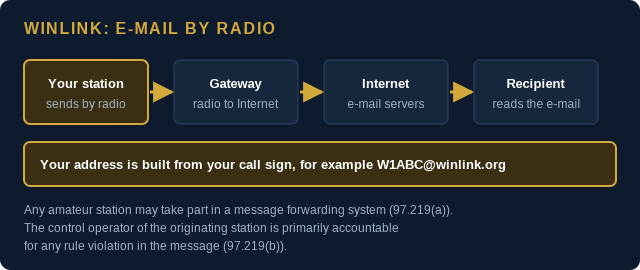
A message path from your station by radio to a gateway, over the Internet, to the recipient.
Describe this graphic in words

Four boxes joined by gold arrows show your station sending by radio, a gateway converting radio to Internet, Internet e-mail servers, and the recipient reading the e-mail. A gold panel says your address is built from your call sign, for example W1ABC@winlink.org. Notes cite 97.219: any amateur station may take part in a message forwarding system, and the control operator of the originating station is primarily accountable for any rule violation in the message.

Winlink is a radio email network. Each user's address is built from their call sign (for example W1ABC@winlink.org), and messages are carried by radio into and out of the system, often through gateway stations connected to the Internet.

Under the rules this is a message forwarding system. Section 97.219 lets any amateur station take part and makes the control operator of the originating station "primarily accountable" for any rule violation in the message.

Why the other choices are wrong

  • B. FT8 is a weak-signal digital mode for short contact exchanges. It is not an email system.
  • C. PSK31 is a keyboard-to-keyboard digital mode, not an email system.
  • D. AMTOR is an older error-correcting teleprinter mode, not an email system based on call signs.

References

Rule text checked against the official source on November 5, 2026. This is a study aid; the linked rule is what governs.

T2C09

Are amateur station control operators ever permitted to operate outside the frequency privileges of their license class?

Show the answer and why

Answer D. Yes, but only in situations involving the immediate safety of human life or protection of property

Yes, but only in situations involving the immediate safety of human life or protection of property.

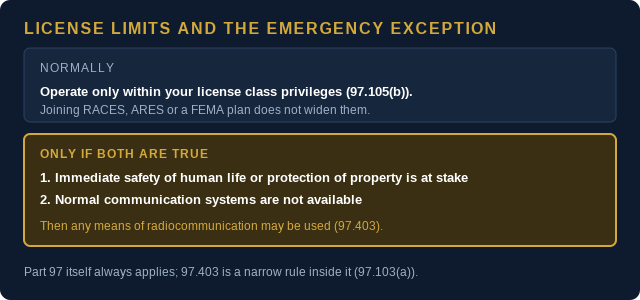
Normal license limits compared with the narrow emergency exception in 97.403.
Describe this graphic in words

A top panel says that normally you operate only within your license class privileges (97.105(b)), and that joining RACES, ARES or a FEMA plan does not widen them. A gold panel says that only if both conditions are true, immediate safety of human life or protection of property is at stake and normal communication systems are not available, may any means of radiocommunication be used (97.403). A note says Part 97 always applies and 97.403 is a narrow rule inside it.

Normally a station may be operated only to the extent of the control operator's license privileges (§ 97.105(b)). Section 97.403 is the exception: "No provision of these rules prevents the use by an amateur station of any means of radiocommunication at its disposal to provide essential communication needs in connection with the immediate safety of human life and immediate protection of property when normal communication systems are not available."

Both parts of the condition matter: the need must involve immediate safety of life or property, and normal communication systems must be unavailable. Being part of RACES or a FEMA plan does not by itself widen your privileges.

Why the other choices are wrong

  • A. The rules do allow it in the narrow circumstances of § 97.403, so "No" is wrong.
  • B. A FEMA plan does not give you extra privileges by itself. The exception depends on the emergency, not on the plan.
  • C. A RACES plan does not give you extra privileges by itself either. The exception turns on immediate safety of life or property.

References

Rule text checked against the official source on November 5, 2026. This is a study aid; the linked rule is what governs.

T2C10

What information is contained in the preamble of a formal traffic message?

Show the answer and why

Answer D. Information needed to track the message

The preamble of a formal message holds the information needed to track the message.

The parts of a sample radiogram: preamble, address, text and signature.
Describe this graphic in words

A sample message is split into parts. The gold preamble holds the information needed to track the message: message number NR 12, precedence R for routine, station of origin W1ABC, check CK 10, place of origin Hartford CT, and time and date filed 1430Z Nov 8. Below it are the address (Jane Doe, 12 Main St, Springfield MA), the 10-word text "Arriving Tuesday by train please meet me at the station", and the signature John; the check of 10 matches the number of words in the text.

In a formal radiogram the preamble is the first part of the message. It carries items such as the message number, precedence, station of origin, check, place of origin, and the time and date filed, so the message can be followed and identified as it is relayed from station to station.

The address of the recipient is a separate part that follows the preamble, then come the text and the signature. This is a teaching note about message form.

Why the other choices are wrong

  • A. The originator's email address is not part of the standard preamble.
  • B. The recipient's address follows the preamble as its own part of the message.
  • C. The addressee's telephone number belongs with the address, not the preamble.

Rule text checked against the official source on November 5, 2026. This is a study aid; the linked rule is what governs.

T2C11

What is meant by “check” in a radiogram header?

Show the answer and why

Answer A. The number of words or word equivalents in the text portion of the message

"Check" in a radiogram header is the number of words or word equivalents in the message text.

The parts of a sample radiogram: preamble, address, text and signature.
Describe this graphic in words

A sample message is split into parts. The gold preamble holds the information needed to track the message: message number NR 12, precedence R for routine, station of origin W1ABC, check CK 10, place of origin Hartford CT, and time and date filed 1430Z Nov 8. Below it are the address (Jane Doe, 12 Main St, Springfield MA), the 10-word text "Arriving Tuesday by train please meet me at the station", and the signature John; the check of 10 matches the number of words in the text.

The check lets the receiving station confirm it copied the whole text: if the number of words it counts matches the check, nothing was lost on the way. If the numbers differ, the receiving station knows to ask for a repeat.

For example, a text of ten words has a check of 10. In the example shown, "Arriving Tuesday by train please meet me at the station" is 10 words, so the preamble has CK 10. This is a teaching note.

Why the other choices are wrong

  • B. The originating station's call sign is a separate item in the preamble (the station of origin).
  • C. Stations that relayed a message are noted separately, not in the check.
  • D. The check is not a box on the form. It is a count of the words in the text.

Rule text checked against the official source on November 5, 2026. This is a study aid; the linked rule is what governs.

T2C12

Which of the following requires certification by a civil defense agency?

Show the answer and why

Answer B. RACES

RACES requires certification by a civil defense agency.

A comparison table of ARES and RACES.
Describe this graphic in words

A table with ARES and RACES columns. ARES is a volunteer group whose members register skills and gear, is not defined in Part 97, and has no civil defense certification requirement. RACES is a Part 97 service for civil defense communications (97.3 and 97.407) and, highlighted in gold, requires the station and control operator to be certified by a civil defense organization (97.407(a)). A bar says Part 97 always applies in both, and a note says MARS and SKYWARN are separate programs without a civil defense certification requirement under Part 97.

Section 97.407(a) says "No station may transmit in RACES unless it is an FCC-licensed primary, club, or military recreation station and it is certified by a civil defense organization as registered with that organization." The control operator must also be certified as enrolled in the organization.

ARES, MARS and SKYWARN are separate organizations, and Part 97 does not require civil defense certification for them. RACES is the one that ties an amateur station to civil defense planning, which is why this certification exists.

Why the other choices are wrong

  • A. ARES is a volunteer group and is not defined in Part 97, so it carries no civil defense certification requirement.
  • C. MARS is a separate program, not a Part 97 service that requires civil defense certification.
  • D. SKYWARN is a weather spotter program. It has no civil defense certification requirement under the rules.

References

Rule text checked against the official source on November 5, 2026. This is a study aid; the linked rule is what governs.