Which of the following is a form of amplitude modulation?
Show the answer and why
Answer C. Single sideband
Single sideband is a form of amplitude modulation with the carrier and one sideband removed.
Describe this graphic in words
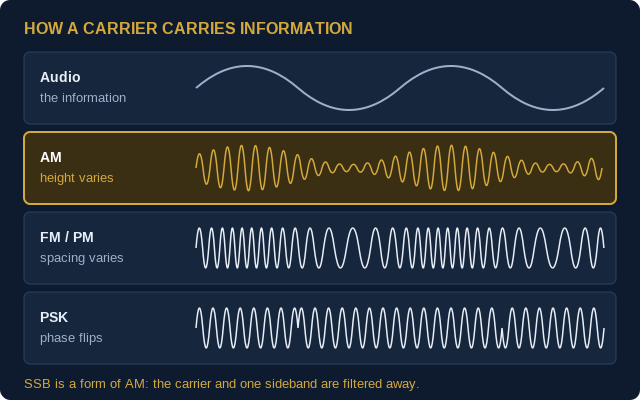
Four stacked rows show waveforms. The top row is a slow audio wave. The AM row, highlighted in gold, has a fast carrier whose height rises and falls with the audio. The FM row has constant height but the spacing of the cycles tightens and stretches. The PSK row has constant height and spacing but the wave flips upside down at the bit boundaries. A caption says SSB is a form of AM with the carrier and one sideband filtered away.
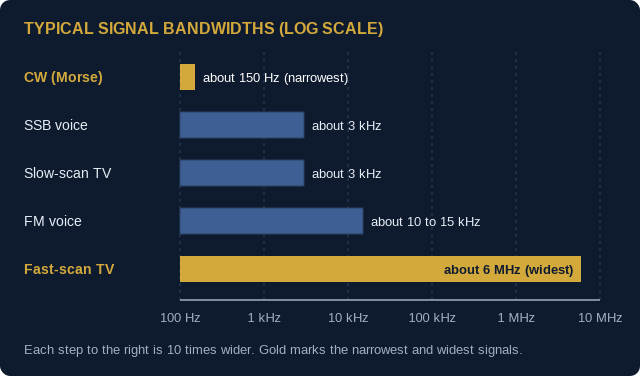
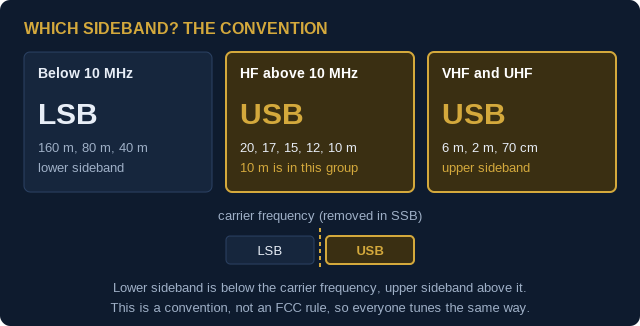
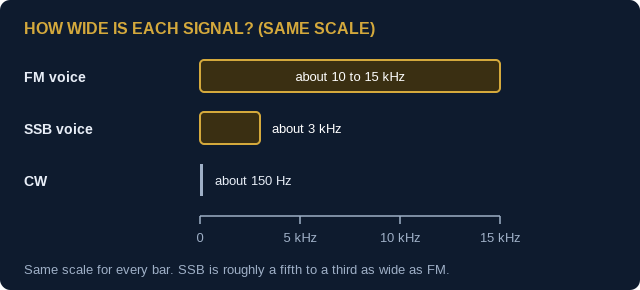
Single sideband (SSB) is a form of amplitude modulation (AM). In ordinary AM the voice changes the strength of the carrier, which creates a mirror-image sideband on each side of it. SSB filters out the carrier and one of those two sidebands, so the transmitter sends only the part that actually carries the voice.
That saves power and bandwidth, but it is still amplitude modulation at heart. Phase shift keying changes the phase of the carrier instead, and packet radio is a data protocol rather than a way of modulating a carrier. This is a teaching note.
Why the other choices are wrong
- A. Spread spectrum spreads a signal over a wide band using a code. It is not a form of AM.
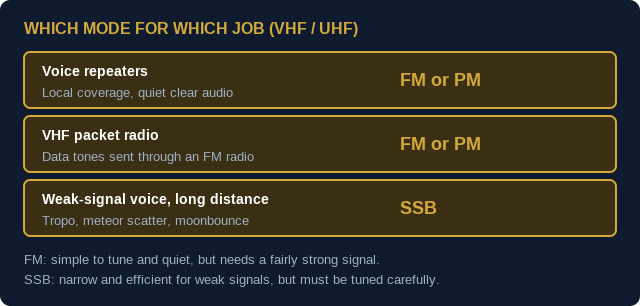
- B. Packet radio is a protocol for sending data in addressed packets. The packets are then sent with some modulation, usually FM tones on VHF.
- D. PSK changes the phase of the carrier, so it is phase modulation, not amplitude modulation.
Rule text checked against the official source on November 5, 2026. This is a study aid; the linked rule is what governs.