Why are simplex UHF signals rarely heard beyond their radio horizon?
Show the answer and why
Answer C. UHF signals are usually not propagated by the ionosphere
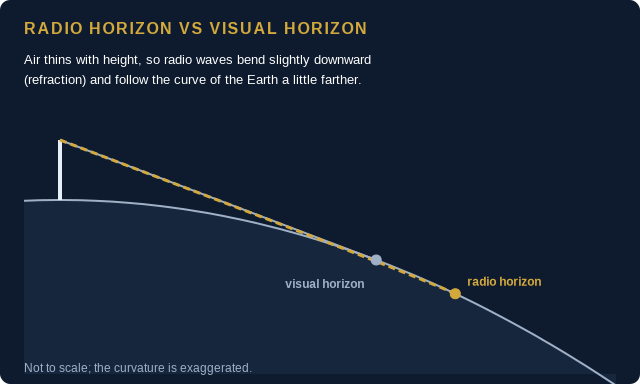
UHF signals are usually not propagated by the ionosphere, so they rarely go beyond the radio horizon.
Describe this graphic in words
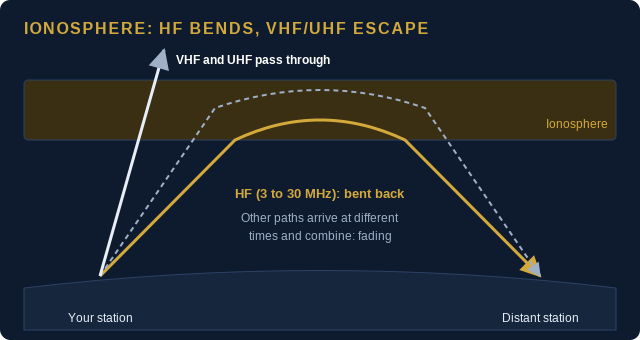
A band across the top is the ionosphere. A gold HF path leaves your station, bends back in the ionosphere and returns to a distant station, while a white VHF and UHF path goes straight up through it and out. A second, dashed grey HF path takes a different route to the same station, and a label says that paths arriving at different times combine to cause fading.
NOAA explains that it is HF (about 1 to 30 MHz) whose path is shaped by the ionosphere's density and structure. At UHF the ionosphere does not bend the wave back to Earth, so simplex UHF signals travel mostly line of sight and fade out near the radio horizon.
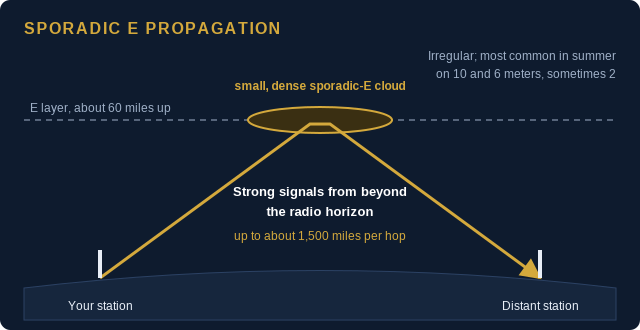
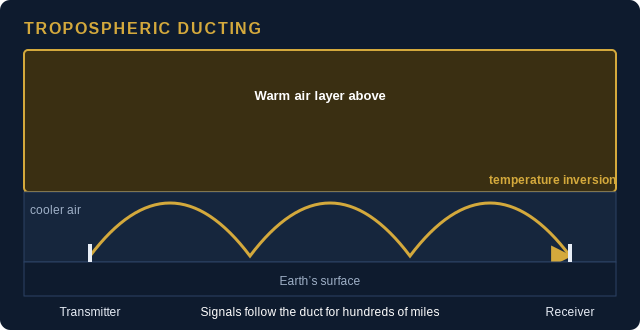
No FCC rule limits the distance; the limit is physical. Unusual conditions such as tropospheric ducting can occasionally carry UHF farther, but not by ionospheric reflection.
Why the other choices are wrong
- A. A UHF signal can be strong; the limit is the path, not its power.
- B. No FCC regulation sets a 50-mile limit.
- D. The D region absorbs lower HF frequencies, not UHF.
References
- AgencyNOAA Space Weather Prediction Center, HF Radio Communications — Ionospheric structure shapes HF paths. That UHF is not bent back is a teaching note.
Rule text checked against the official source on November 5, 2026. This is a study aid; the linked rule is what governs.