
ARSC Tech School

Technician T3B: Electromagnetic wave properties

409 questions · pool July 1, 2026 to June 30, 2030 · the exam has 35 questions; 26 to pass

T3 · RADIO WAVE PROPAGATION

Electromagnetic wave properties: wavelength vs frequency, nature and velocity of electromagnetic waves, relationship of wavelength and frequency; Electromagnetic Spectrum Definitions: UHF, VHF, HF

12 questions in group T3B

One question from this group appears on each exam.

T3B01

What is the relationship between the electric and magnetic fields of an electromagnetic wave?

Show the answer and why

Answer D. They are at right angles

The electric and magnetic fields of a radio wave are at right angles to each other.
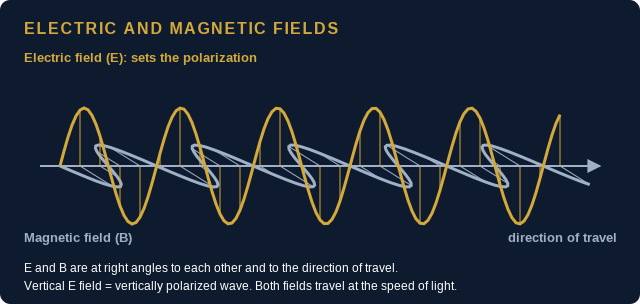
A radio wave drawn as an electric field and a magnetic field at right angles to each other.
Describe this graphic in words

A wave travels left to right. The electric field (E), drawn in gold, swings up and down and sets the polarization. The magnetic field (B), drawn in grey, swings in a plane at right angles to the electric field, and both are at right angles to the direction of travel. Notes say a vertical electric field means a vertically polarized wave, and that both fields travel at the speed of light.

NASA explains that a changing magnetic field induces a changing electric field and vice versa; the two are linked, and together they form an electromagnetic wave. In a radio wave the two fields are perpendicular to each other, and both are perpendicular to the direction the wave travels.

Both fields travel together at the same speed, so they are never separate, and they cannot be parallel to each other.

Why the other choices are wrong

  • A. Both fields travel together at the speed of light, not at different speeds.
  • B. The fields are perpendicular, not parallel.
  • C. The fields do not revolve in opposite directions; they oscillate together at right angles.

References

Rule text checked against the official source on November 5, 2026. This is a study aid; the linked rule is what governs.
T3B02

What property of a radio wave defines its polarization?

Show the answer and why

Answer A. The orientation of the electric field

Polarization is defined by the orientation of the wave's electric field.

NASA defines polarization as a measure of the electromagnetic field's alignment, and its illustration shows the electric field vertical for a vertically polarized wave. By convention, a wave is called vertically polarized when its electric field is vertical, and horizontally polarized when it is horizontal.

A vertical antenna produces a vertically polarized wave, and a horizontal antenna a horizontally polarized one. The magnetic field is always at right angles to the electric field, so it is the electric field that is used to name the polarization.

Why the other choices are wrong

  • B. By convention it is the electric field's orientation, not the magnetic field's, that names the polarization.
  • C. The ratio of the energy in the two fields does not define polarization.
  • D. Velocity divided by wavelength is frequency, not polarization.

References

Rule text checked against the official source on November 5, 2026. This is a study aid; the linked rule is what governs.
T3B03

What are the two components of a radio wave?

Show the answer and why

Answer C. Electric and magnetic fields

A radio wave has two components: electric and magnetic fields.

NASA says changing electric and magnetic fields are linked and together form electromagnetic waves. Radio waves are electromagnetic waves, so they are made of both fields, drawn at right angles to each other.

Voltage and current, impedance and reactance describe circuits and wires. Ionizing versus non-ionizing describes how much energy the radiation carries. None of these are the components of the wave itself.

Why the other choices are wrong

  • A. Impedance and reactance are circuit quantities, not parts of a wave in space.
  • B. Voltage and current are circuit quantities, not parts of a wave in space.
  • D. Ionizing and non-ionizing is a classification of radiation by energy, not its components.

References

Rule text checked against the official source on November 5, 2026. This is a study aid; the linked rule is what governs.

T3B04

What is the velocity of a radio wave traveling through free space?

Show the answer and why

Answer A. Speed of light

A radio wave travels through free space at the speed of light.

Radio waves are a form of light, and NASA's account of Heinrich Hertz's experiment notes that the velocity of radio waves was found to equal the velocity of light. NIST lists the speed of light in vacuum as exactly 299,792,458 meters per second.

Sound is far slower, about 343 meters per second in air, and no radio wave in free space travels at 0.86 times the speed of light.

Why the other choices are wrong

  • B. The speed of sound is a tiny fraction of the speed of light.
  • C. In free space radio waves travel at the full speed of light, not 0.86 of it.
  • D. The speed of sound is not a factor for radio waves at all.

References

Rule text checked against the official source on November 5, 2026. This is a study aid; the linked rule is what governs.

T3B05

What is the relationship between wavelength and frequency?

Show the answer and why

Answer B. Wavelength gets shorter as frequency increases

Wavelength gets shorter as frequency increases.

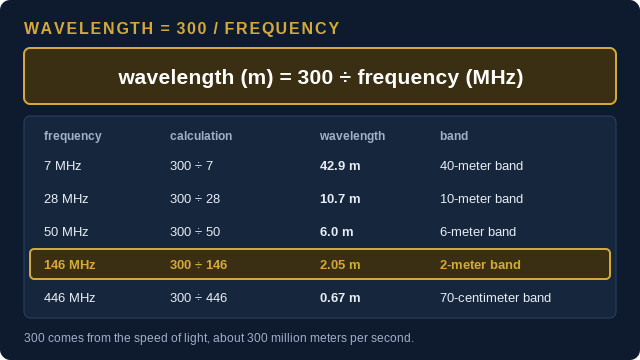
The formula wavelength in meters equals 300 divided by frequency in megahertz, with five worked examples.
Describe this graphic in words

A gold card gives the formula wavelength (m) = 300 / frequency (MHz). A table works five examples: 7 MHz gives 42.9 m (40-meter band), 28 MHz gives 10.7 m (10-meter band), 50 MHz gives 6.0 m (6-meter band), 146 MHz gives 2.05 m (2-meter band, highlighted), and 446 MHz gives 0.67 m (70-centimeter band). A note says the 300 comes from the speed of light, about 300 million meters per second.

NASA states that frequency, wavelength and energy are related mathematically: know one and you can calculate the others. For radio waves, wavelength equals the speed of light divided by frequency, so a higher frequency means a shorter wavelength.

Worked example: 7 MHz has a wavelength of about 300 / 7 = 43 meters, 146 MHz about 300 / 146 = 2 meters, and 446 MHz about 300 / 446 = 0.67 meters. Frequency rises across the list and wavelength falls.

Why the other choices are wrong

  • A. This reverses the relationship. Wavelength gets shorter, not longer, as frequency increases.
  • C. Wavelength changes with frequency; it is not constant.
  • D. Path length has no bearing on the relationship between wavelength and frequency.

References

Rule text checked against the official source on November 5, 2026. This is a study aid; the linked rule is what governs.

T3B06

What is the formula for converting frequency to approximate wavelength in meters?

Show the answer and why

Answer D. Wavelength in meters equals 300 divided by frequency in megahertz

Wavelength in meters equals 300 divided by frequency in megahertz.

The formula wavelength in meters equals 300 divided by frequency in megahertz, with five worked examples.
Describe this graphic in words

A gold card gives the formula wavelength (m) = 300 / frequency (MHz). A table works five examples: 7 MHz gives 42.9 m (40-meter band), 28 MHz gives 10.7 m (10-meter band), 50 MHz gives 6.0 m (6-meter band), 146 MHz gives 2.05 m (2-meter band, highlighted), and 446 MHz gives 0.67 m (70-centimeter band). A note says the 300 comes from the speed of light, about 300 million meters per second.

Wavelength is the speed of light divided by frequency. With the speed of light about 300,000,000 m/s (NIST: 299,792,458 m/s) and frequency measured in megahertz, the millions cancel and this reduces to wavelength in meters = 300 / f(MHz).

Worked example: 146 MHz gives 300 / 146 = about 2.05 meters, which is why it is called the 2-meter band. Check: 50 MHz gives 300 / 50 = 6 meters, the 6-meter band.

Why the other choices are wrong

  • A. Multiplying frequency by 300 gives a number that grows with frequency, but wavelength shrinks as frequency rises.
  • B. Dividing frequency in hertz by 300 gives a wrong size and the wrong direction; the answer would grow with frequency.
  • C. Dividing megahertz by 300 also grows with frequency. The 300 has to be the numerator, so the answer falls as frequency rises.

References

Rule text checked against the official source on November 5, 2026. This is a study aid; the linked rule is what governs.

T3B07

In addition to frequency, which of the following is used to identify amateur radio bands?

Show the answer and why

Answer A. The approximate wavelength in meters

Amateur bands are identified by frequency and by their approximate wavelength in meters.

The FCC's list of authorized bands in § 97.301 names each band by its wavelength, for example 10 m, 6 m, 2 m, 1.25 m, 70 cm and 23 cm, alongside the frequencies. The name comes from the formula wavelength = 300 / frequency in MHz, rounded: 146 MHz works out to about 2 meters.

Traditional letter and number designators and channel numbers are not how amateur bands are named, so "all of these" is wrong.

Why the other choices are wrong

  • B. Letter and number designators are not used to name amateur bands; the bands are named by wavelength.
  • C. Amateur bands are not identified by channel numbers; they are named by their frequency range and wavelength.
  • D. Only the wavelength choice is correct, so "all of these" is wrong.

References

Rule text checked against the official source on November 5, 2026. This is a study aid; the linked rule is what governs.

T3B08

What frequency range is referred to as VHF?

Show the answer and why

Answer B. 30 MHz to 300 MHz

VHF is 30 MHz to 300 MHz.

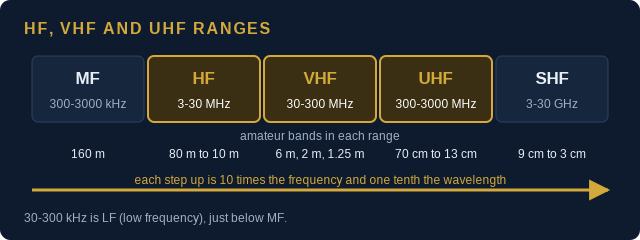
The frequency ranges MF, HF, VHF, UHF and SHF with the amateur bands in each.
Describe this graphic in words

Five boxes in a row show MF 300 to 3000 kHz, HF 3 to 30 MHz, VHF 30 to 300 MHz, UHF 300 to 3000 MHz and SHF 3 to 30 GHz, with HF, VHF and UHF highlighted in gold. Under them are example amateur bands: 160 m for MF, 80 m to 10 m for HF, 6 m, 2 m and 1.25 m for VHF, 70 cm to 13 cm for UHF, and 9 cm to 3 cm for SHF. A gold arrow says each step up is 10 times the frequency and one tenth the wavelength, and a note says 30 to 300 kHz is LF.

The FCC's table of frequency band nomenclature in 47 CFR § 2.101 lists VHF as 30 to 300 MHz (metric waves). The 6-meter, 2-meter and 1.25-meter amateur bands all fall in it.

The other choices are other bands: 30 to 300 kHz is low frequency (LF), 300 to 3000 kHz is medium frequency (MF), and 300 to 3000 MHz is UHF. Each range spans ten times the frequency of the one below it.

Why the other choices are wrong

  • A. 30 to 300 kHz is low frequency (LF), far below VHF.
  • C. 300 to 3000 kHz is medium frequency (MF), the AM broadcast region.
  • D. 300 to 3000 MHz is UHF, the next range up from VHF.

References

Rule text checked against the official source on November 5, 2026. This is a study aid; the linked rule is what governs.

T3B09

What frequency range is referred to as UHF?

Show the answer and why

Answer D. 300 to 3000 MHz

UHF is 300 MHz to 3000 MHz.

The frequency ranges MF, HF, VHF, UHF and SHF with the amateur bands in each.
Describe this graphic in words

Five boxes in a row show MF 300 to 3000 kHz, HF 3 to 30 MHz, VHF 30 to 300 MHz, UHF 300 to 3000 MHz and SHF 3 to 30 GHz, with HF, VHF and UHF highlighted in gold. Under them are example amateur bands: 160 m for MF, 80 m to 10 m for HF, 6 m, 2 m and 1.25 m for VHF, 70 cm to 13 cm for UHF, and 9 cm to 3 cm for SHF. A gold arrow says each step up is 10 times the frequency and one tenth the wavelength, and a note says 30 to 300 kHz is LF.

Section 2.101 lists UHF as 300 to 3,000 MHz (decimetric waves). The 70-centimeter and 23-centimeter amateur bands are in it.

Each step up is a factor of ten in frequency: HF is 3 to 30 MHz, VHF is 30 to 300 MHz, and UHF is 300 to 3,000 MHz. Remember the three together and the others are easy to rule out.

Why the other choices are wrong

  • A. 30 to 300 kHz is low frequency (LF).
  • B. 30 to 300 MHz is VHF, the range just below UHF.
  • C. 300 to 3000 kHz is medium frequency (MF).

References

Rule text checked against the official source on November 5, 2026. This is a study aid; the linked rule is what governs.

T3B10

What frequency range is referred to as HF?

Show the answer and why

Answer C. 3 to 30 MHz

HF is 3 MHz to 30 MHz.

The frequency ranges MF, HF, VHF, UHF and SHF with the amateur bands in each.
Describe this graphic in words

Five boxes in a row show MF 300 to 3000 kHz, HF 3 to 30 MHz, VHF 30 to 300 MHz, UHF 300 to 3000 MHz and SHF 3 to 30 GHz, with HF, VHF and UHF highlighted in gold. Under them are example amateur bands: 160 m for MF, 80 m to 10 m for HF, 6 m, 2 m and 1.25 m for VHF, 70 cm to 13 cm for UHF, and 9 cm to 3 cm for SHF. A gold arrow says each step up is 10 times the frequency and one tenth the wavelength, and a note says 30 to 300 kHz is LF.

Section 2.101 lists HF as 3 to 30 MHz (decametric waves), which includes the amateur bands from 80 meters through 10 meters.

NOAA also describes HF as the range of about 1 to 30 MHz when discussing space weather, but the formal band designation starts at 3 MHz. Of the choices, only 3 to 30 MHz matches.

Why the other choices are wrong

  • A. 300 to 3000 MHz is UHF.
  • B. 30 to 300 MHz is VHF.
  • D. 300 to 3000 kHz is medium frequency (MF).

References

Rule text checked against the official source on November 5, 2026. This is a study aid; the linked rule is what governs.

T3B11

What is the approximate velocity of a radio wave in free space?

Show the answer and why

Answer B. 300,000,000 meters per second

A radio wave travels at about 300,000,000 meters per second in free space.

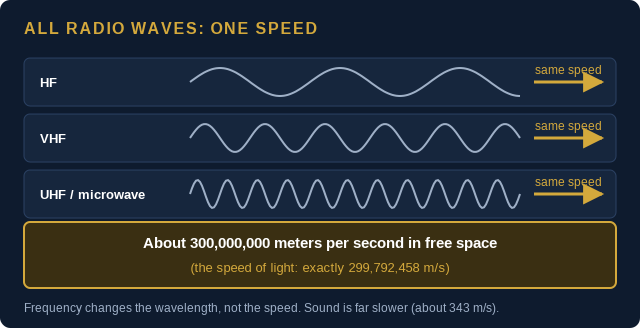
Waves of different wavelengths all travelling at the same speed.
Describe this graphic in words

Three rows show a long wave labelled HF, a shorter wave labelled VHF and the shortest wave labelled UHF or microwave, each followed by a gold arrow of the same length marked same speed. A gold panel gives the speed as about 300,000,000 meters per second in free space (exactly 299,792,458 m/s). A note says frequency changes the wavelength, not the speed, and that sound is far slower at about 343 m/s.

NIST gives the speed of light in vacuum as exactly 299,792,458 m/s, which rounds to 300,000,000 m/s. Radio waves travel at that speed (NASA), which is how the wavelength formula uses 300 for megahertz.

The 150,000,000 figures are half of the true value. The miles-per-hour figures do not match, because 300,000,000 is a value in meters per second, not miles per hour.

Why the other choices are wrong

  • A. 150,000,000 m/s is half the true speed.
  • C. 300,000,000 is meters per second. In miles per hour the speed would be a far larger number.
  • D. 150,000,000 miles per hour is far too small and uses the wrong unit.

References

Rule text checked against the official source on November 5, 2026. This is a study aid; the linked rule is what governs.

T3B12

Which of these frequencies travels at the highest velocity in free space?

Show the answer and why

Answer D. All radio frequencies travel at the same velocity

All radio frequencies travel at the same speed in free space.

Radio waves of every frequency are electromagnetic waves and travel at the speed of light in free space (NASA, NIST). Frequency changes the wavelength, not the speed.

Microwaves, UHF and VHF differ in how they behave in the atmosphere and around objects, but in free space they all move at the same speed.

Why the other choices are wrong

  • A. Microwaves are not faster; they have a shorter wavelength, not a higher speed.
  • B. UHF is not faster than other radio frequencies in free space.
  • C. VHF is not faster than other radio frequencies in free space.

References

Rule text checked against the official source on November 5, 2026. This is a study aid; the linked rule is what governs.