
ARSC Tech School

Technician T1C: Licensing

409 questions · pool July 1, 2026 to June 30, 2030 · the exam has 35 questions; 26 to pass

T1 · COMMISSION’S RULES

Licensing: classes, sequential and vanity call sign systems, places where the Amateur Radio Service is regulated by the FCC, name and address on FCC license database, term, renewal, grace period, maintaining mailing address; International communications

11 questions in group T1C

One question from this group appears on each exam.

T1C01FCC rule 97.9(a), 97.17(a)

For which classes of amateur radio licenses does the FCC currently issue new licenses?

Show the answer and why

Answer D. Technician, General, Amateur Extra

FCC rule 97.9(a), 97.17(a)

The FCC currently issues new licenses only in three classes: Technician, General and Amateur Extra.

Section 97.9(a) still lists five classes of operator license grant: Novice, Technician, General, Advanced and Amateur Extra. But 97.17(a) says "No new license grant will be issued for a Novice or Advanced Class operator/primary station." Existing Novice and Advanced licensees keep their privileges and can renew, but nobody can newly earn those classes.

That leaves Technician, General and Amateur Extra as the classes you can test for today.

Why the other choices are wrong

  • A. Novice licenses are no longer issued.
  • B. Technician Plus is not a class that appears in 97.9(a), and it is not issued.
  • C. Novice, Technician Plus and Advanced are not issued as new licenses.

References

Rule text checked against the official source on November 5, 2026. This is a study aid; the linked rule is what governs.
T1C02FCC rule 97.19

Who may select a desired call sign under the vanity call sign rules?

Show the answer and why

Answer D. Any licensed amateur

FCC rule 97.19

Any licensed amateur may apply for a vanity call sign.

Section 97.19(a) says the person named in an operator/primary station license grant "is eligible to make application for modification of the license grant, or the renewal thereof, to show a call sign selected by the vanity call sign system." It does not limit that to General or Extra operators or to long-time licensees.

There is a limit on what you can choose. Under 97.19(d), the vanity call sign must come from the group of call signs for the same or a lower operator class than the one you hold. A Technician therefore cannot choose a call sign reserved for Amateur Extra.

Why the other choices are wrong

  • A. The rule is not limited to General or Extra operators.
  • B. The rule is not limited to Amateur Extra operators.
  • C. There is no ten-year licensing requirement in 97.19.

References

Rule text checked against the official source on November 5, 2026. This is a study aid; the linked rule is what governs.
T1C03FCC rule 97.117

What types of international communications are FCC-licensed amateur radio stations permitted to make?

Show the answer and why

Answer A. Communications incidental to the purposes of the Amateur Radio Service and remarks of a personal character

FCC rule 97.117

International communications are limited to those incidental to the purposes of the amateur service and to remarks of a personal character.

Section 97.117 is one sentence: "Transmissions to a different country, where permitted, shall be limited to communications incidental to the purposes of the amateur service and to remarks of a personal character." It says what you may talk about with amateurs abroad: ham radio topics and personal chat.

Which countries you may contact is a separate matter, covered by 97.111(a)(1).

Why the other choices are wrong

  • B. Communications incidental to business are not allowed, only personal remarks.
  • C. Contest exchanges are not the only permitted communications.
  • D. Amateur stations are not held to what a broadcast station may carry.

References

Rule text checked against the official source on November 5, 2026. This is a study aid; the linked rule is what governs.

T1C04FCC rule 97.23

What may happen if the FCC is unable to reach you by email?

Show the answer and why

Answer B. Revocation of the station license or suspension of the operator license

FCC rule 97.23

If FCC correspondence to your email address is returned undeliverable, your station license can be revoked or your operator license suspended.

Section 97.23 requires each license grant to show "the grantee's correct name, mailing address, and email address," and says the email address "must be an address where the grantee can receive electronic correspondence." It continues: "Revocation of the station license or suspension of the operator license may result when correspondence from the FCC is returned as undeliverable because the grantee failed to provide the correct email address."

Keep your address current in the FCC's database, and check the account that receives it.

Why the other choices are wrong

  • A. The rule says revocation of the station license or suspension of the operator license, not a fine.
  • C. The rule does not mention revoking access to the license record.
  • D. There is such a requirement; it is in 97.23.

References

Rule text checked against the official source on November 5, 2026. This is a study aid; the linked rule is what governs.

T1C05

Which of the following is a valid Group D call sign format for Technician class?

Show the answer and why

Answer A. KF1XXX

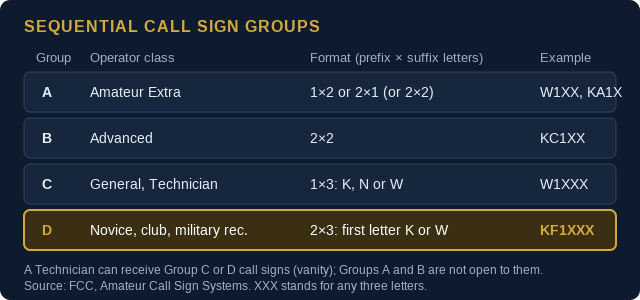
KF1XXX is the Group D format: a two-letter prefix beginning with K or W, a numeral, and a three-letter suffix.

Table of FCC call sign groups A to D with operator classes, formats and examples; Group D is highlighted.
Describe this graphic in words

Four rows. Group A, Amateur Extra, uses 1 by 2, 2 by 1 or 2 by 2 formats, for example W1XX and KA1X. Group B, Advanced, uses a two-letter prefix and a two-letter suffix (2 by 2), for example KC1XX. Group C, General and Technician, uses a K, N or W prefix with a three-letter suffix, for example W1XXX. Group D, Novice, club and military recreation, uses a two-letter prefix starting with K or W and a three-letter suffix, for example KF1XXX, and is highlighted in gold. A note says a Technician can receive Group C or D call signs but not A or B.

The FCC sorts call signs into four groups by the number of letters in the prefix and suffix. It describes Group D as call signs with a two-letter prefix whose first letter is K or W, and a three-letter suffix, as in KF1XXX (two letters, the numeral 1, then three letters). Group D is assigned to Novice class operators, club stations and military recreation stations.

The FCC notes that a Technician can receive call signs from Groups C and D (for example through a vanity request), but not from Groups A or B. Group C, the group a new Technician normally gets, is a single K, N or W prefix with a three-letter suffix. In KF1XXX, XXX is just a placeholder for three letters.

Why the other choices are wrong

  • B. KA1X has a two-letter prefix and a one-letter suffix (2×1). That format belongs to Group A, which is for Amateur Extra operators.
  • C. W1XX has a one-letter prefix and a two-letter suffix (1×2). That format belongs to Group A, for Amateur Extra operators.
  • D. Only KF1XXX is a Group D format, so the other choices cannot also be correct.

References

Rule text checked against the official source on November 9, 2026. This is a study aid; the linked rule is what governs.

T1C06FCC rule 97.5(a)(2), 97.11(a)

Which of the following statements is true about using your amateur radio license when operating aboard a vessel or craft in international waters?

Show the answer and why

Answer D. You may operate from a US-documented vessel with the master's permission

FCC rule 97.5(a)(2), 97.11(a)

You may operate an amateur station aboard a U.S.-documented vessel with the master's permission.

Section 97.11(a) says the installation and operation of an amateur station on a ship or aircraft "must be approved by the master of the ship or pilot in command of the aircraft." Section 97.5(a)(2) says a license covers operation aboard any vessel or craft documented or registered in the United States, so no special maritime FCC authorization is needed.

The same section sets conditions: the station must be separate from the ship's other radio equipment, must not interfere with it, and must not be a hazard to life or property.

Why the other choices are wrong

  • A. Amateur operation is not prohibited in international waters from a U.S.-documented vessel.
  • B. You are not limited to maritime emergencies.
  • C. The rules do not require special FCC authorization for maritime mobile operation.

References

Rule text checked against the official source on November 5, 2026. This is a study aid; the linked rule is what governs.

T1C07FCC rule 97.21, 1.949

How long before the expiration date may an amateur radio license renewal be requested?

Show the answer and why

Answer B. 90 days

FCC rule 97.21, 1.949

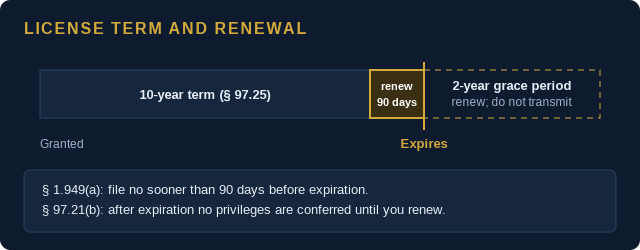
You may request renewal up to 90 days before the license expires.

Timeline of a 10-year license showing the renewal window opening 90 days before expiration and a two-year grace period after it.
Describe this graphic in words

A timeline. The license is granted for a 10-year term. Ninety days before the expiration date, the renewal window opens; renewal can be filed up to and including the expiration date. After expiration there is a two-year grace period in which you can still renew, but you may not transmit until the license is renewed.

Section 97.21(a)(3) says you may apply for renewal "in accordance with §§ 1.913 and 1.949 of this chapter." Section 1.949(a) sets the window: renewal applications "must be filed no later than the expiration date of the authorization, and no sooner than 90 days prior to the expiration date."

So the window opens 90 days before expiration and closes on the expiration date.

Why the other choices are wrong

  • A. 30 days is shorter than the window; renewal can be filed as early as 90 days before.
  • C. Six months is longer than the window allows.
  • D. One year is longer than the window allows.

References

Rule text checked against the official source on November 5, 2026. This is a study aid; the linked rule is what governs.

T1C08FCC rule 97.25

What is the normal term for an FCC-issued amateur radio license?

Show the answer and why

Answer C. Ten years

FCC rule 97.25

An amateur license is normally granted for a 10-year term.

Timeline of a 10-year license showing the renewal window opening 90 days before expiration and a two-year grace period after it.
Describe this graphic in words

A timeline. The license is granted for a 10-year term. Ninety days before the expiration date, the renewal window opens; renewal can be filed up to and including the expiration date. After expiration there is a two-year grace period in which you can still renew, but you may not transmit until the license is renewed.

Section 97.25 is a single sentence: "An amateur service license is normally granted for a 10-year term." Renewal gives another term.

Put the dates together with T1C07 and T1C09: renew within the 90 days before expiration, or within the two-year grace period after it.

Why the other choices are wrong

  • A. Five years is not the term in 97.25.
  • B. Eight years is not the term in 97.25.
  • D. Licenses are not for life; they must be renewed.

References

Rule text checked against the official source on November 5, 2026. This is a study aid; the linked rule is what governs.

T1C09FCC rule 97.21(a)(b)

What is the grace period for renewal if an amateur license expires?

Show the answer and why

Answer A. Two years

FCC rule 97.21(a)(b)

After a license expires, there is a two-year grace period in which it can still be renewed.

Timeline of a 10-year license showing the renewal window opening 90 days before expiration and a two-year grace period after it.
Describe this graphic in words

A timeline. The license is granted for a 10-year term. Ninety days before the expiration date, the renewal window opens; renewal can be filed up to and including the expiration date. After expiration there is a two-year grace period in which you can still renew, but you may not transmit until the license is renewed.

Section 97.21(b) says: "A person whose amateur station license grant has expired may apply to the FCC for renewal of the license grant for another term during a 2 year filing grace period." After the grace period, you would have to take the exams again.

The grace period lets you renew, but it does not let you transmit. See the next question.

Why the other choices are wrong

  • B. Three years is longer than the grace period in 97.21(b).
  • C. Five years is longer than the grace period in 97.21(b).
  • D. Ten years is a full license term, not the grace period.

References

Rule text checked against the official source on November 5, 2026. This is a study aid; the linked rule is what governs.

T1C10FCC rule 97.5a

How soon after passing the examination for your first amateur radio license may you transmit on the amateur radio bands?

Show the answer and why

Answer C. As soon as your operator/station license grant appears in the FCC’s license database

FCC rule 97.5a

You may transmit as soon as your operator/station license grant appears in the FCC's license database.

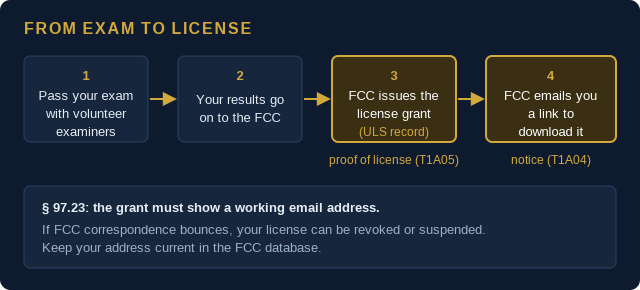
Four-step flow from passing the exam to the FCC emailing you a link to your license grant, with the ULS record marked as proof of your license.
Describe this graphic in words

Step 1: you pass your exam with volunteer examiners. Step 2: your results go on to the FCC. Step 3: the FCC issues the license grant, which appears as a record in the Universal Licensing System; this is the proof of your license. Step 4: the FCC emails you a link to download it.

Section 97.5(a) says the station apparatus must be under the physical control of "a person named in an amateur station license grant on the ULS consolidated license database" before the station may transmit. Passing the exam is not enough, and neither is a certificate or a letter. The grant has to be in the database.

A Certificate of Successful Completion of Examination (CSCE) does let someone who already holds a license use the privileges of a higher class, under 97.9(b), but that is for upgrades, not a first license.

Why the other choices are wrong

  • A. A CSCE does not authorize a first transmission. It matters only for upgrades under 97.9(b).
  • B. The ARRL does not grant licenses; the FCC database is what counts.
  • D. You do not have to wait for anything by mail.

References

Rule text checked against the official source on November 5, 2026. This is a study aid; the linked rule is what governs.

T1C11FCC rule 97.21(b)

If your license has expired and is still within the allowable grace period, may you continue to transmit on the amateur radio bands?

Show the answer and why

Answer D. No, you must wait until the license has been renewed

FCC rule 97.21(b)

No. During the grace period you may apply to renew, but you may not transmit until the license is renewed.

Timeline of a 10-year license showing the renewal window opening 90 days before expiration and a two-year grace period after it.
Describe this graphic in words

A timeline. The license is granted for a 10-year term. Ninety days before the expiration date, the renewal window opens; renewal can be filed up to and including the expiration date. After expiration there is a two-year grace period in which you can still renew, but you may not transmit until the license is renewed.

Section 97.21(b) ends with a clear sentence: "Unless and until the license grant is renewed, no privileges in this part are conferred." An expired license gives you no transmitting privileges, even while you are still inside the two-year grace period.

The practical lesson is to renew on time. If you miss it, renew right away and stay off the air until the new grant shows in the FCC database.

Why the other choices are wrong

  • A. The grace period is for filing the renewal. It does not allow transmitting.
  • B. Applying for renewal after expiration does not restore privileges. Only the renewal does.
  • C. There is no one-year transmitting allowance.

References

Rule text checked against the official source on November 5, 2026. This is a study aid; the linked rule is what governs.