
ARSC Tech School

Technician T4B: Operating controls

409 questions · pool July 1, 2026 to June 30, 2030 · the exam has 35 questions; 26 to pass

T4 · AMATEUR RADIO PRACTICES

Operating controls: frequency tuning, use of filters, squelch function, AGC, memory channels, noise blanker, microphone gain, receiver incremental tuning (RIT), bandwidth selection, scanning function; Digital transceiver configuration; DMR code plugs and talk groups

11 questions in group T4B

One question from this group appears on each exam.

T4B01

What is the effect of excessive microphone gain on SSB transmissions?

Show the answer and why

Answer B. Distorted transmitted audio

Excessive microphone gain distorts the transmitted audio on SSB.
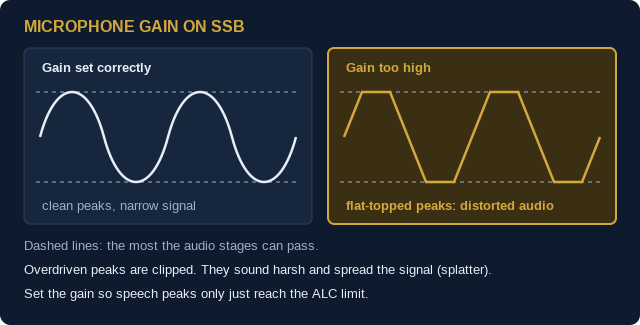
Waveform with correct microphone gain compared with a flat-topped, clipped waveform from too much gain.
Describe this graphic in words

Two panels show an audio waveform between two dashed limit lines that mark the most the audio stages can pass. With gain set correctly, the wave is a smooth curve whose peaks just reach the limits. With gain too high, shown in gold, the peaks are flattened against the limits, which is labeled flat-topped peaks and distorted audio. Text below says clipped peaks sound harsh and spread the signal, and that gain should be set so peaks just reach the ALC limit.

Microphone gain sets how hard your voice drives the radio's audio and modulator stages. When it is set too high, the loud peaks of your speech overdrive those stages and are flattened (clipped), so the transmitted audio sounds harsh and distorted.

Clipping also creates unwanted frequency components that widen the signal, which causes splatter and interference on nearby frequencies. Set the gain so voice peaks only just reach the ALC (automatic level control) limit. This is a teaching note.

Why the other choices are wrong

  • A. Frequency stability depends on the radio's oscillator and its temperature, not on microphone gain.
  • C. SWR is a property of how well the antenna system matches the feed line; changing the microphone gain does not change it.
  • D. Which sideband you transmit (USB or LSB) is set by the mode selection; gain does not invert the sideband.

Rule text checked against the official source on November 5, 2026. This is a study aid; the linked rule is what governs.
T4B02

Which of the following can be used to enter a transceiver’s operating frequency?

Show the answer and why

Answer A. The keypad or VFO knob

You can enter a transceiver's operating frequency with the keypad or the VFO knob.

Most transceivers let you set the operating frequency in two ways: key it in directly on the keypad, or turn the VFO (variable frequency oscillator) tuning knob until the display shows the frequency you want. Memory channels recall a frequency you already stored, but they start from one of these two methods.

A CTCSS or DTMF encoder only generates tones, such as the subaudible tone some repeaters require or touch-tone signals, and automatic frequency control only makes small corrections to follow a signal. None of those selects the operating frequency, so "all of these" is also wrong. This is a teaching note.

Why the other choices are wrong

  • B. A CTCSS encoder makes the subaudible tone some repeaters require and a DTMF encoder sends touch tones; neither sets the operating frequency.
  • C. Automatic frequency control only corrects small drift away from a frequency you have already tuned.
  • D. Only the keypad or VFO knob enters a frequency, and the other choices cannot, so not all of these are correct.

Rule text checked against the official source on November 5, 2026. This is a study aid; the linked rule is what governs.
T4B03

How is squelch adjusted so that a weak FM signal can be heard?

Show the answer and why

Answer A. Set the squelch threshold so that receiver output audio is on all the time

Set the squelch threshold so receiver output audio is on all the time to hear a weak FM signal.

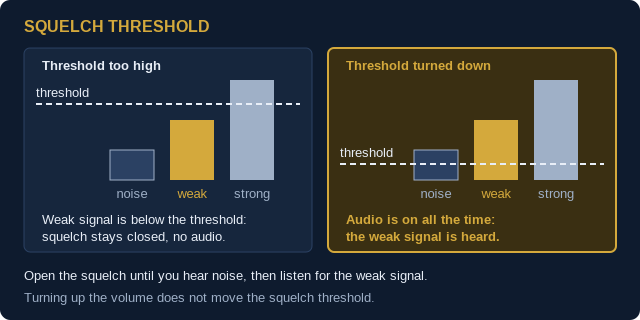
Bar graphs showing a squelch threshold above a weak signal and then turned down.
Describe this graphic in words

Two panels each show three bars for background noise, a weak signal in gold and a strong signal, with a dashed squelch threshold line. When the threshold is above the weak signal, the weak signal stays muted and nothing is heard. In the gold panel the threshold is turned down below the noise, so audio is on all the time and the weak signal is heard. Text says to open the squelch until noise is heard, and that raising the volume does not move the threshold.

Squelch silences the receiver's audio until a signal is strong enough to open it. A very weak signal may stay below the squelch threshold, so you hear nothing even though it is there. Setting the threshold so the receiver's audio is on all the time (the squelch fully open, so you hear noise) lets the weak signal through.

The threshold is a level the signal must exceed, so turning up the volume does not help; volume only makes sound louder after the squelch has opened. There is no standard "anti-squelch" or "squelch enhancement" setting that lowers the threshold for you. This is a teaching note.

Why the other choices are wrong

  • B. Raising the audio level does not change the squelch threshold; it only makes sound louder after the squelch has opened.
  • C. Anti-squelch is not the control that lets a weak FM signal through; you adjust the squelch threshold itself.
  • D. Squelch enhancement is not how weak FM signals are heard; lowering the threshold so audio is always on is.

Rule text checked against the official source on November 5, 2026. This is a study aid; the linked rule is what governs.
T4B04

What does an FM signal sound like when received slightly off frequency?

Show the answer and why

Answer D. The audio becomes distorted

An FM signal received slightly off frequency sounds distorted.

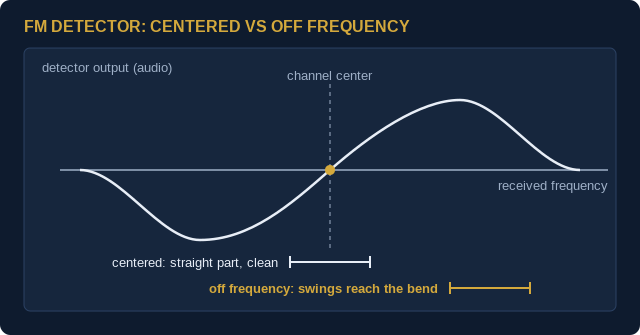
FM detector response curve showing why an off-frequency signal sounds distorted.
Describe this graphic in words

A graph plots detector output against received frequency as an S-shaped curve that crosses zero at the channel center, marked with a gold dot and a dashed line. A bracket for a centered signal spans the straight part of the curve and is labeled centered, straight part, clean. A gold bracket for an off-frequency signal spans the flattened bend of the curve and is labeled off frequency, swings reach the bend.

An FM receiver's detector is set so that a signal centered on the channel produces clean, symmetrical audio. If the signal is received slightly off frequency, the swings in frequency that carry the voice fall partly on the curved edge of the detector's response, and the audio comes out distorted. The signal can also be weaker, because it is no longer centered in the receiver's filter.

Unlike a single-sideband signal, an off-frequency FM signal does not simply sound higher or lower in pitch. The effect is distortion. This is a teaching note.

Why the other choices are wrong

  • A. A rising pitch is the typical symptom of an SSB signal tuned off frequency, not FM.
  • B. A falling pitch is also an SSB symptom; in FM the detector distorts the audio instead.
  • C. The main effect is distortion, not just a lower level; the quality of the audio changes as well as its loudness.

Rule text checked against the official source on November 5, 2026. This is a study aid; the linked rule is what governs.
T4B05

What does the scanning function of an FM transceiver do?

Show the answer and why

Answer C. Tunes through a range of frequencies to check for activity

The scanning function tunes through a range of frequencies to check for activity.

Scanning makes the receiver step through memory channels or a range of frequencies and stop when it finds a signal. That lets you monitor several frequencies, such as local repeaters, without tuning by hand.

It does not measure deviation, protect repeaters from interference, or find an antenna's resonant frequency. This is a teaching note.

Why the other choices are wrong

  • A. Signal deviation is measured with test equipment such as a service monitor, not by scanning.
  • B. Scanning is a receive function; it does not control your transmissions, so it cannot prevent interference to repeaters.
  • D. Scanning looks for signals, not for resonance; an antenna analyzer or SWR sweep finds an antenna's resonant frequency.

Rule text checked against the official source on November 5, 2026. This is a study aid; the linked rule is what governs.

T4B06

Which of the following controls could be used if the voice pitch of a single-sideband signal returning to your CQ call seems too high or low?

Show the answer and why

Answer D. The RIT or Clarifier

The RIT or Clarifier shifts your receive frequency to correct a voice pitch that seems too high or low.

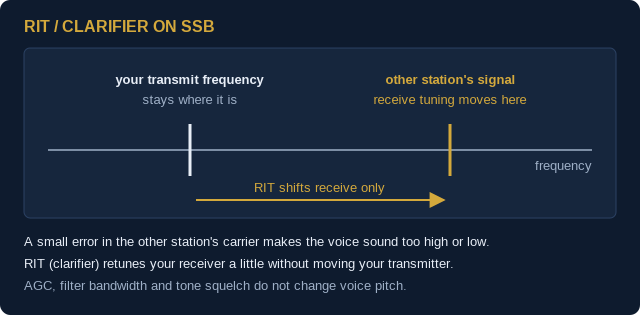
A frequency line showing the RIT moving only the receive tuning to the other station's signal.
Describe this graphic in words

A frequency axis has a white mark for your transmit frequency, which stays where it is, and a gold mark for the other station's signal, where receive tuning moves. A gold arrow labeled RIT shifts receive only runs from the first to the second. Text explains that a small carrier error makes the voice sound too high or low, that RIT retunes the receiver without moving the transmitter, and that AGC, filter bandwidth and tone squelch do not change pitch.

On SSB the pitch of a voice depends on exact tuning: if your receiver is a few hundred hertz off the other station's carrier, the voice sounds too high or too low. The RIT (receiver incremental tuning) or Clarifier control changes the receive frequency by a small amount, so you can tune the other voice until it sounds natural.

It shifts only the receiver, so your transmit frequency stays where it is. AGC and limiters control audio level, bandwidth selection changes noise and selectivity, and tone squelch is an FM function, so none of them affects pitch. This is a teaching note.

Why the other choices are wrong

  • A. AGC and a limiter control the signal level, not the pitch.
  • B. Bandwidth selection changes how much noise and interference gets through, not the pitch.
  • C. Tone squelch opens the receiver only when it hears a certain subaudible tone and has no effect on pitch.

Rule text checked against the official source on November 5, 2026. This is a study aid; the linked rule is what governs.

T4B07

What is a DMR “code plug”?

Show the answer and why

Answer B. Configuration data loaded onto your radio to access repeaters and talkgroups

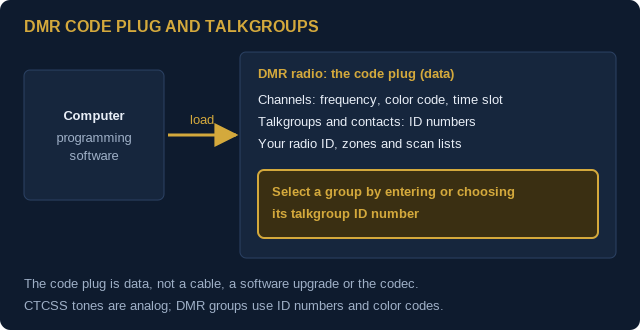
A DMR code plug is configuration data loaded onto your radio to access repeaters and talkgroups.

A computer loads a DMR code plug into a radio; groups are selected by talkgroup ID.
Describe this graphic in words

A computer with programming software loads data into a DMR radio through a gold arrow labeled load. The radio panel lists the code plug contents: channels (frequency, color code, time slot), talkgroups and contacts as ID numbers, and your radio ID, zones and scan lists. A highlighted box says to select a group by entering or choosing its talkgroup ID number. Notes say the code plug is data, not a cable, software upgrade or codec, and that CTCSS tones are analog while DMR groups use ID numbers and color codes.

A DMR code plug is the configuration file for your radio. It lists the channels (frequency, color code and time slot), the talkgroups and contacts, your radio ID and other settings. You build it on a computer with programming software and load it into the radio; without it the radio cannot reach your local repeaters or talkgroups.

It is data, not hardware. It is not a cable, a manufacturer's software update, or the codec that converts voice to digital data. This is a teaching note.

Why the other choices are wrong

  • A. A programming cable connects the radio to the computer; the code plug is the data that is loaded through it.
  • C. A manufacturer's software update is a different thing; the code plug is your own configuration of channels and talkgroups.
  • D. A codec converts voice to digital data and back inside the radio; the code plug is configuration data, not a converter.

Rule text checked against the official source on November 5, 2026. This is a study aid; the linked rule is what governs.

T4B08

What is the advantage of having a choice of receiver filter bandwidths in a multimode transceiver?

Show the answer and why

Answer B. Permits noise or interference reduction by selecting a bandwidth matching the mode

Choosing a receiver filter bandwidth that matches the mode reduces noise and interference.

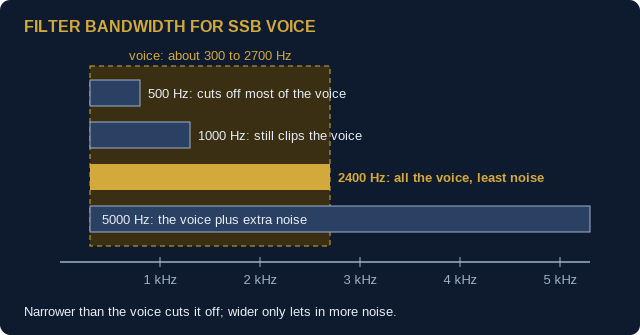
Receiver filter widths of 500, 1000, 2400 and 5000 hertz compared with the voice band of an SSB signal.
Describe this graphic in words

A shaded band from about 300 to 2700 Hz marks the energy of an SSB voice signal on a scale to 5 kHz. Four bars show filter widths: 500 Hz cuts off most of the voice, 1000 Hz still clips it, 2400 Hz (in gold) covers all the voice with the least noise, and 5000 Hz admits the voice plus extra noise. A note says narrower than the voice cuts it off and wider only lets in more noise.

Different modes occupy different amounts of spectrum: CW needs only a few hundred hertz, SSB voice about 2.4 kHz, and FM voice much more. A receiver filter passes the signal and rejects noise and other signals outside its width, so choosing the filter that matches the mode keeps your signal while cutting noise and nearby interference.

A filter narrower than the signal cuts part of it off, and a wider one lets in extra noise and neighbors. The radio uses one filter at a time, so it cannot monitor several modes at once, and filters do not change memory size or the transmit and receive offset. This is a teaching note.

Why the other choices are wrong

  • A. The receiver uses one filter at a time; it cannot monitor several modes simultaneously.
  • C. Filters shape what the receiver passes; the number of frequencies the radio can store depends on its memory size.
  • D. The offset between transmit and receive frequencies (the repeater split) is a frequency setting that filters do not change.

Rule text checked against the official source on November 5, 2026. This is a study aid; the linked rule is what governs.

T4B09

How is a specific group of stations selected on a DMR digital voice transceiver?

Show the answer and why

Answer C. By entering the group’s identification code

On a DMR radio you select a group of stations by entering the group's identification code.

A computer loads a DMR code plug into a radio; groups are selected by talkgroup ID.
Describe this graphic in words

A computer with programming software loads data into a DMR radio through a gold arrow labeled load. The radio panel lists the code plug contents: channels (frequency, color code, time slot), talkgroups and contacts as ID numbers, and your radio ID, zones and scan lists. A highlighted box says to select a group by entering or choosing its talkgroup ID number. Notes say the code plug is data, not a cable, software upgrade or codec, and that CTCSS tones are analog while DMR groups use ID numbers and color codes.

Each DMR talkgroup is identified by a numeric ID. To reach a group you choose or enter that talkgroup ID, usually stored in your code plug as a contact, and the radio sends it along with your transmission so everyone listening to that talkgroup on the network hears you.

A frequency in memory only selects a channel, not a group, and CTCSS is an analog tone method that DMR does not use for this. A code plug is a file of data, not a pre-programmed hardware plug. This is a teaching note.

Why the other choices are wrong

  • A. A memory frequency selects a channel (a frequency, color code and time slot), not which group of stations you are talking to.
  • B. CTCSS is an analog subaudible tone used on FM repeaters; DMR groups are selected by talkgroup ID.
  • D. A code plug is configuration data, not a physical five-pin plug.

Rule text checked against the official source on November 5, 2026. This is a study aid; the linked rule is what governs.

T4B10

Which of the following receiver filter bandwidths provides the best signal-to-noise ratio for SSB reception?

Show the answer and why

Answer C. 2400 Hz

A 2400 Hz bandwidth gives the best signal-to-noise ratio for SSB reception.

Receiver filter widths of 500, 1000, 2400 and 5000 hertz compared with the voice band of an SSB signal.
Describe this graphic in words

A shaded band from about 300 to 2700 Hz marks the energy of an SSB voice signal on a scale to 5 kHz. Four bars show filter widths: 500 Hz cuts off most of the voice, 1000 Hz still clips it, 2400 Hz (in gold) covers all the voice with the least noise, and 5000 Hz admits the voice plus extra noise. A note says narrower than the voice cuts it off and wider only lets in more noise.

An SSB voice signal occupies about 2.4 kHz, roughly 300 to 2700 Hz, so a 2400 Hz filter passes all of the voice while letting in as little noise as possible. That gives the best signal-to-noise ratio.

Noise power grows with bandwidth, so a filter wider than the signal, such as 5000 Hz, lets in extra noise without adding any speech. A filter narrower than the signal cuts off part of the voice: 500 Hz removes most of it, and 1000 Hz still clips important parts, leaving speech muffled and hard to understand. This is a teaching note.

Why the other choices are wrong

  • A. 500 Hz is a CW-width filter; it throws away most of the voice.
  • B. 1000 Hz still removes part of the voice, so speech sounds muffled.
  • D. 5000 Hz is more than twice the signal's width; it passes extra noise and adjacent signals without adding any voice.

Rule text checked against the official source on November 5, 2026. This is a study aid; the linked rule is what governs.

T4B11

Which of the following must be programmed into a D-STAR digital transceiver before transmitting?

Show the answer and why

Answer A. Your call sign

A D-STAR radio must be programmed with your call sign before you transmit.

Section 97.119(a) requires each station to "transmit its assigned call sign" at the end of each communication and at least every 10 minutes during it, and forbids transmitting unidentified communications. D-STAR sends your call sign as part of the digital data stream, so the radio has to be programmed with your call sign before it can transmit.

Output power and the codec type are not required entries. Power has a working default, and D-STAR uses a single voice codec built into the radio, so there is no codec to choose. Only the call sign is required, so "all of these" is wrong.

Why the other choices are wrong

  • B. Output power has a default setting, so it is not required to be entered before transmitting.
  • C. D-STAR uses one fixed voice codec built into the radio, so no codec type needs to be programmed.
  • D. Only the call sign is required, so not all of these choices are correct.

References

Rule text checked against the official source on November 5, 2026. This is a study aid; the linked rule is what governs.