
ARSC Tech School

Technician T5A: Current and voltage

409 questions · pool July 1, 2026 to June 30, 2030 · the exam has 35 questions; 26 to pass

T5 · ELECTRICAL PRINCIPLES

Current and voltage: terminology and units, conductors and insulators, alternating and direct current

11 questions in group T5A

One question from this group appears on each exam.

T5A01

Electrical current is measured in which of the following units?

Show the answer and why

Answer D. Amperes

Electrical current is measured in amperes.
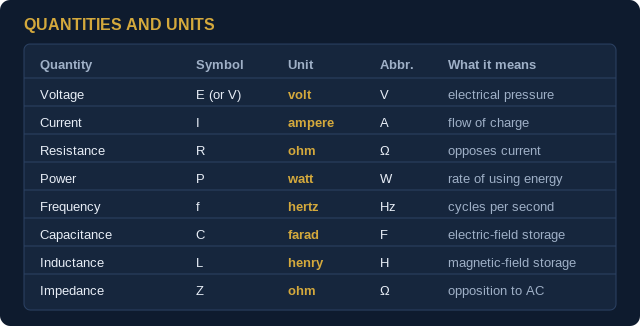
Table of electrical quantities with their symbols, units and abbreviations.
Describe this graphic in words

A table lists eight quantities with symbol, unit, abbreviation and meaning: voltage (E or V, volt, V, electrical pressure), current (I, ampere, A, flow of charge), resistance (R, ohm, symbol Ω, opposes current), power (P, watt, W, rate of using energy), frequency (f, hertz, Hz, cycles per second), capacitance (C, farad, F, electric-field storage), inductance (L, henry, H, magnetic-field storage) and impedance (Z, ohm, Ω, opposition to AC). The unit names are shown in gold.

Current is the rate at which electric charge flows past a point in a circuit, and its unit is the ampere (amp, A). One ampere is one coulomb of charge passing a point each second.

Keep the units straight by what they describe: amperes measure how much is flowing, volts measure the push behind it, ohms measure the opposition, and watts measure the power. In Ohm's law the symbol for current is I. This is a teaching note.

Why the other choices are wrong

  • A. Volts measure electrical pressure (potential difference), the push that makes current flow, not the flow itself.
  • B. Watts measure power, the rate at which energy is used; power is volts times amperes.
  • C. Ohms measure resistance, how strongly a material opposes current.

Rule text checked against the official source on November 5, 2026. This is a study aid; the linked rule is what governs.
T5A02

Electrical power is measured in which of the following units?

Show the answer and why

Answer B. Watts

Electrical power is measured in watts.

Table of electrical quantities with their symbols, units and abbreviations.
Describe this graphic in words

A table lists eight quantities with symbol, unit, abbreviation and meaning: voltage (E or V, volt, V, electrical pressure), current (I, ampere, A, flow of charge), resistance (R, ohm, symbol Ω, opposes current), power (P, watt, W, rate of using energy), frequency (f, hertz, Hz, cycles per second), capacitance (C, farad, F, electric-field storage), inductance (L, henry, H, magnetic-field storage) and impedance (Z, ohm, Ω, opposition to AC). The unit names are shown in gold.

Power is the rate at which energy is used or delivered, and its unit is the watt (W). In a DC circuit, power in watts equals voltage in volts times current in amperes.

For example, a radio drawing 10 amperes at 13.8 volts uses 13.8 x 10 = 138 watts, and a 100 W transmitter works ten times harder than a 10 W one. Do not confuse the watt with the watt-hour, which measures a total amount of energy used over time. This is a teaching note.

Why the other choices are wrong

  • A. Volts measure potential difference, not the rate of using energy.
  • C. A watt-hour is a unit of energy, the amount used over time; power is the rate, measured in watts.
  • D. Amperes measure current, the flow of charge.

Rule text checked against the official source on November 5, 2026. This is a study aid; the linked rule is what governs.
T5A03

What is the term for the flow of electrons in an electric circuit?

Show the answer and why

Answer D. Current

The flow of electrons in a circuit is called current.

A battery pushing electrons around a simple circuit through a resistor.
Describe this graphic in words

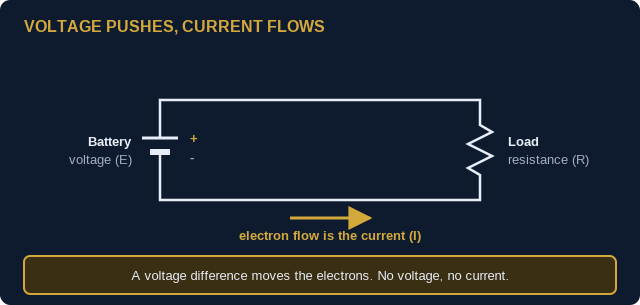
A rectangular circuit loop has a battery on the left, labeled voltage (E), and a resistor on the right, labeled the load with resistance (R). A gold arrow along the bottom wire shows electron flow, labeled as the current (I). A note says a voltage difference moves the electrons, and with no voltage there is no current.

Current is the term for the flow of electrons, which carry the charge through a wire and around a circuit. The amount of flow is measured in amperes.

Voltage is the push that causes the flow, so voltage is the cause and current is the effect. Without a complete path, such as an open switch, no current flows even if a battery supplies voltage. This is a teaching note.

Why the other choices are wrong

  • A. Voltage is the electrical pressure that drives the flow, not the flow itself.
  • B. Amperes per second is not a standard quantity; the ampere is already a rate of flow, one coulomb per second.
  • C. Volts per second is not the term for electron flow.

Rule text checked against the official source on November 5, 2026. This is a study aid; the linked rule is what governs.

T5A04

What term describes the number of times per second that an alternating current makes a complete cycle?

Show the answer and why

Answer C. Frequency

The number of complete cycles per second is the frequency.

Graphs of steady DC, pulsating DC and alternating current against time.
Describe this graphic in words

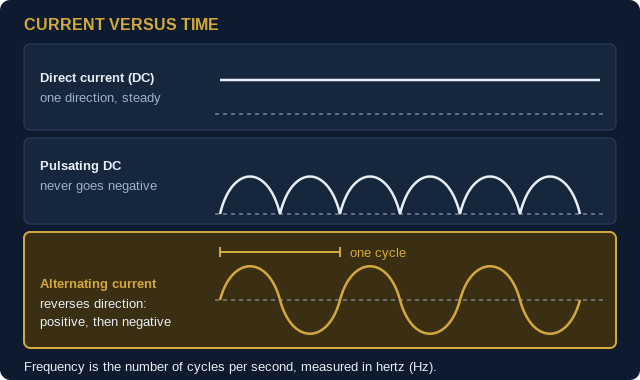
Three stacked graphs plot current against time. Direct current is a flat line on one side of zero, steady in one direction. Pulsating DC rises and falls but never goes below zero. Alternating current, in gold, is a sine wave that swings above and below zero, reversing direction, with one complete cycle marked. A note says frequency is the number of cycles per second, measured in hertz.

One complete cycle of an alternating current goes from zero up to a positive peak, back through zero to a negative peak, and returns to zero. The number of these complete cycles each second is the frequency, measured in hertz.

U.S. household power makes 60 complete cycles every second (60 Hz), and a 146 MHz signal makes 146 million. Wavelength is a different quantity: it is the distance one cycle covers as it travels, and it gets shorter as frequency goes up. This is a teaching note.

Why the other choices are wrong

  • A. Pulse rate is not the standard term for how often an AC wave completes a cycle.
  • B. Wave number is a different measure, counting cycles per unit distance rather than per second.
  • D. Wavelength is the distance one cycle covers, not how often cycles occur.

Rule text checked against the official source on November 5, 2026. This is a study aid; the linked rule is what governs.

T5A05

A difference in which of the following causes electron flow?

Show the answer and why

Answer A. Voltage

A difference in voltage (potential) causes electrons to flow.

A battery pushing electrons around a simple circuit through a resistor.
Describe this graphic in words

A rectangular circuit loop has a battery on the left, labeled voltage (E), and a resistor on the right, labeled the load with resistance (R). A gold arrow along the bottom wire shows electron flow, labeled as the current (I). A note says a voltage difference moves the electrons, and with no voltage there is no current.

Electrons move through a conductor when there is a difference in electrical potential between two points, which is voltage. A battery creates that difference: connect a load across it and the voltage pushes electrons around the circuit. With no voltage difference there is no push and no current.

The other choices do not cause flow by themselves. Ampere-hours rate how much charge a battery holds, and capacitance and inductance describe storing energy in electric and magnetic fields. This is a teaching note.

Why the other choices are wrong

  • B. Ampere-hours rate a battery's capacity; they are not a cause of electron flow.
  • C. Capacitance is the ability to store energy in an electric field.
  • D. Inductance is the ability to store energy in a magnetic field.

Rule text checked against the official source on November 5, 2026. This is a study aid; the linked rule is what governs.

T5A06

What is the unit of frequency?

Show the answer and why

Answer A. Hertz

The unit of frequency is the hertz.

One hertz (Hz) is one cycle per second. Radio frequencies are large numbers, so they are written with prefixes, such as kHz, MHz and GHz.

The other choices are units of other quantities, or not real units at all. This is a teaching note.

Why the other choices are wrong

  • B. The henry is the unit of inductance.
  • C. The farad is the unit of capacitance.
  • D. Epicycles per second is not a real unit; cycles per second are called hertz.

Rule text checked against the official source on November 5, 2026. This is a study aid; the linked rule is what governs.

T5A07

Why are metals generally good conductors of electricity?

Show the answer and why

Answer B. They have many free electrons

Metals conduct well because they have many free electrons.

Conductors have free electrons; insulators hold their electrons tightly. Examples of each.
Describe this graphic in words

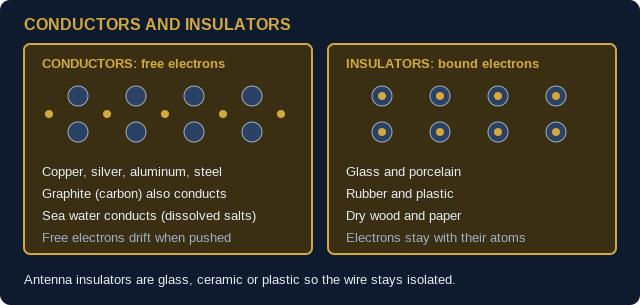
Two panels compare materials. The conductors panel shows atoms with free electrons drifting between them, and lists copper, silver, aluminum and steel, graphite (carbon) and sea water as conductors. The insulators panel shows each electron sitting on its atom, and lists glass, porcelain, rubber, plastic, dry wood and paper. A note says antenna insulators are glass, ceramic or plastic so the wire stays isolated.

In a metal the outer electrons of each atom are only loosely held and drift freely through the material. When a voltage is applied across a piece of metal, those free electrons move together as a current.

That is why copper and aluminum are used for wires and antennas. Materials with few free electrons, such as glass, rubber and plastic, are insulators. Density and stiffness have nothing to do with conduction, and protons are locked in the atomic nuclei. This is a teaching note.

Why the other choices are wrong

  • A. Density does not decide conduction; some dense materials are insulators and some light ones conduct.
  • C. Protons are held in the atomic nuclei and do not move through a conductor.
  • D. Young's modulus measures stiffness, which has nothing to do with conducting electricity.

Rule text checked against the official source on November 5, 2026. This is a study aid; the linked rule is what governs.

T5A08

Which of the following is a good electrical insulator?

Show the answer and why

Answer B. Glass

Glass is a good electrical insulator.

Conductors have free electrons; insulators hold their electrons tightly. Examples of each.
Describe this graphic in words

Two panels compare materials. The conductors panel shows atoms with free electrons drifting between them, and lists copper, silver, aluminum and steel, graphite (carbon) and sea water as conductors. The insulators panel shows each electron sitting on its atom, and lists glass, porcelain, rubber, plastic, dry wood and paper. A note says antenna insulators are glass, ceramic or plastic so the wire stays isolated.

An insulator holds its electrons tightly to their atoms, so almost no current flows when a voltage is applied. Glass, porcelain, rubber and plastic are good insulators, which is why glass and ceramic insulators support antenna wires.

The other choices all conduct. Sea water carries dissolved salts that form charged ions, stainless steel is a metal with free electrons, and graphite is a form of carbon whose structure lets electrons move. This is a teaching note.

Why the other choices are wrong

  • A. Sea water contains dissolved salts that form charged ions, so it conducts.
  • C. Stainless steel is a metal with many free electrons, so it conducts.
  • D. Graphite, a form of carbon, conducts electricity and is used for brushes and contacts.

Rule text checked against the official source on November 5, 2026. This is a study aid; the linked rule is what governs.

T5A09

Which of the following describes alternating current?

Show the answer and why

Answer C. Current that alternates between positive and negative directions

Alternating current alternates between positive and negative directions.

Graphs of steady DC, pulsating DC and alternating current against time.
Describe this graphic in words

Three stacked graphs plot current against time. Direct current is a flat line on one side of zero, steady in one direction. Pulsating DC rises and falls but never goes below zero. Alternating current, in gold, is a sine wave that swings above and below zero, reversing direction, with one complete cycle marked. A note says frequency is the number of cycles per second, measured in hertz.

Alternating current reverses direction over and over: it flows one way, drops to zero, flows the opposite way, and repeats. Plotted against time it swings above and below zero like a sine wave, so it is positive in one half of each cycle and negative in the other.

Direct current, by contrast, flows in one direction only. A current that rises and falls but never reverses, such as a positive-only pulsing current, is pulsating DC, not AC. This is a teaching note.

Why the other choices are wrong

  • A. Current that only varies between positive and zero never reverses direction; that is pulsating DC.
  • B. Current that only varies between negative and zero also never reverses; it is pulsating DC in the other direction.
  • D. Only the description with both positive and negative directions is AC, so the other two descriptions do not belong.

Rule text checked against the official source on November 5, 2026. This is a study aid; the linked rule is what governs.

T5A10

Which term describes the rate at which electrical energy is used?

Show the answer and why

Answer C. Power

Power is the rate at which electrical energy is used.

Power is the rate of using energy, measured in watts. The faster a circuit turns electrical energy into heat, light, sound or radio waves, the more power it is using.

A 50 W radio running for an hour uses 50 watt-hours of energy. Resistance, current and voltage describe the circuit, but none of them is the rate of energy use by itself; power is current times voltage. This is a teaching note.

Why the other choices are wrong

  • A. Resistance is the opposition to current flow.
  • B. Current is the flow of charge.
  • D. Voltage is the potential difference that drives current.

Rule text checked against the official source on November 5, 2026. This is a study aid; the linked rule is what governs.

T5A11

What type of current flow is opposed by resistance?

Show the answer and why

Answer D. All these choices are correct

Resistance opposes all of these: DC, AC and RF current.

Resistance opposes current of every kind and turns the electrical energy into heat. The same resistor dissipates power whether the current is steady DC, 60 Hz AC or an RF signal.

So every choice is correct, and "all of these" is the answer. Other kinds of opposition, such as reactance, apply only to changing currents, but resistance applies to all of them. This is a teaching note.

Why the other choices are wrong

  • A. Direct current is opposed by resistance, but so are alternating and RF current, so this choice is only part of the answer.
  • B. Alternating current is opposed by resistance, but so are direct and RF current, so this choice is only part of the answer.
  • C. RF current is opposed by resistance, but so are direct and alternating current, so this choice is only part of the answer.

Rule text checked against the official source on November 5, 2026. This is a study aid; the linked rule is what governs.