
ARSC Tech School

Technician T2B: VHF/UHF operating practices

409 questions · pool July 1, 2026 to June 30, 2030 · the exam has 35 questions; 26 to pass

T2 · OPERATING PROCEDURES

VHF/UHF operating practices: FM repeater, simplex, reverse splits; Access tones: CTCSS, DTMF; DMR operation; Resolving operating problems; Q signals

14 questions in group T2B

One question from this group appears on each exam.

T2B01

What is the purpose of the reverse function on a VHF/UHF transceiver?

Show the answer and why

Answer C. To listen on a repeater’s input frequency

Reverse swaps your transmit and receive frequencies so you can listen on the repeater's input frequency.
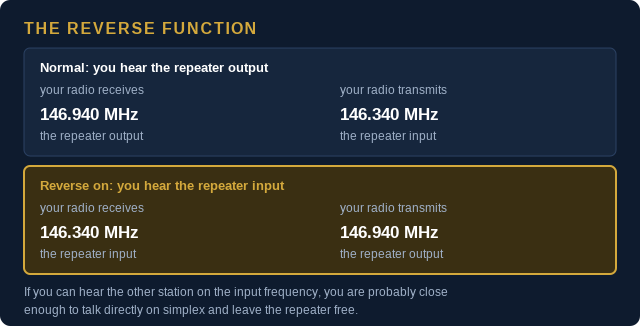
Normal and reverse settings compared for a repeater with output 146.940 MHz and input 146.340 MHz.
Describe this graphic in words

Two panels list what your radio receives and transmits. In the normal panel it receives 146.940 MHz (the repeater output) and transmits 146.340 MHz (the repeater input). In the gold reverse panel it receives 146.340 MHz (the input) and transmits 146.940 MHz (the output). A note says that hearing the other station on the input means you are probably in simplex range.

A repeater "simultaneously retransmits the transmission of another amateur station on a different channel" (§ 97.3). Normally your radio receives on the repeater's output and transmits on its input. Pressing the reverse function swaps the two, so the radio listens on the input frequency and transmits on the output.

Worked example: a repeater outputs on 146.940 MHz and listens on 146.340 MHz. With reverse on, your radio receives 146.340 MHz. If you can hear the other station there, you are probably within simplex range of each other and can move off the repeater to a simplex frequency, leaving the repeater free.

Why the other choices are wrong

  • A. Reverse does not change power. A separate power setting (high, medium or low) does that.
  • B. Reverse does not increase power; it only swaps which frequency is used for receiving and for transmitting.
  • D. The repeater's output is what you listen to normally, without reverse. Reverse is how you hear the input instead.

References

  • FCC rule47 CFR § 97.3(a)(40), Repeater — A repeater receives on one channel and retransmits on another. The reverse function itself is equipment practice, so this is a teaching note.

Rule text checked against the official source on November 5, 2026. This is a study aid; the linked rule is what governs.
T2B02

What term describes the use of a sub-audible tone transmitted along with normal voice audio to open the squelch of a receiver?

Show the answer and why

Answer D. CTCSS

CTCSS is a sub-audible tone sent along with your voice that opens a receiver's squelch.

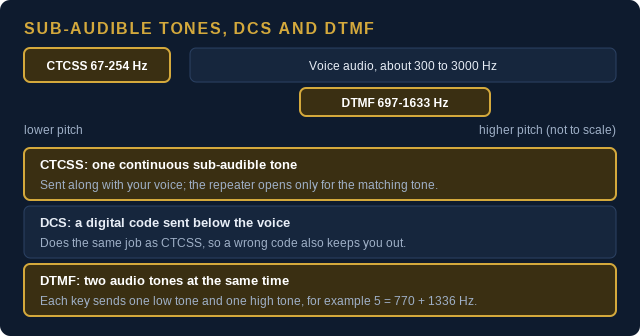
Where CTCSS, voice audio and DTMF tones sit in the audio range, with a short explanation of each.
Describe this graphic in words

A bar chart (not to scale) shows CTCSS tones from 67 to 254 Hz below the voice audio band of about 300 to 3000 Hz, with DTMF tones from 697 to 1633 Hz sitting inside the voice range. Three panels explain them: CTCSS is one continuous sub-audible tone sent along with your voice, DCS is a digital code sent below the voice that does the same job, and DTMF is two audio tones at the same time, for example the 5 key is 770 plus 1336 Hz. CTCSS and DTMF are highlighted in gold.

CTCSS (Continuous Tone-Coded Squelch System) adds a steady tone, below the range of normal voice audio, to your FM signal. A repeater set to require that tone opens only for signals carrying it, so it ignores other signals on the channel. The tone is sub-audible, meaning that you do not hear it, because receivers filter it out.

Section 97.205(e) allows this: "Limiting the use of a repeater to only certain user stations is permissible." Many radios label the setting PL (a brand term) or simply "tone".

Why the other choices are wrong

  • A. Carrier squelch opens on any carrier, with no tone involved, so it cannot tell wanted signals from unwanted ones.
  • B. A tone burst is a short tone at the start of a transmission, used on some repeaters to open them. It is not a continuous sub-audible tone sent with the voice.
  • C. DTMF tones are in the audible range, are generated from a keypad, and are used for control, not to open a squelch.

References

Rule text checked against the official source on November 5, 2026. This is a study aid; the linked rule is what governs.
T2B03

Which of the following describes a linked repeater network?

Show the answer and why

Answer A. A network of repeaters in which signals received by one repeater are transmitted by all the repeaters in the network

In a linked repeater network, what one repeater receives is transmitted by all the repeaters in the network.

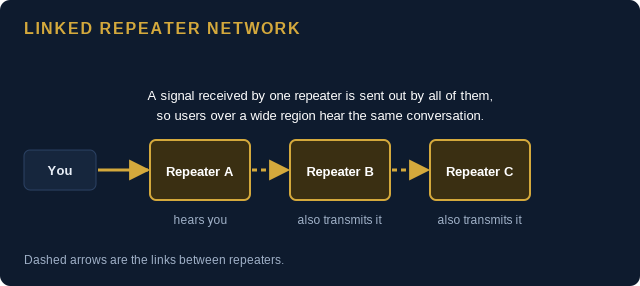
Three linked repeaters that all transmit what Repeater A receives from you.
Describe this graphic in words

You transmit to Repeater A on the left. Dashed gold arrows link A to Repeater B and B to Repeater C, and labels under the repeaters say A hears you while B and C also transmit it. Text above explains that a signal received by one repeater is sent out by all of them, so users over a wide region hear the same conversation.

A repeater "retransmits the transmission of another amateur station" (§ 97.3). In a linked network, repeaters are connected (by radio or the Internet) so the signal one receives is retransmitted by every repeater in the system, which extends coverage across a region.

Compare the wrong choices: one repeater with several receivers is a voting or multi-site receive system, not a link between repeaters. Several repeaters that share a control operator are not necessarily linked at all, and APRS is a separate system for positions and messages.

Why the other choices are wrong

  • B. More than one receiver on a single repeater is a receive-site arrangement. It is one repeater, not a network of repeaters.
  • C. Sharing a control operator does not link the repeaters' signals. Each could still operate completely independently.
  • D. APRS is a position and message system. It does not define a linked repeater network.

References

Rule text checked against the official source on November 5, 2026. This is a study aid; the linked rule is what governs.
T2B04

Which of the following could be the reason you are unable to access a repeater whose output you can hear?

Show the answer and why

Answer D. All these choices are correct

Any of these can keep you out of a repeater you can hear: wrong offset, wrong CTCSS tone, or wrong DCS code.

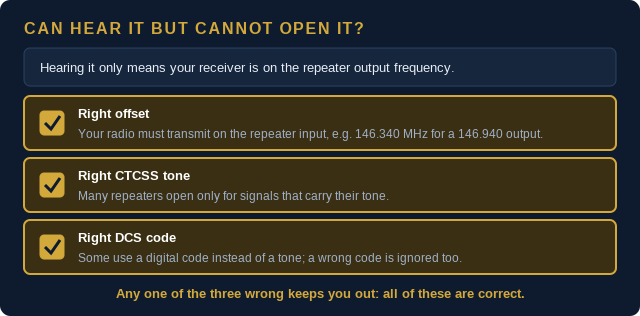
A checklist of three things that must be right to open a repeater you can hear.
Describe this graphic in words

A note says hearing a repeater only means your receiver is on its output frequency. Three gold-outlined checkboxes follow: the right offset (transmit on the repeater input, for example 146.340 MHz for a 146.940 MHz output), the right CTCSS tone, and the right DCS code. A closing line says any one of the three wrong keeps you out, so all of these are correct.

Hearing a repeater only means your receiver is tuned to its output frequency. To use it you must also transmit on its input frequency (the offset) and, if it requires one, send the right access tone (CTCSS) or digital squelch code (DCS).

Section 97.205(e) permits repeaters to limit access to certain users, and a required tone or code is how that is done. If the offset is wrong your signal never reaches the repeater's receiver; if the tone or code is wrong the receiver hears you but stays closed. Any one fault is enough, so "all of these" is correct.

Why the other choices are wrong

  • A. A wrong offset is one real cause, but it is not the only one, so choosing it alone leaves out the tone and code problems.
  • B. A wrong CTCSS tone is one real cause, but it is not the only one, so choosing it alone leaves out the offset and DCS problems.
  • C. A wrong DCS code is one real cause, but it is not the only one, so choosing it alone leaves out the offset and tone problems.

References

Rule text checked against the official source on November 5, 2026. This is a study aid; the linked rule is what governs.
T2B05

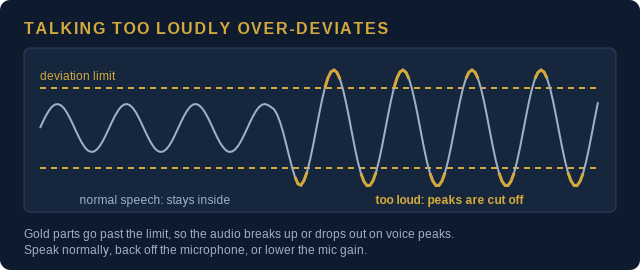
Which of the following would cause your FM transmission audio to drop out on voice peaks?

Show the answer and why

Answer C. You are talking too loudly

Talking too loudly over-deviates an FM transmitter, so the audio clips or drops out on voice peaks.

A speech waveform that stays inside the deviation limit when normal and is cut off when too loud.
Describe this graphic in words

A wave is drawn between two dashed gold lines marking the deviation limit. On the left, normal speech stays inside the limit. On the right the speech is louder, and the parts beyond the limit are drawn in thick gold and labelled as cut off. A note says the clipped parts make the audio break up or drop out, and to speak normally, back off the microphone or lower the mic gain.

An FM transmitter has a limit on how far its carrier may swing in frequency (the deviation). When you speak too loudly, the voice peaks try to go beyond that limit and the transmitter's limiter, or the receiver's filter, cuts them off. The loudest syllables then break up or drop out.

Speak at a normal level, hold the microphone a little farther from your mouth, or reduce the microphone gain. This is a teaching note.

Why the other choices are wrong

  • A. An inverted offset keeps you from reaching the repeater at all. It does not cause drop-outs on only the loudest peaks.
  • B. Too little deviation makes the audio weak and quiet all the time, not cut out on peaks.
  • D. Transmit power sets how strong the signal is, not how loud the audio is, so it does not cause peak drop-outs.

Rule text checked against the official source on November 5, 2026. This is a study aid; the linked rule is what governs.
T2B06

What type of signaling to a repeater uses two simultaneous audio tones?

Show the answer and why

Answer A. DTMF

DTMF signaling uses two audio tones sent at the same time.

Where CTCSS, voice audio and DTMF tones sit in the audio range, with a short explanation of each.
Describe this graphic in words

A bar chart (not to scale) shows CTCSS tones from 67 to 254 Hz below the voice audio band of about 300 to 3000 Hz, with DTMF tones from 697 to 1633 Hz sitting inside the voice range. Three panels explain them: CTCSS is one continuous sub-audible tone sent along with your voice, DCS is a digital code sent below the voice that does the same job, and DTMF is two audio tones at the same time, for example the 5 key is 770 plus 1336 Hz. CTCSS and DTMF are highlighted in gold.

DTMF (dual-tone multi-frequency) is the touch-tone keypad system. Each key sends one tone from a low group and one tone from a high group together, and a repeater or controller decodes the pair to tell which key was pressed. For example, the 5 key sends 770 Hz and 1336 Hz at the same moment.

Repeaters use DTMF for control functions, such as turning a link on or off. Section 97.205(e) notes that ancillary functions available to users on the repeater's input channel are not remote control of the station.

Why the other choices are wrong

  • B. CTCSS uses one continuous sub-audible tone, not two tones at once.
  • C. GMRS is a different radio service, not a signaling method.
  • D. D-STAR is a digital voice system, not a pair of simultaneous audio tones.

References

Rule text checked against the official source on November 5, 2026. This is a study aid; the linked rule is what governs.
T2B07

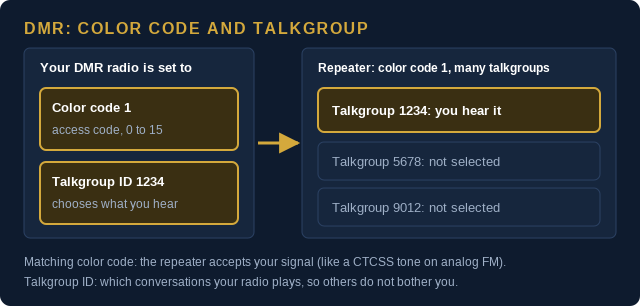
How can you join a digital repeater’s “talkgroup”?

Show the answer and why

Answer C. Program your radio with the group’s ID or code

You join a digital repeater's talkgroup by programming your radio with the group's ID or code.

A DMR radio set to color code 1 and talkgroup 1234 talking through a repeater that carries several talkgroups.
Describe this graphic in words

On the left a DMR radio is programmed with color code 1 (an access code from 0 to 15) and talkgroup ID 1234 (which chooses what you hear). An arrow leads to a repeater panel using color code 1 that carries talkgroups 1234, 5678 and 9012; only 1234 is highlighted in gold as the one you hear, and the other two are marked not selected. Notes say a matching color code makes the repeater accept your signal, like a CTCSS tone on analog FM, and the talkgroup ID decides which conversations your radio plays.

On DMR, a talkgroup is selected by its numeric ID. You enter that ID in your radio's configuration (its code plug) as a contact or channel, and from then on you hear and are heard on that group.

Networks may also require you to register your own personal DMR ID, but joining a talkgroup itself needs no approval from the frequency coordinator, and DTMF is not used for it. This is a teaching note.

Why the other choices are wrong

  • A. The frequency coordinator recommends repeater channels. It does not register talkgroup members.
  • B. Talkgroup membership comes from programming the group ID into your radio, not from registering with the control operator.
  • D. DMR talkgroups are selected by an ID in the digital data, not by a DTMF tone.

Rule text checked against the official source on November 5, 2026. This is a study aid; the linked rule is what governs.

T2B08

Which of the following applies when two stations transmitting on the same frequency interfere with each other?

Show the answer and why

Answer A. The stations should negotiate continued use of the frequency

Stations that interfere on the same frequency should negotiate continued use of it.

Section 97.101(b) says each licensee and control operator "must cooperate in selecting transmitting channels and in making the most effective use of the amateur service frequencies. No frequency will be assigned for the exclusive use of any station." Nobody owns a frequency, so being there first gives no legal priority.

The cooperative answer is for the two stations to talk it over and settle who stays and who moves. Willful or malicious interference is a separate matter and is prohibited by § 97.101(d).

Why the other choices are wrong

  • B. The rule asks for cooperation, not for both stations to leave automatically. One of them may reasonably stay.
  • C. No station gets rights to a frequency by being there first; the rule says none is assigned for exclusive use.
  • D. Sub-audible tones do not let two signals share a frequency. Both transmissions would still interfere.

References

Rule text checked against the official source on November 5, 2026. This is a study aid; the linked rule is what governs.

T2B09

Why are simplex channels designated in the VHF/UHF band plans?

Show the answer and why

Answer A. So stations within range of each other can communicate without tying up a repeater

Simplex channels let stations within range of each other talk directly without tying up a repeater.

A repeater is a shared resource, and every conversation through one blocks it for others. Stations that can hear each other directly can use a simplex channel instead, which keeps the repeater free. This matches § 97.101(b), which asks operators to make "the most effective use of the amateur service frequencies."

Band plans mark certain channels for simplex. That designation is voluntary guidance, not an FCC rule.

Why the other choices are wrong

  • B. Simplex channels are not set aside for contest operation; contests use whatever frequencies the band plan allows.
  • C. They are not for DX only. They exist mostly for local contacts that would otherwise load a repeater.
  • D. Repeater access has nothing to do with "simple transmitters". Every repeater user transmits on the input frequency using the offset.

References

Rule text checked against the official source on November 5, 2026. This is a study aid; the linked rule is what governs.

T2B10

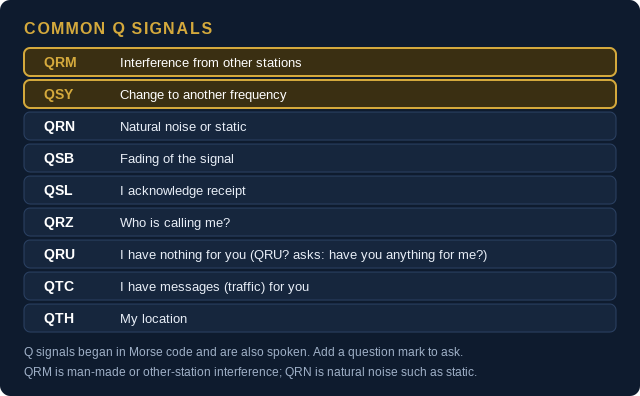
Which Q signal indicates that you are receiving interference from other stations?

Show the answer and why

Answer A. QRM

QRM is the Q signal for interference from other stations.

A table of common Q signals and their meanings.
Describe this graphic in words

A list of nine Q signals with meanings: QRM interference from other stations, QSY change to another frequency, QRN natural noise or static, QSB fading, QSL I acknowledge receipt, QRZ who is calling me, QRU I have nothing for you, QTC I have messages (traffic) for you, and QTH my location. QRM and QSY are highlighted in gold. A note says Q signals began in Morse code and are also spoken, and that adding a question mark asks the question.

Q signals are three-letter shorthand that began in Morse code and are also spoken on voice. "QRM" means you are receiving interference from other stations; sent as a question, "QRM?", it asks "Are you being interfered with?"

Do not confuse it with QRN, which is natural noise such as static from lightning. A handy memory aid is that QRM is "man-made" and QRN is "natural". This is a teaching note.

Why the other choices are wrong

  • B. QRN is natural noise or static, not interference from other stations.
  • C. QTH is your location. For example, "My QTH is Denver."
  • D. QSB is fading of the signal, where the strength rises and falls.

Rule text checked against the official source on November 5, 2026. This is a study aid; the linked rule is what governs.

T2B11

Which Q signal indicates that you are changing frequency?

Show the answer and why

Answer B. QSY

QSY means you are changing frequency.

QSY is the Q signal for changing to another frequency. "QSY to 146.520" means moving there, and "Shall I QSY?" asks whether to move. It is often used when a contact begun on a calling channel moves to a working channel.

Q signals are shorthand that began in Morse code and are also spoken. This is a teaching note.

Why the other choices are wrong

  • A. QRU is about having traffic for someone: "I have nothing for you", or as a question, "Have you anything for me?" It has nothing to do with changing frequency.
  • C. QSL means you acknowledge receipt, and a QSL card confirms a contact.
  • D. QRZ asks who is calling you.

Rule text checked against the official source on November 5, 2026. This is a study aid; the linked rule is what governs.

T2B12

What is the digital color code used on DMR repeater systems?

Show the answer and why

Answer A. An access code which must be programmed into a DMR transmitter to access a specific repeater

A DMR color code is an access code that must be programmed into your radio to use a specific repeater.

DMR repeaters use a color code (a number from 0 to 15) to tell wanted signals from others on the same frequency. The repeater ignores a transmission whose color code does not match its own, so your radio must be programmed with the right one for the repeater you are using.

That works like a CTCSS tone does for analog FM. Section 97.205(e) permits limiting a repeater's use to only certain user stations, and a color code is one way that limit is applied.

Why the other choices are wrong

  • B. The color code does not set the offset. The offset is a pair of frequencies you program separately.
  • C. The vocoder (CODEC) is identified by other parts of the digital signal, not by the color code.
  • D. The color code is sent by your radio so that the repeater accepts you. It is not a status message the repeater sends about its own health.

References

Rule text checked against the official source on November 5, 2026. This is a study aid; the linked rule is what governs.

T2B13

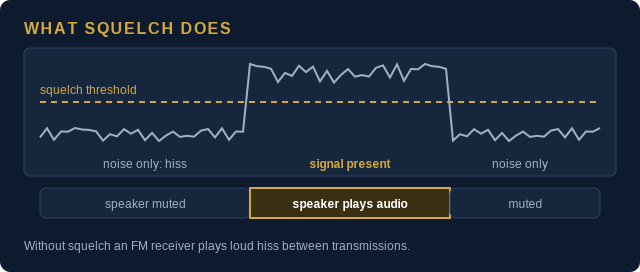
What is the purpose of a squelch function?

Show the answer and why

Answer B. Mute the receiver audio when a signal is not present

Squelch mutes the receiver audio when no signal is present.

A received-signal graph with a squelch threshold, showing the speaker muted until a signal rises above it.
Describe this graphic in words

A graph shows jagged noise below a dashed gold squelch threshold, then a stronger signal in the middle that rises above it, then noise again. Below the graph, the speaker is muted for the noise-only parts and plays audio, shown in gold, only while the signal is above the threshold. A note says that without squelch an FM receiver plays loud hiss between transmissions.

Without squelch, an FM receiver outputs loud hiss between transmissions. The squelch circuit senses when no signal is present and silences the speaker, then opens when a signal strong enough to cross the squelch threshold arrives.

You set the squelch control just above the point where the hiss disappears. Squelch has nothing to do with CW key clicks, amplifier oscillations or impulse noise. This is a teaching note.

Why the other choices are wrong

  • A. Key clicks are reduced in the transmitter's keying circuit, not by a receiver's squelch.
  • C. Parasitic oscillations are cured by amplifier design and shielding, not by squelch.
  • D. Impulse noise is reduced by a noise blanker. Squelch only decides whether the speaker is on or off.

Rule text checked against the official source on November 5, 2026. This is a study aid; the linked rule is what governs.

T2B14

Which of the following is a “talkgroup”?

Show the answer and why

Answer B. An identifier used by DMR to organize radio traffic so that those who want to hear the group aren’t bothered by other radio traffic

A talkgroup is a DMR identifier that organizes traffic so you hear only the group you choose.

A DMR network carries many conversations over shared repeaters. Each conversation is tagged with a talkgroup ID, and your radio plays audio only for the talkgroups you have programmed, so people who are not part of that group are not bothered by it.

It is not an email list, a net membership, or an alert system. A talkgroup is simply the label that sorts traffic on the digital network. This is a teaching note.

Why the other choices are wrong

  • A. A talkgroup is a radio traffic identifier, not an email list.
  • C. A net is organized by interest and schedule, with a net control station. A talkgroup is just an ID on a digital network.
  • D. A talkgroup does not alert members. You simply hear the group when your radio is set to it.

Rule text checked against the official source on November 5, 2026. This is a study aid; the linked rule is what governs.