
ARSC Tech School

Technician T8D: Non-voice and digital communications

409 questions · pool July 1, 2026 to June 30, 2030 · the exam has 35 questions; 26 to pass

T8 · SIGNALS AND EMISSIONS

Non-voice and digital communications: image signals and definition of NTSC, CW, packet radio, PSK, APRS, error detection and correction, amateur radio networking, DMR, WSJT modes, Broadband-Hamnet

12 questions in group T8D

One question from this group appears on each exam.

T8D01

Which of the following is a digital communications mode?

Show the answer and why

Answer D. All these choices are correct

Packet radio, IEEE 802.11 and FT8 are all digital modes.

A digital mode sends information as data bits rather than as a continuously varying audio wave. Packet radio sends data in addressed packets, IEEE 802.11 is the standard behind Wi-Fi, and FT8 is a weak-signal mode that sends short, coded messages. All three carry information as digital data, so "all of these" is correct.

Part 97 also allows amateurs to use any digital technique whose technical characteristics are publicly documented. This is a teaching note for the three examples.

Why the other choices are wrong

  • A. Packet radio is digital, but so are the other two.
  • B. IEEE 802.11 is digital, but so are the other two.
  • C. FT8 is digital, but so are the other two.

References

Rule text checked against the official source on November 5, 2026. This is a study aid; the linked rule is what governs.
T8D02

What is FT8?

Show the answer and why

Answer B. A digital mode capable of low signal-to-noise operation

FT8 is a digital mode that works at very low signal-to-noise ratios.

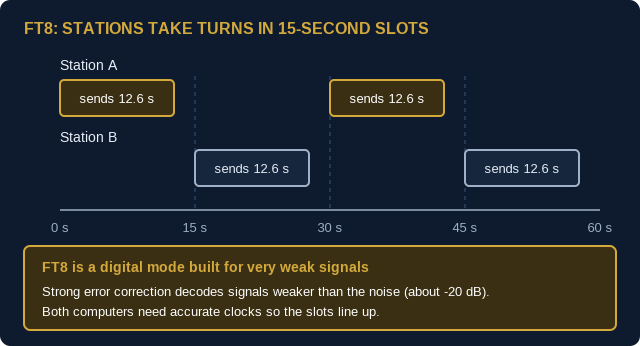
Timeline of two stations alternating 12.6 second FT8 transmissions in 15 second slots.
Describe this graphic in words

A 60-second timeline split into four 15-second slots. Station A sends in the first and third slots, in gold, and Station B sends in the second and fourth. Each block is labelled sends 12.6 s. A gold panel below says FT8 is a digital mode built for very weak signals, decodes signals weaker than the noise at about -20 dB, and needs accurate clocks so the slots line up.

FT8 is a digital mode built for very weak signals. Each station sends a short coded message in a 15-second time slot (about 12.6 seconds of actual transmission) and strong error correction lets a computer decode signals that are weaker than the noise, down to about -20 dB signal-to-noise ratio. That makes it popular for worldwide contacts with low power and small antennas.

The two stations take turns on alternating slots, and both computers must keep accurate clocks. FT8 is not a voice mode, a repeater multiplex or a TV mode. This is a teaching note.

Why the other choices are wrong

  • A. FT8 is not voice, and it is very narrow, not wide.
  • C. FT8 is not a multiplex for FM repeaters.
  • D. FT8 is not slow-scan TV; it sends short text-like messages.

Rule text checked against the official source on November 5, 2026. This is a study aid; the linked rule is what governs.
T8D03

What kind of data can be transmitted by APRS?

Show the answer and why

Answer D. All these choices are correct

APRS can carry GPS position, text messages and weather data.

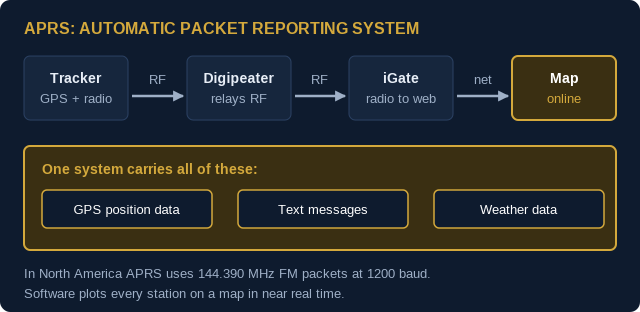
APRS data path from a GPS tracker through a digipeater and iGate to a map online.
Describe this graphic in words

A row of four boxes shows a tracker with GPS and radio, a digipeater that relays by radio, an iGate that joins radio to the web, and an online map in gold, linked by arrows marked RF, RF and net. A gold panel lists what one system carries: GPS position data, text messages and weather data. Captions note the 144.390 MHz FM, 1200 baud frequency used in North America.

The Automatic Packet Reporting System sends short packets over radio, and one system carries many kinds of information. Stations report GPS position, exchange short text messages, and send readings from weather stations, along with items such as objects and status. Because it carries all of these, "all of these" is the answer.

In North America APRS packets are sent on 144.390 MHz. This is a teaching note.

Why the other choices are wrong

  • A. Position data is carried, but so are messages and weather data.
  • B. Text messages are carried, but so are position and weather data.
  • C. Weather data is carried, but so are position and messages.

Rule text checked against the official source on November 5, 2026. This is a study aid; the linked rule is what governs.
T8D04

What is meant by the term "NTSC?"

Show the answer and why

Answer C. An analog fast-scan color TV signal

NTSC is an analog fast-scan color TV standard.

NTSC stands for National Television System Committee, the group that defined the analog TV format long used in the United States. It sends about 30 full pictures per second in a channel roughly 6 MHz wide. Amateurs use it for fast-scan television (ATV), mainly on 70 centimeters and higher bands.

It is not an encryption method, a satellite mode or a way of compressing frames. This is a teaching note.

Why the other choices are wrong

  • A. NTSC is not an encryption standard; amateur rules also forbid obscuring the meaning of messages.
  • B. It is not a satellite uplink mode.
  • D. NTSC is the signal format itself, not a frame compression scheme.

Rule text checked against the official source on November 5, 2026. This is a study aid; the linked rule is what governs.
T8D05

Which of the following is an application of APRS?

Show the answer and why

Answer A. Providing real-time tactical digital communications in conjunction with a map showing the locations of stations

APRS provides real-time tactical digital communications with a map showing station locations.

APRS data path from a GPS tracker through a digipeater and iGate to a map online.
Describe this graphic in words

A row of four boxes shows a tracker with GPS and radio, a digipeater that relays by radio, an iGate that joins radio to the web, and an online map in gold, linked by arrows marked RF, RF and net. A gold panel lists what one system carries: GPS position data, text messages and weather data. Captions say software plots every station on a map in near real time.

APRS stations broadcast their positions and other data, and software plots them on a map. That gives events and emergency responders a live picture of who is where, and the same system can pass short messages and weather data.

The other choices describe different things: PACTOR is a separate data mode, VoIP between repeaters is IRLP or EchoLink, and APRS does not count who is signed into a repeater. This is a teaching note.

Why the other choices are wrong

  • B. APRS is not a counter for PACTOR packets; PACTOR is a separate HF data mode.
  • C. Voice over the internet between repeaters is what IRLP and EchoLink do.
  • D. APRS does not report how many stations are signed in to a repeater.

Rule text checked against the official source on November 5, 2026. This is a study aid; the linked rule is what governs.
T8D06

What does the abbreviation "PSK" mean?

Show the answer and why

Answer B. Phase Shift Keying

PSK stands for Phase Shift Keying.

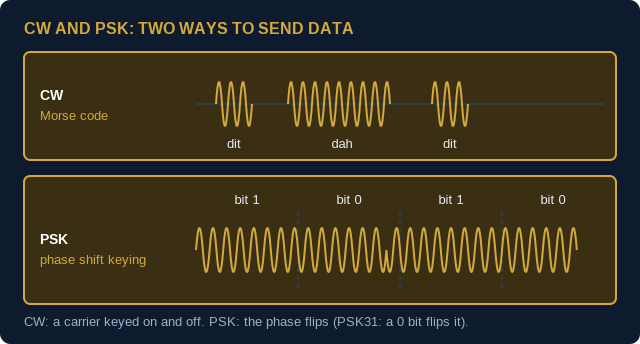
Waveform sketches of CW keyed on and off and PSK with phase reversals.
Describe this graphic in words

Two gold panels. The first shows CW, Morse code, as bursts of carrier switched on and off with the short bursts labelled dit and the long one dah. The second shows PSK, phase shift keying, as a constant-height wave that flips upside down at the start of the second and fourth bits, marked bit 1, bit 0, bit 1, bit 0. A caption says CW is a carrier keyed on and off and in PSK31 a 0 bit flips the phase.

PSK represents data by shifting the phase of a carrier. The carrier keeps the same frequency and strength, but its wave is flipped (shifted by 180 degrees in the simplest form, BPSK) at certain moments to carry a bit. PSK31, a popular keyboard-to-keyboard mode, uses this method and takes up very little bandwidth.

The other choices (pulse, packet sampled and power sampled) are not real terms for this. This is a teaching note.

Why the other choices are wrong

  • A. There is no mode called pulse shift keying in this sense.
  • C. "Packet Sampled Keying" is not an actual term.
  • D. "Power Sampled Keying" is not an actual term.

Rule text checked against the official source on November 5, 2026. This is a study aid; the linked rule is what governs.

T8D07

Which of the following describes DMR?

Show the answer and why

Answer A. A technique for time-multiplexing two digital voice signals on a single 12.5 kHz repeater channel

DMR time-multiplexes two digital voice signals on one 12.5 kHz repeater channel.

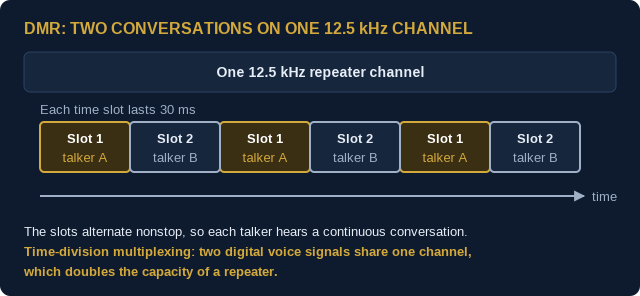
Timeline of DMR alternating two time slots on one 12.5 kHz channel.
Describe this graphic in words

A bar at the top reads one 12.5 kHz repeater channel. Below it six blocks in a row alternate between slot 1 for talker A, in gold, and slot 2 for talker B, each slot lasting 30 ms, with a time arrow underneath. A caption says the slots alternate nonstop, so each talker hears a continuous conversation, and that two digital voice signals share one channel.

DMR (Digital Mobile Radio) uses time-division multiple access. The 12.5 kHz channel is split into two time slots of 30 ms each that alternate continuously, and each slot carries its own conversation. The radios hold their voice in short digital bursts, so each talker hears a continuous conversation.

This effectively doubles the capacity of a repeater, because two groups can use one repeater at the same time. This is a teaching note.

Why the other choices are wrong

  • B. Automatic position tracking over FM repeaters describes APRS, not DMR.
  • C. DMR is a voice and data mode, not a computer logging technique.
  • D. DMR does not transmit on two repeater inputs at once; it divides one channel in time.

Rule text checked against the official source on November 5, 2026. This is a study aid; the linked rule is what governs.

T8D08

Which of the following is included in packet radio transmissions?

Show the answer and why

Answer D. All these choices are correct

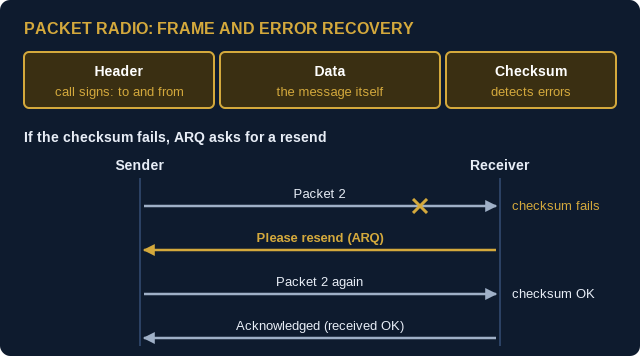
Packet radio transmissions include a checksum, an address header and automatic repeat request.

A packet frame with header, data and checksum, and an ARQ resend exchange.
Describe this graphic in words

The top shows a packet as three gold boxes: a header with the call signs of the sender and receiver, the data, and a checksum that detects errors. Below, a sender and receiver exchange messages. Packet 2 is damaged and the receiver's checksum fails, so it asks for a resend, labelled ARQ. The sender sends Packet 2 again, the checksum is correct, and the receiver acknowledges it.

A packet is a short block of data wrapped in extra information. The header carries the call signs of the sender and the station it is for, the data is the message itself, and a checksum lets the receiver detect whether any bits were damaged on the way. If the checksum shows an error, an automatic repeat request (ARQ) scheme has the sender transmit the packet again.

Since a checksum, an address header and ARQ are all part of packet radio, "all of these" is correct. This is a teaching note.

Why the other choices are wrong

  • A. A checksum is included, but so are the header and ARQ.
  • B. An address header is included, but so are the checksum and ARQ.
  • C. ARQ is included, but so are the checksum and the address header.

Rule text checked against the official source on November 5, 2026. This is a study aid; the linked rule is what governs.

T8D09

What is CW?

Show the answer and why

Answer D. Another name for a Morse code transmission

CW is another name for a Morse code transmission.

Waveform sketches of CW keyed on and off and PSK with phase reversals.
Describe this graphic in words

Two gold panels. The first shows CW, Morse code, as bursts of carrier switched on and off with the short bursts labelled dit and the long one dah. The second shows PSK, phase shift keying, as a constant-height wave that flips upside down at certain bit boundaries. A caption says CW is a carrier keyed on and off.

CW stands for continuous wave. A steady carrier is switched on and off to form the dots and dashes of international Morse code. Part 97 defines CW as "international Morse code telegraphy emissions."

It is a type of emission and a way of keying a signal, not a form of propagation, a 2 meter FM digital mode, or an error-correction scheme.

Why the other choices are wrong

  • A. CW is a way of sending information, not a type of electromagnetic propagation.
  • B. CW is not a digital mode used primarily on 2-meter FM.
  • C. CW is not an error-correction scheme.

References

Rule text checked against the official source on November 5, 2026. This is a study aid; the linked rule is what governs.

T8D10

Which of the following operating activities is supported by digital mode software in the WSJT-X software suite?

Show the answer and why

Answer D. All these choices are correct

WSJT-X supports Earth-Moon-Earth, weak-signal beacons and meteor scatter.

The WSJT-X software suite includes digital modes designed for very weak signals. Examples include modes for Earth-Moon-Earth (EME, or moonbounce), where signals are reflected off the Moon; modes for meteor scatter, where signals bounce off the brief ionized trails left by meteors; and WSPR for monitoring weak propagation beacons. All of them use heavy error correction and precise timing to pull signals out of the noise.

Since all three activities are supported, "all of these" is correct. This is a teaching note.

Why the other choices are wrong

  • A. EME is supported, but so are beacons and meteor scatter.
  • B. Weak-signal propagation beacons are supported, but so are EME and meteor scatter.
  • C. Meteor scatter is supported, but so are EME and beacons.

Rule text checked against the official source on November 5, 2026. This is a study aid; the linked rule is what governs.

T8D11

What is the role of ARQ in a transmission system?

Show the answer and why

Answer C. An error correction method in which the receiving station detects errors and sends a request for retransmission

ARQ is an error correction method where the receiver detects errors and requests retransmission.

A packet frame with header, data and checksum, and an ARQ resend exchange.
Describe this graphic in words

The top shows a packet as three gold boxes: a header with call signs, the data, and a checksum that detects errors. Below, a sender and receiver exchange messages. Packet 2 is damaged and the receiver's checksum fails, so the receiver sends a gold please-resend message, labelled ARQ. The sender sends Packet 2 again and the receiver acknowledges it.

ARQ stands for Automatic Repeat reQuest. The receiver checks each block of data, often using a checksum, and when it finds an error it asks the sender to send that block again. The sender repeats it until the receiver acknowledges that it arrived correctly.

For example, if Packet 2 arrives damaged, the receiver does not acknowledge it and the sender resends Packet 2. Packet radio uses this method. This is a teaching note.

Why the other choices are wrong

  • A. ARQ is a general method that works for any data, not a format limited to video.
  • B. ARQ is not encryption; amateur rules do not allow obscuring the meaning of messages.
  • D. ARQ is an error-correction method, not a way of compressing data.

Rule text checked against the official source on November 5, 2026. This is a study aid; the linked rule is what governs.

T8D12

Which of the following best describes an amateur radio mesh network?

Show the answer and why

Answer A. An amateur-radio data network using commercial Wi-Fi equipment with modified firmware

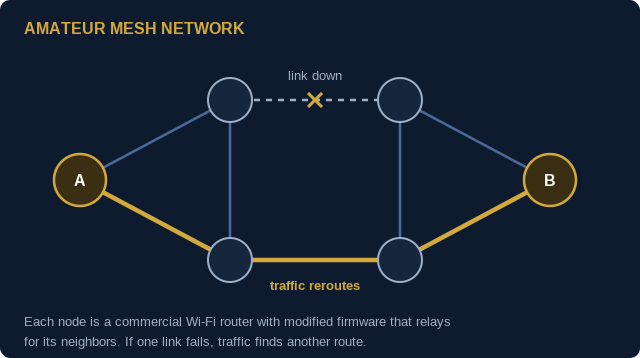
An amateur mesh network is a data network using commercial Wi-Fi equipment with modified firmware.

A mesh network of six nodes where traffic reroutes around a failed link.
Describe this graphic in words

Six circles are linked in a net. A top link between two nodes is marked with a gold X and the words link down. A thick gold route from node A runs along the bottom through two other nodes to node B, labelled traffic reroutes. A caption says each node is a commercial Wi-Fi router with modified firmware that relays for its neighbors.

Amateur mesh networks, such as Broadband-Hamnet, use ordinary commercial Wi-Fi routers loaded with modified firmware and run on frequencies inside amateur allocations. Each node relays traffic for its neighbors, so the network has several possible routes between any two points.

If one link fails, traffic automatically finds another route, which makes a mesh network useful for emergency data and video links. This is a teaching note.

Why the other choices are wrong

  • B. DMR is a separate digital voice mode; a mesh network is not a voice mode.
  • C. Mesh networks are ground-based, not satellite networks.
  • D. Linking repeaters worldwide through the internet describes IRLP or EchoLink, not a mesh network.

Rule text checked against the official source on November 5, 2026. This is a study aid; the linked rule is what governs.