
ARSC Tech School

Technician T2A: Station operation

409 questions · pool July 1, 2026 to June 30, 2030 · the exam has 35 questions; 26 to pass

T2 · OPERATING PROCEDURES

Station operation: choosing an operating frequency, calling another station, test transmissions; Band plans: calling frequencies, repeater offsets

11 questions in group T2A

One question from this group appears on each exam.

T2A01

What is a common repeater frequency offset in the 2-meter band?

Show the answer and why

Answer B. Plus or minus 600 kHz

On 2 meters the usual repeater offset is plus or minus 600 kHz.
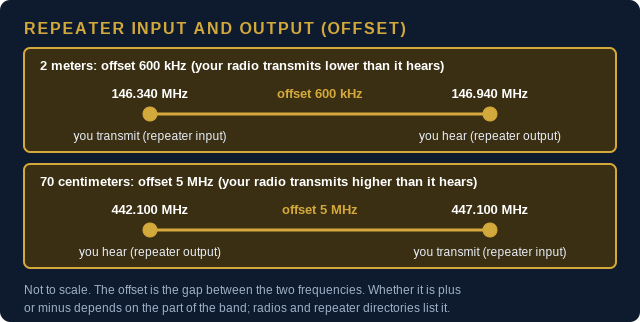
Two repeater examples showing the input and output frequencies and the offset between them.
Describe this graphic in words

Two panels each show a frequency line with a gold dot at each end. The 2-meter example has you transmitting on 146.340 MHz (repeater input) and hearing 146.940 MHz (repeater output), an offset of 600 kHz. The 70-centimeter example has you hearing 442.100 MHz (repeater output) and transmitting on 447.100 MHz (repeater input), an offset of 5 MHz. A note says the figure is not to scale and that the plus or minus direction depends on the part of the band.

A repeater listens on one channel and retransmits on another, so every repeater has two frequencies and the "offset" is the gap between them. Part 97 defines a repeater that way (it "retransmits the transmission of another amateur station on a different channel or channels") but does not fix the spacing. The spacing comes from local convention and from the frequency coordinator, defined in § 97.3 as the entity that "recommends transmit/receive channels" for repeaters so they do not interfere.

On 2 meters the common spacing is 600 kHz. Worked example: a repeater that transmits on 146.940 MHz listens on 146.340 MHz (146.940 - 0.600), so your radio receives on 146.940 and transmits 600 kHz lower. Whether the offset is plus or minus depends on the part of the band, which is why radios and repeater directories list it.

Why the other choices are wrong

  • A. 5 MHz is the usual offset on 70 centimeters. On 2 meters a 5 MHz shift would move the input outside the 144 to 148 MHz band for most repeaters.
  • C. 500 kHz is not a standard 2-meter repeater spacing. The common figure is 600 kHz, so a radio set to 500 kHz would transmit on the wrong frequency.
  • D. 1 MHz is not the common 2-meter spacing. It is sometimes used on the 222 MHz band, which is a different band from the one asked about.

References

Rule text checked against the official source on November 5, 2026. This is a study aid; the linked rule is what governs.
T2A02

What is the national calling frequency for FM simplex operations in the 2-meter band?

Show the answer and why

Answer A. 146.520 MHz

146.520 MHz is the national calling frequency for 2-meter FM simplex.

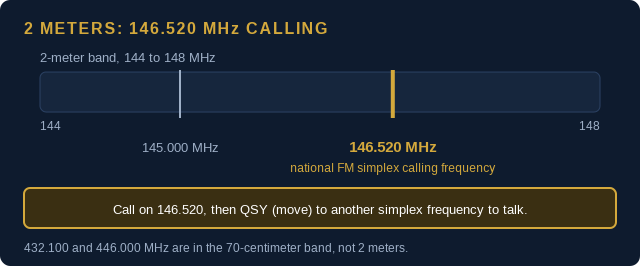
The 2-meter band with 146.520 MHz marked as the national FM simplex calling frequency.
Describe this graphic in words

A bar represents the 2-meter band from 144 to 148 MHz. A thick gold marker sits at 146.520 MHz, labelled as the national FM simplex calling frequency, and a thin grey marker at 145.000 MHz is shown for contrast. A gold box says to call on 146.520 and then QSY to another simplex frequency to talk, and a note says 432.100 and 446.000 MHz are in the 70-centimeter band.

Part 97 does not name calling frequencies. Section 97.101(b) tells operators to "cooperate in selecting transmitting channels" and says "No frequency will be assigned for the exclusive use of any station." Amateurs meet that duty with voluntary conventions, and 146.520 MHz is the 2-meter FM simplex calling channel across the country.

The idea is to call on 146.520, and when someone answers, agree to move (QSY) to another simplex frequency to talk so the calling channel stays free for others. This is a teaching note about convention, not a rule.

Why the other choices are wrong

  • B. 145.000 MHz is inside the 2-meter band, but nothing makes it the national calling frequency, so few people would be listening there.
  • C. 432.100 MHz is in the 70-centimeter band, not 2 meters. It is a calling frequency for weak-signal SSB and CW work, not for 2-meter FM.
  • D. 446.000 MHz is in the 70-centimeter band, not 2 meters. It is the 70-centimeter FM simplex calling frequency.

References

Rule text checked against the official source on November 5, 2026. This is a study aid; the linked rule is what governs.
T2A03

What is a common repeater frequency offset in the 70-centimeter band?

Show the answer and why

Answer A. Plus or minus 5 MHz

On 70 centimeters the usual repeater offset is plus or minus 5 MHz.

Two repeater examples showing the input and output frequencies and the offset between them.
Describe this graphic in words

Two panels each show a frequency line with a gold dot at each end. The 2-meter example has you transmitting on 146.340 MHz (repeater input) and hearing 146.940 MHz (repeater output), an offset of 600 kHz. The 70-centimeter example has you hearing 442.100 MHz (repeater output) and transmitting on 447.100 MHz (repeater input), an offset of 5 MHz. A note says the figure is not to scale and that the plus or minus direction depends on the part of the band.

As on 2 meters, the rules define a repeater as a station that retransmits on a different channel (§ 97.3) and leave the spacing to frequency coordinators and local practice. On 70 centimeters the common spacing is 5 MHz, much wider than on 2 meters because the band is wider and the frequencies are higher.

Worked example: a repeater transmitting on 442.100 MHz listens on 447.100 MHz (442.100 + 5.000), so your radio receives on 442.100 and transmits 5 MHz higher. This is a teaching note about common practice, not a Part 97 requirement.

Why the other choices are wrong

  • B. 600 kHz is the usual 2-meter spacing. Used on 70 centimeters it would put your transmit frequency far from the repeater's input.
  • C. 500 kHz is not a common repeater offset on either band.
  • D. 1 MHz is not the common spacing on 70 centimeters; 5 MHz is.

References

Rule text checked against the official source on November 5, 2026. This is a study aid; the linked rule is what governs.

T2A04

What is an appropriate way to call another station on a repeater if you know the other station's call sign?

Show the answer and why

Answer B. Say the station's call sign, then identify with your call sign

On a repeater, say the other station's call sign and then give your own.

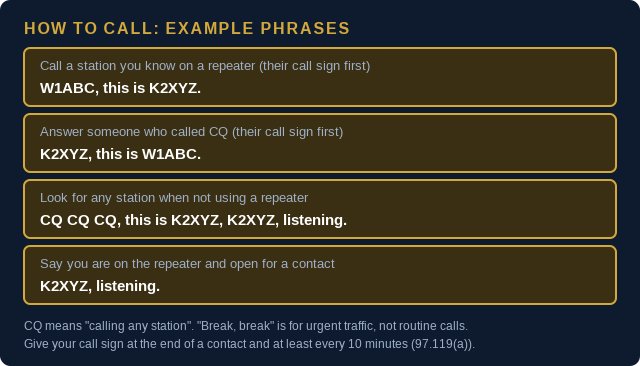
Four example phrases for calling, answering and listening on a repeater or simplex.
Describe this graphic in words

Four gold-outlined cards each give a situation and an example phrase. Calling a known station on a repeater is "W1ABC, this is K2XYZ", answering a CQ is "K2XYZ, this is W1ABC" (the called station first), a general call off a repeater is "CQ CQ CQ, this is K2XYZ, K2XYZ, listening", and showing you are available on a repeater is "K2XYZ, listening". Notes below say CQ means calling any station, "break, break" is for urgent traffic, and your call sign is required at the end of a contact and at least every 10 minutes.

Repeaters are shared, so calling practice is short and plain: say the call sign of the station you want, then yours. For example, "W1ABC, this is K2XYZ." The called station hears its own call sign first and knows the call is for it.

Your call sign also helps meet the identification rule, which requires giving your assigned call sign at the end of a communication and at least every 10 minutes during it (§ 97.119(a)). The order of words is customary operating practice (§ 97.101(a), "good amateur practice"), not a fixed procedure in the rules.

Why the other choices are wrong

  • A. "Break, break" signals urgent or emergency traffic. Using it for a routine call can make others stop and clear the repeater for no reason.
  • C. "CQ" calls any station, so it is not how you reach a specific known station. Saying it three times on a busy repeater is also unnecessary.
  • D. Waiting for the other station to call CQ means you never call at all. If you know who you want, call them.

References

Rule text checked against the official source on November 5, 2026. This is a study aid; the linked rule is what governs.

T2A05

How should you respond to a station calling CQ?

Show the answer and why

Answer C. Transmit the other station’s call sign followed by your call sign

Answer a CQ by sending the other station's call sign followed by your own.

CQ is a general call that means any station may answer. To answer, you say who you are replying to and then who you are: "K2XYZ, this is W1ABC." The caller's call sign comes first so the caller knows the reply is meant for them.

Giving your own call sign also satisfies the rule that each station must transmit its assigned call sign at the end of a communication and at least every 10 minutes during it (§ 97.119(a)). The calling order itself is customary practice rather than a rule.

Why the other choices are wrong

  • A. Sending "CQ" again just makes your own general call. It does not answer anyone, and the original caller will not know you replied.
  • B. Your call sign first reverses the usual order. The caller may not realize the reply is meant for them until you finish speaking.
  • D. A signal report alone, without identifying who is calling whom, is not a call. A report is sent after contact is made, not as the first reply.

References

Rule text checked against the official source on November 5, 2026. This is a study aid; the linked rule is what governs.

T2A06

What is an effective way to seek a call from any phone station when not using a repeater?

Show the answer and why

Answer D. Repeat “CQ” a few times, followed by “this is,” and your call sign, then pause to listen; repeat as necessary

Repeat "CQ" a few times, then "this is" and your call sign, then listen, and repeat as needed.

CQ is the general call to any station. A good CQ is short: say "CQ" a few times, then "this is" and your call sign, then pause to listen for an answer. If nothing comes back, repeat. Short calls with listening gaps let other stations break in and keep you from monopolizing a frequency.

Your call sign is the part the rules care about, because a station "may not transmit unidentified communications or signals" (§ 97.119(a)). The advice to keep calls short and listen between them is good operating practice (§ 97.101(a)).

Why the other choices are wrong

  • A. One call sign plus "listening for a call" is not the standard way to invite any station to answer, and changing frequency after every call means you never stay where anyone is listening.
  • B. "QTC" means you have messages to send, not that you want a contact, so nobody would know to answer.
  • C. An unmodulated carrier on a phone frequency does not identify you or invite a reply, and it just ties up the frequency.

References

Rule text checked against the official source on November 5, 2026. This is a study aid; the linked rule is what governs.

T2A07

What does the term "repeater offset" mean?

Show the answer and why

Answer A. The difference between a repeater’s transmit and receive frequencies

Repeater offset is the difference between a repeater's transmit and receive frequencies.

Two repeater examples showing the input and output frequencies and the offset between them.
Describe this graphic in words

Two panels each show a frequency line with a gold dot at each end. The 2-meter example has you transmitting on 146.340 MHz (repeater input) and hearing 146.940 MHz (repeater output), an offset of 600 kHz. The 70-centimeter example has you hearing 442.100 MHz (repeater output) and transmitting on 447.100 MHz (repeater input), an offset of 5 MHz. A note says the figure is not to scale and that the plus or minus direction depends on the part of the band.

A repeater "simultaneously retransmits the transmission of another amateur station on a different channel or channels" (§ 97.3). The gap between the channel it listens on (its input) and the channel it transmits on (its output) is the offset.

Worked example: a 2-meter repeater that transmits on 146.940 MHz and listens on 146.340 MHz has an offset of 146.940 - 146.340 = 0.600 MHz, or 600 kHz. Your radio is set to receive on 146.940 and to transmit 600 kHz lower, and most radios do that automatically once the offset is programmed.

Why the other choices are wrong

  • B. Offset is a difference in frequency, not a time delay.
  • C. The short pause after a transmission is the squelch tail or courtesy tone, which is a different thing and has nothing to do with the offset.
  • D. Offset has nothing to do with fees or club dues.

References

Rule text checked against the official source on November 5, 2026. This is a study aid; the linked rule is what governs.

T2A08

What is the meaning of the procedural signal “CQ”?

Show the answer and why

Answer D. Calling any station

"CQ" means calling any station.

CQ is a general call, an invitation for any station that hears it to answer. It is spoken on phone and sent in Morse code. Part 97 does not define CQ; it is a long-standing operating signal.

After CQ you say "this is" and your call sign, so those who hear you know who is calling, and the call sign also satisfies identification under § 97.119(a). A station answering you then replies with your call sign followed by theirs.

Why the other choices are wrong

  • A. CQ is not an abbreviation for "Contest QSO." It is used for ordinary contacts too, not only contests.
  • B. Audio clarity is reported in a signal report (such as "5 and 9"), not with CQ.
  • C. CQ does the opposite: it invites any station to reply, rather than limiting transmitting to one station.

References

Rule text checked against the official source on November 5, 2026. This is a study aid; the linked rule is what governs.

T2A09

Which of the following is a customary way to indicate a station is listening on a repeater and looking for a contact?

Show the answer and why

Answer B. The station’s call sign followed by the word “listening”

On a repeater, saying your call sign followed by "listening" shows you are available for a contact.

On a repeater you do not need a long CQ. Giving your call sign followed by the word "listening" (for example, "K2XYZ, listening") tells others you are on and open to a contact. It also identifies your station as § 97.119(a) requires.

This is customary practice, not a rule. Because a repeater is shared, brief and clear is considered good amateur practice (§ 97.101(a)).

Why the other choices are wrong

  • A. "CQ CQ" followed by the repeater's call sign gets it wrong: the repeater is not the one calling, and you should give your own call sign.
  • C. The repeater's call sign followed by yours reads like a call to the repeater itself, not an invitation for others to answer.
  • D. "QSY" means to change frequency. It does not say you are listening.

References

Rule text checked against the official source on November 5, 2026. This is a study aid; the linked rule is what governs.

T2A10

What is a band plan, beyond the privileges established by the FCC?

Show the answer and why

Answer A. A voluntary guideline for using different modes or activities within an amateur band

A band plan is a voluntary guideline for using different modes or activities within an amateur band.

The FCC sets which frequencies each license class may use and which emissions are allowed (§§ 97.301, 97.305). A band plan goes further: it is a voluntary agreement among operators about where to put things such as weak-signal work, FM voice, repeaters, or data within the band.

It has no force of law, but § 97.101(b) requires each licensee to "cooperate in selecting transmitting channels and in making the most effective use of the amateur service frequencies," and following the band plan is how that cooperation usually happens in practice.

Why the other choices are wrong

  • B. A band plan is about how frequencies are used, not a list of operating schedules.
  • C. A band plan may mention net frequencies, but it covers far more than that, including modes and repeater segments.
  • D. A band plan is not simply one club's private plan; it is a broadly shared guideline that operators generally follow.

References

Rule text checked against the official source on November 5, 2026. This is a study aid; the linked rule is what governs.

T2A11

What term describes an amateur station that is transmitting and receiving on the same frequency?

Show the answer and why

Answer C. Simplex

Transmitting and receiving on the same frequency is simplex.

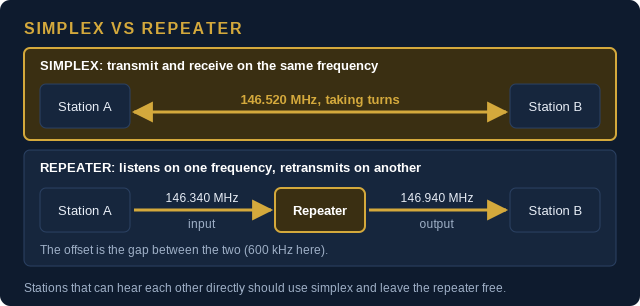
Simplex uses one shared frequency; a repeater listens on one frequency and transmits on another.
Describe this graphic in words

The top panel shows Station A and Station B joined by a double-headed gold arrow labelled 146.520 MHz, taking turns on one frequency (simplex). The bottom panel shows Station A transmitting to a repeater on 146.340 MHz (the input) and the repeater transmitting to Station B on 146.940 MHz (the output), a 600 kHz offset. A note says stations that can hear each other directly should use simplex and leave the repeater free.

In simplex, both stations use one frequency and take turns, so only one transmits at a time. Calling and talking directly on 146.520 MHz is an example. A repeater is the contrast: it retransmits on a different channel (§ 97.3), so users work through it with an offset, transmitting on one frequency and hearing the repeater on another.

Full duplex means sending and receiving at the same time, which needs two different frequencies. Simplex is the default for direct contacts, and stations that can hear each other directly should use it to keep repeaters free. This is a teaching note on terminology.

Why the other choices are wrong

  • A. Full duplex means transmitting and receiving at the same time on different frequencies, not on the same one.
  • B. Diplex is a way of combining two signals on one feed line or antenna, not an operating mode.
  • D. Multiplex means combining several signals into one channel, not using one frequency for both directions.

References

Rule text checked against the official source on November 5, 2026. This is a study aid; the linked rule is what governs.