
ARSC Tech School

Technician T5D: Ohm’s Law

409 questions · pool July 1, 2026 to June 30, 2030 · the exam has 35 questions; 26 to pass

T5 · ELECTRICAL PRINCIPLES

Ohm’s Law; Series and parallel circuits

14 questions in group T5D

One question from this group appears on each exam.

T5D01

What formula is used to calculate current in a circuit?

Show the answer and why

Answer B. I = E / R

Current equals voltage divided by resistance: I = E / R.
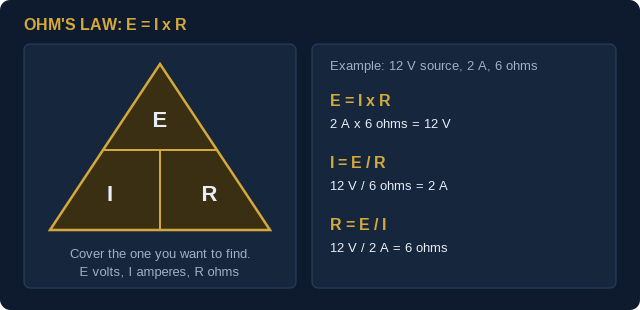
Ohm's law triangle with E on top and I and R below, with a 12 volt, 2 ampere, 6 ohm example.
Describe this graphic in words

A triangle has E at the top and I and R side by side at the bottom; covering one letter shows how to calculate it. A panel works an example with a 12 V source, 2 A and 6 ohms: E = I x R gives 2 x 6 = 12 V, I = E / R gives 12 / 6 = 2 A, and R = E / I gives 12 / 2 = 6 ohms.

This is Ohm's law. For a given voltage, more resistance means less current, and more voltage means more current. Divide the voltage in volts by the resistance in ohms to get the current in amperes.

Example: a 12 V source across 6 ohms drives 12 / 6 = 2 A. The units work out too: volts divided by ohms gives amperes. This is a teaching note.

Why the other choices are wrong

  • A. E x R would grow as resistance grows, but current falls when resistance rises.
  • C. E squared times R is not a current formula.
  • D. E squared divided by R is the formula for power in watts, not current.

Rule text checked against the official source on November 5, 2026. This is a study aid; the linked rule is what governs.
T5D02

What formula is used to calculate voltage in a circuit?

Show the answer and why

Answer A. E = I x R

Voltage equals current times resistance: E = I x R.

Ohm's law triangle with E on top and I and R below, with a 12 volt, 2 ampere, 6 ohm example.
Describe this graphic in words

A triangle has E at the top and I and R side by side at the bottom; covering one letter shows how to calculate it. A panel works an example with a 12 V source, 2 A and 6 ohms: E = I x R gives 2 x 6 = 12 V, I = E / R gives 12 / 6 = 2 A, and R = E / I gives 12 / 2 = 6 ohms.

Rearranging Ohm's law (I = E / R) gives E = I x R. The voltage across a resistor is the product of the current through it and its resistance.

Example: a current of 2 A through 6 ohms produces 2 x 6 = 12 V across the resistor. This is a teaching note.

Why the other choices are wrong

  • B. I / R divides current by resistance, which is not voltage.
  • C. I squared times R is the formula for power in watts.
  • D. I squared divided by R is not a standard electrical quantity.

Rule text checked against the official source on November 5, 2026. This is a study aid; the linked rule is what governs.

T5D03

What formula is used to calculate resistance in a circuit?

Show the answer and why

Answer B. R = E / I

Resistance equals voltage divided by current: R = E / I.

Ohm's law triangle with E on top and I and R below, with a 12 volt, 2 ampere, 6 ohm example.
Describe this graphic in words

A triangle has E at the top and I and R side by side at the bottom; covering one letter shows how to calculate it. A panel works an example with a 12 V source, 2 A and 6 ohms: E = I x R gives 2 x 6 = 12 V, I = E / R gives 12 / 6 = 2 A, and R = E / I gives 12 / 2 = 6 ohms.

Rearranging Ohm's law gives R = E / I. If 12 V pushes 2 A through a circuit, the resistance is 12 / 2 = 6 ohms.

For a given voltage, a smaller current means a larger resistance. This is a teaching note.

Why the other choices are wrong

  • A. E x I is power in watts, not resistance.
  • C. Adding volts and amperes is meaningless because the units differ.
  • D. Subtracting amperes from volts is also meaningless.

Rule text checked against the official source on November 5, 2026. This is a study aid; the linked rule is what governs.

T5D04

What is the resistance of a circuit in which a current of 3 amperes flows when connected to 90 volts?

Show the answer and why

Answer B. 30 ohms

90 V with 3 A flowing gives 30 ohms.

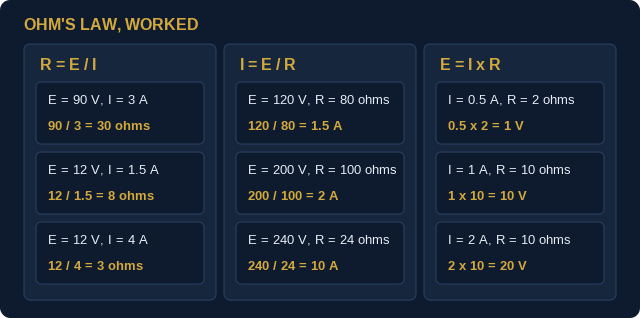
Nine worked Ohm's law problems for resistance, current and voltage.
Describe this graphic in words

Three columns each show three worked problems. R = E / I: 90 V and 3 A gives 30 ohms, 12 V and 1.5 A gives 8 ohms, 12 V and 4 A gives 3 ohms. I = E / R: 120 V and 80 ohms gives 1.5 A, 200 V and 100 ohms gives 2 A, 240 V and 24 ohms gives 10 A. E = I x R: 0.5 A and 2 ohms gives 1 V, 1 A and 10 ohms gives 10 V, 2 A and 10 ohms gives 20 V.

Use R = E / I. Divide 90 V by 3 A to get 30 ohms. Check: 3 A x 30 ohms = 90 V.

Whenever a question gives volts and amperes and asks for ohms, divide the volts by the amperes. The wrong answers come from other operations on the same numbers. This is a teaching note.

Why the other choices are wrong

  • A. 3 ohms just repeats the current figure; resistance is E / I, not I.
  • C. 1/30 ohm is I / E, the inverse of resistance (conductance).
  • D. 270 ohms comes from multiplying 90 by 3.

Rule text checked against the official source on November 5, 2026. This is a study aid; the linked rule is what governs.

T5D05

What is the resistance of a circuit for which the applied voltage is 12 volts and the current flow is 1.5 amperes?

Show the answer and why

Answer C. 8 ohms

12 V with 1.5 A flowing gives 8 ohms.

Nine worked Ohm's law problems for resistance, current and voltage.
Describe this graphic in words

Three columns each show three worked problems. R = E / I: 90 V and 3 A gives 30 ohms, 12 V and 1.5 A gives 8 ohms, 12 V and 4 A gives 3 ohms. I = E / R: 120 V and 80 ohms gives 1.5 A, 200 V and 100 ohms gives 2 A, 240 V and 24 ohms gives 10 A. E = I x R: 0.5 A and 2 ohms gives 1 V, 1 A and 10 ohms gives 10 V, 2 A and 10 ohms gives 20 V.

Use R = E / I. Divide 12 V by 1.5 A to get 8 ohms. Check: 1.5 A x 8 ohms = 12 V.

The wrong answers come from using the wrong operation on 12 and 1.5. This is a teaching note.

Why the other choices are wrong

  • A. 18 ohms comes from multiplying 12 by 1.5.
  • B. 0.125 ohm comes from dividing 1.5 by 12, which is the division upside down.
  • D. 13.5 ohms comes from adding the numbers.

Rule text checked against the official source on November 5, 2026. This is a study aid; the linked rule is what governs.

T5D06

What is the resistance of a circuit that draws 4 amperes from a 12-volt source?

Show the answer and why

Answer A. 3 ohms

4 A from a 12 V source means 3 ohms.

Nine worked Ohm's law problems for resistance, current and voltage.
Describe this graphic in words

Three columns each show three worked problems. R = E / I: 90 V and 3 A gives 30 ohms, 12 V and 1.5 A gives 8 ohms, 12 V and 4 A gives 3 ohms. I = E / R: 120 V and 80 ohms gives 1.5 A, 200 V and 100 ohms gives 2 A, 240 V and 24 ohms gives 10 A. E = I x R: 0.5 A and 2 ohms gives 1 V, 1 A and 10 ohms gives 10 V, 2 A and 10 ohms gives 20 V.

Use R = E / I. Divide 12 V by 4 A to get 3 ohms. Check: 4 A x 3 ohms = 12 V.

The wrong answers come from adding, subtracting or multiplying 12 and 4 instead of dividing. This is a teaching note.

Why the other choices are wrong

  • B. 16 ohms comes from adding the numbers.
  • C. 48 ohms comes from multiplying 12 by 4.
  • D. 8 ohms comes from subtracting 4 from 12.

Rule text checked against the official source on November 5, 2026. This is a study aid; the linked rule is what governs.

T5D07

What is the current in a circuit with an applied voltage of 120 volts and a resistance of 80 ohms?

Show the answer and why

Answer D. 1.5 amperes

120 V across 80 ohms gives 1.5 amperes.

Nine worked Ohm's law problems for resistance, current and voltage.
Describe this graphic in words

Three columns each show three worked problems. R = E / I: 90 V and 3 A gives 30 ohms, 12 V and 1.5 A gives 8 ohms, 12 V and 4 A gives 3 ohms. I = E / R: 120 V and 80 ohms gives 1.5 A, 200 V and 100 ohms gives 2 A, 240 V and 24 ohms gives 10 A. E = I x R: 0.5 A and 2 ohms gives 1 V, 1 A and 10 ohms gives 10 V, 2 A and 10 ohms gives 20 V.

Use I = E / R. Divide 120 V by 80 ohms to get 1.5 A. Check: 1.5 A x 80 ohms = 120 V.

Current comes out smaller than the voltage whenever the resistance is more than 1 ohm, so an answer in the hundreds or thousands of amperes should look wrong. This is a teaching note.

Why the other choices are wrong

  • A. 9600 A comes from multiplying 120 by 80.
  • B. 200 A comes from adding the numbers, which does not give current.
  • C. 0.667 A comes from dividing 80 by 120, which is the division upside down.

Rule text checked against the official source on November 5, 2026. This is a study aid; the linked rule is what governs.

T5D08

What is the current through a 100-ohm resistor connected across 200 volts?

Show the answer and why

Answer C. 2 amperes

200 V across 100 ohms gives 2 amperes.

Nine worked Ohm's law problems for resistance, current and voltage.
Describe this graphic in words

Three columns each show three worked problems. R = E / I: 90 V and 3 A gives 30 ohms, 12 V and 1.5 A gives 8 ohms, 12 V and 4 A gives 3 ohms. I = E / R: 120 V and 80 ohms gives 1.5 A, 200 V and 100 ohms gives 2 A, 240 V and 24 ohms gives 10 A. E = I x R: 0.5 A and 2 ohms gives 1 V, 1 A and 10 ohms gives 10 V, 2 A and 10 ohms gives 20 V.

Use I = E / R. Divide 200 V by 100 ohms to get 2 A. Check: 2 A x 100 ohms = 200 V.

More resistance means less current, so 100 ohms across 200 V cannot pass a huge current. This is a teaching note.

Why the other choices are wrong

  • A. 20,000 A comes from multiplying 200 by 100.
  • B. 0.5 A comes from dividing 100 by 200, which is the division upside down.
  • D. 100 A just repeats the resistance value.

Rule text checked against the official source on November 5, 2026. This is a study aid; the linked rule is what governs.

T5D09

What is the current through a 24-ohm resistor connected across 240 volts?

Show the answer and why

Answer C. 10 amperes

240 V across 24 ohms gives 10 amperes.

Nine worked Ohm's law problems for resistance, current and voltage.
Describe this graphic in words

Three columns each show three worked problems. R = E / I: 90 V and 3 A gives 30 ohms, 12 V and 1.5 A gives 8 ohms, 12 V and 4 A gives 3 ohms. I = E / R: 120 V and 80 ohms gives 1.5 A, 200 V and 100 ohms gives 2 A, 240 V and 24 ohms gives 10 A. E = I x R: 0.5 A and 2 ohms gives 1 V, 1 A and 10 ohms gives 10 V, 2 A and 10 ohms gives 20 V.

Use I = E / R. Divide 240 V by 24 ohms to get 10 A. Check: 10 A x 24 ohms = 240 V.

A quick estimate helps: 24 goes into 240 ten times. This is a teaching note.

Why the other choices are wrong

  • A. 2400 A is 240 times the correct answer and does not follow from I = E / R.
  • B. 0.1 A comes from dividing 24 by 240, which is the division upside down.
  • D. 5760 A comes from multiplying 240 by 24.

Rule text checked against the official source on November 5, 2026. This is a study aid; the linked rule is what governs.

T5D10

What is the voltage across a 2-ohm resistor if a current of 0.5 amperes flows through it?

Show the answer and why

Answer A. 1 volt

0.5 A through 2 ohms gives 1 volt.

Nine worked Ohm's law problems for resistance, current and voltage.
Describe this graphic in words

Three columns each show three worked problems. R = E / I: 90 V and 3 A gives 30 ohms, 12 V and 1.5 A gives 8 ohms, 12 V and 4 A gives 3 ohms. I = E / R: 120 V and 80 ohms gives 1.5 A, 200 V and 100 ohms gives 2 A, 240 V and 24 ohms gives 10 A. E = I x R: 0.5 A and 2 ohms gives 1 V, 1 A and 10 ohms gives 10 V, 2 A and 10 ohms gives 20 V.

Use E = I x R. Multiply 0.5 A by 2 ohms to get 1 V. Check: 1 V / 2 ohms = 0.5 A.

Half of 2 is 1, which is a quick way to confirm the result. This is a teaching note.

Why the other choices are wrong

  • B. 0.25 V comes from dividing 0.5 by 2.
  • C. 2.5 V comes from adding the numbers.
  • D. 1.5 V comes from subtracting 0.5 from 2.

Rule text checked against the official source on November 5, 2026. This is a study aid; the linked rule is what governs.

T5D11

What is the voltage across a 10-ohm resistor if a current of 1 ampere flows through it?

Show the answer and why

Answer B. 10 volts

1 A through 10 ohms gives 10 volts.

Nine worked Ohm's law problems for resistance, current and voltage.
Describe this graphic in words

Three columns each show three worked problems. R = E / I: 90 V and 3 A gives 30 ohms, 12 V and 1.5 A gives 8 ohms, 12 V and 4 A gives 3 ohms. I = E / R: 120 V and 80 ohms gives 1.5 A, 200 V and 100 ohms gives 2 A, 240 V and 24 ohms gives 10 A. E = I x R: 0.5 A and 2 ohms gives 1 V, 1 A and 10 ohms gives 10 V, 2 A and 10 ohms gives 20 V.

Use E = I x R. Multiply 1 A by 10 ohms to get 10 V. Check: 10 V / 10 ohms = 1 A.

When the current is exactly 1 A, the voltage in volts is the same number as the resistance in ohms. This is a teaching note.

Why the other choices are wrong

  • A. 1 V would come from dividing 10 by 10, or from ignoring the resistance.
  • C. 11 V comes from adding the numbers.
  • D. 9 V comes from subtracting 1 from 10.

Rule text checked against the official source on November 5, 2026. This is a study aid; the linked rule is what governs.

T5D12

What is the voltage across a 10-ohm resistor if a current of 2 amperes flows through it?

Show the answer and why

Answer D. 20 volts

2 A through 10 ohms gives 20 volts.

Nine worked Ohm's law problems for resistance, current and voltage.
Describe this graphic in words

Three columns each show three worked problems. R = E / I: 90 V and 3 A gives 30 ohms, 12 V and 1.5 A gives 8 ohms, 12 V and 4 A gives 3 ohms. I = E / R: 120 V and 80 ohms gives 1.5 A, 200 V and 100 ohms gives 2 A, 240 V and 24 ohms gives 10 A. E = I x R: 0.5 A and 2 ohms gives 1 V, 1 A and 10 ohms gives 10 V, 2 A and 10 ohms gives 20 V.

Use E = I x R. Multiply 2 A by 10 ohms to get 20 V. Check: 20 V / 10 ohms = 2 A.

Doubling the current across the same resistance doubles the voltage across it. This is a teaching note.

Why the other choices are wrong

  • A. 8 V comes from subtracting 2 from 10.
  • B. 0.2 V comes from dividing 2 by 10.
  • C. 12 V comes from adding the numbers.

Rule text checked against the official source on November 5, 2026. This is a study aid; the linked rule is what governs.

T5D13

In which type of circuit is the current always the same through all components?

Show the answer and why

Answer A. Series

In a series circuit the current is the same through every component.

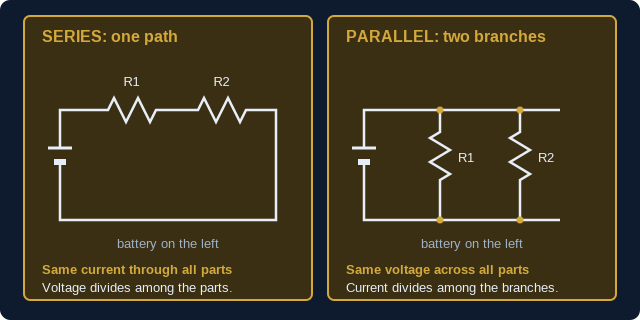
A series circuit and a parallel circuit side by side, each with a battery and two resistors.
Describe this graphic in words

On the left, a series circuit has a battery and resistors R1 and R2 in one loop, so there is only one path; the note says the current is the same through all parts and the voltage divides among the parts. On the right, a parallel circuit has R1 and R2 on separate branches across the same two wires from the battery; the note says the voltage is the same across all parts and the current divides among the branches.

In a series circuit the parts are connected end to end in a single loop, so there is only one path for the charge. All the current that leaves the source must pass through every component in turn, so the current is the same at every point.

The voltage, however, divides among the parts: with two series resistors, the voltage across each depends on its resistance, and the voltages add up to the source voltage. In a parallel circuit it is the voltage that is the same. This is a teaching note.

Why the other choices are wrong

  • B. In a parallel circuit the current splits among the branches, so each part can carry a different current.
  • C. Resonant describes a frequency condition of a circuit with inductance and capacitance, not a way parts are connected.
  • D. A branch is one path within a parallel circuit, where the current divides; it is not a type of circuit.

Rule text checked against the official source on November 5, 2026. This is a study aid; the linked rule is what governs.

T5D14

In which type of circuit is the voltage always the same across all components?

Show the answer and why

Answer B. Parallel

In a parallel circuit the voltage is the same across every component.

A series circuit and a parallel circuit side by side, each with a battery and two resistors.
Describe this graphic in words

On the left, a series circuit has a battery and resistors R1 and R2 in one loop, so there is only one path; the note says the current is the same through all parts and the voltage divides among the parts. On the right, a parallel circuit has R1 and R2 on separate branches across the same two wires from the battery; the note says the voltage is the same across all parts and the current divides among the branches.

In a parallel circuit every component is connected directly across the same two points, so each one sees the same voltage as the source. Each branch draws its own current according to its resistance (I = E / R), and the branch currents add up to the total from the source.

Example: two 6 ohm resistors across 12 V each see 12 V and each carry 2 A, so the source supplies 4 A. Household outlets are wired in parallel so every appliance gets the full line voltage. This is a teaching note.

Why the other choices are wrong

  • A. In a series circuit the voltage divides among the components, so each sees only part of it.
  • C. Resonant describes a frequency condition of a circuit with inductance and capacitance, not a way parts are connected.
  • D. A branch is one path within a parallel circuit; it is not a type of circuit.

Rule text checked against the official source on November 5, 2026. This is a study aid; the linked rule is what governs.