Which of the following is a safety hazard of a 12-volt storage battery that lacks internal protection circuitry?
Show the answer and why
Answer B. Shorting the terminals can cause burns, fire, or an explosion
Shorting the terminals of a battery can cause burns, fire or an explosion.
Describe this graphic in words
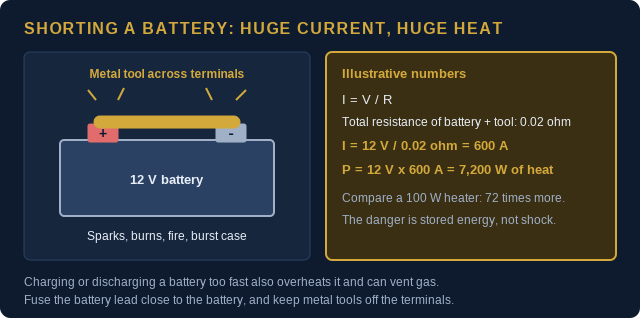
A 12-volt battery has a gold metal tool lying across its positive and negative terminals with sparks above it. A gold panel gives illustrative numbers: with 0.02 ohm total resistance, I = 12 / 0.02 = 600 A and P = 12 V x 600 A = 7,200 W, 72 times a 100 W heater. A note says the danger is stored energy, not shock.
A storage battery can deliver very large current into a short circuit. Worked example: if the battery and a wrench across its terminals add up to 0.02 ohm, I = 12 / 0.02 = 600 A, and the power is 12 V x 600 A = 7,200 W of heat. That heat melts jewelry and tools in seconds, causes burns and can ignite nearby material.
Lead-acid batteries also give off hydrogen, which can explode from a spark, and a shorted lithium pack can overheat and burn. Packs with internal protection circuitry limit this; one without it depends on you keeping metal off the terminals and fusing the leads. This is a teaching note.
Why the other choices are wrong
- A. 12 volts will not push a harmful current through dry skin. At about 10,000 ohms, 12 V gives roughly 1 mA. The danger is the short circuit, not shock.
- C. RF from a nearby transmitter does not make a battery's electrolyte give off poison gas. Gas comes from charging, overheating or damage.
- D. Only statement B is correct, so "all of these" fails.
Rule text checked against the official source on November 5, 2026. This is a study aid; the linked rule is what governs.