
ARSC Tech School

Technician T1E: Control operator

409 questions · pool July 1, 2026 to June 30, 2030 · the exam has 35 questions; 26 to pass

T1 · COMMISSION’S RULES

Control operator: eligibility, designating, privileges, duties, location, required; Control point; Control types: automatic, remote

11 questions in group T1E

One question from this group appears on each exam.

T1E01FCC rule 97.7(a)

When may an amateur station transmit without a control operator?

Show the answer and why

Answer D. Never

FCC rule 97.7(a)

Never. Every transmitting amateur station must have a control operator, even one under automatic control.
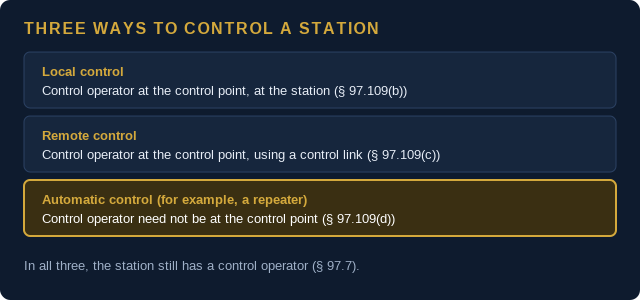
Three ways a station can be controlled, local, remote and automatic, each with a control operator, showing where the operator is.
Describe this graphic in words

Three rows. Local control: the control operator is at the control point at the station. Remote control: the control operator is at the control point and manipulates the station through a control link. Automatic control, as with a repeater: the control operator need not be at the control point, but the station still has one. A note says every transmitting station must have a control operator.

Section 97.7 begins: "When transmitting, each amateur station must have a control operator." There is no exception for repeaters or auxiliary stations.

Automatic control, as in a repeater, means the control operator does not have to be at the control point while it transmits (97.109(d)). It does not mean the station has no control operator. Someone is still designated and responsible.

Why the other choices are wrong

  • A. An automatically controlled station, such as a repeater, still has a control operator. It just does not need to be at the control point.
  • B. When the licensee is away, the person using the station is the control operator.
  • C. An auxiliary station also needs a control operator.

References

Rule text checked against the official source on November 5, 2026. This is a study aid; the linked rule is what governs.

T1E02FCC rule 97.301, 97.207(c)

Who may be the control operator of a station communicating through an amateur satellite or space station?

Show the answer and why

Answer D. Any amateur allowed to transmit on the satellite uplink frequency

FCC rule 97.301, 97.207(c)

Any amateur who is allowed to transmit on the satellite's uplink frequency may be the control operator of a station communicating through it.

No special satellite operator certification exists in Part 97. What counts is your privileges. Section 97.301 tells you which bands each operator class may use, and 97.207(c) lists the segments space stations may use. If your license lets you transmit on the uplink frequency, you can be the control operator of a station using that satellite.

For a Technician, that includes satellites with VHF and UHF uplinks inside the bands Technicians already have.

Why the other choices are wrong

  • A. Amateur Extra is not required.
  • B. No satellite operator certification exists in Part 97.
  • C. AMSAT membership is not a requirement of the rules.

References

Rule text checked against the official source on November 5, 2026. This is a study aid; the linked rule is what governs.

T1E03FCC rule 97.103(b)

Who must designate the station control operator?

Show the answer and why

Answer A. The station licensee

FCC rule 97.103(b)

The station licensee designates the control operator.

Section 97.103(b) says: "The station licensee must designate the station control operator. The FCC will presume that the station licensee is also the control operator, unless documentation to the contrary is in the station records."

If you let someone else operate your station, you are the one who designates them as control operator, and your station records are where that is documented.

Why the other choices are wrong

  • B. The FCC presumes the licensee is the control operator, but it does not designate one.
  • C. A frequency coordinator deals with repeater channels, not control operators.
  • D. Not just any licensed operator can designate; the licensee does.

References

Rule text checked against the official source on November 5, 2026. This is a study aid; the linked rule is what governs.

T1E04FCC rule 97.103(b)

What determines the transmitting frequency privileges of an amateur station?

Show the answer and why

Answer D. The class of operator license held by the control operator

FCC rule 97.103(b)

The class of operator license held by the control operator determines a station's transmitting frequency privileges.

Section 97.301 opens each band table with the words "For a station having a control operator who has been granted ..." a particular operator class. In other words, the frequencies available to the station depend on the control operator in charge at that moment. Section 97.9(a) says the same thing: the person named in a license is a control operator "with the privileges authorized to the operator class specified on the license grant."

If a Technician and an Amateur Extra take turns at the same station, the station's privileges change with whoever is the control operator.

Why the other choices are wrong

  • A. A frequency coordinator recommends repeater channels. It does not set station privileges.
  • B. The license grant lists your class, but privileges come from the rules for that class.
  • C. The highest class on the premises does not matter. Only the control operator's class does.

References

Rule text checked against the official source on November 5, 2026. This is a study aid; the linked rule is what governs.

T1E05FCC rule 97.3(a)(14)

What is an amateur station’s control point?

Show the answer and why

Answer C. The location at which the control operator function is performed

FCC rule 97.3(a)(14)

The control point is the location at which the control operator function is performed.

Three ways a station can be controlled, local, remote and automatic, each with a control operator, showing where the operator is.
Describe this graphic in words

Three rows. Local control: the control operator is at the control point at the station. Remote control: the control operator is at the control point and manipulates the station through a control link. Automatic control, as with a repeater: the control operator need not be at the control point, but the station still has one. A note says every transmitting station must have a control operator.

Section 97.3(a)(14) says: "Control point. The location at which the control operator function is performed." It is where the control operator is, not necessarily where the antenna or transmitter is.

Every station must have at least one control point (97.109(a)). For a station in your home shack, the control point is the operating position. For a remotely controlled station, it is wherever you are controlling it from.

Why the other choices are wrong

  • A. The antenna's location is not the control point.
  • B. The location of the transmitting apparatus is not necessarily the control point.
  • D. The licensee's mailing address is just an address on the license.

References

Rule text checked against the official source on November 5, 2026. This is a study aid; the linked rule is what governs.

T1E06FCC rule 97.301

When, other than during an emergency, may a Technician class licensee be the control operator of a station operating in an Amateur Extra Class band segment?

Show the answer and why

Answer A. At no time

FCC rule 97.301

Other than in an emergency, a Technician cannot be the control operator of a station operating in an Amateur Extra band segment.

Section 97.301 ties each band table to the control operator's license class. A Technician control operator gets the bands in 97.301(a) and the HF segments in 97.301(e); the segments listed for higher classes in 97.301(b) to (d) are not among them. Being designated by an Amateur Extra licensee, being part of a contest team, or using a club station whose trustee holds an Extra license does not change the control operator's own privileges.

One nuance outside this question: under 97.9(b), someone who has passed the exam for a higher class and holds a CSCE may use the higher class privileges for up to 365 days, pending the grant. That is about a person who has already passed the upgrade exam, not a general way around the class limits.

Why the other choices are wrong

  • B. A designation by an Extra does not extend a Technician's privileges. Privileges follow the control operator's own class.
  • C. A contest team does not change a control operator's privileges.
  • D. A club trustee's license class does not give the control operator extra privileges.

References

Rule text checked against the official source on November 5, 2026. This is a study aid; the linked rule is what governs.

T1E07FCC rule 97.103(a)

When the control operator is not the station licensee, who is responsible for the proper operation of the station?

Show the answer and why

Answer D. The control operator and the station licensee

FCC rule 97.103(a)

The control operator and the station licensee are both responsible for the proper operation of the station.

Section 97.103(a) says: "The station licensee is responsible for the proper operation of the station in accordance with the FCC Rules. When the control operator is a different amateur operator than the station licensee, both persons are equally responsible for proper operation of the station."

Lending your station to a friend does not move the responsibility off of you.

Why the other choices are wrong

  • A. Other licensed amateurs who are merely present are not responsible.
  • B. The licensee is responsible, but not alone.
  • C. The control operator is responsible, but not alone.

References

Rule text checked against the official source on November 5, 2026. This is a study aid; the linked rule is what governs.

T1E08FCC rule 97.3(a)(6), 97.205(d)

Which of the following is an example of automatic control?

Show the answer and why

Answer A. Repeater operation

FCC rule 97.3(a)(6), 97.205(d)

Repeater operation is an example of automatic control.

Three ways a station can be controlled, local, remote and automatic, each with a control operator, showing where the operator is.
Describe this graphic in words

Three rows. Local control: the control operator is at the control point at the station. Remote control: the control operator is at the control point and manipulates the station through a control link. Automatic control, as with a repeater: the control operator need not be at the control point, but the station still has one. A note says every transmitting station must have a control operator.

Section 97.3(a)(6) defines automatic control as "the use of devices and procedures for control of a station when it is transmitting so that compliance with the FCC Rules is achieved without the control operator being present at a control point." Section 97.205(d) says "A repeater may be automatically controlled." Under 97.109(d), only stations specifically designated elsewhere in Part 97 may be automatically controlled, and repeaters are among them.

Controlling a station over the internet is remote control, because the control operator is at a control point. Sending CW or identifying automatically with a computer is a station function, not automatic control of the station.

Why the other choices are wrong

  • B. Controlling a station over the internet is remote control, since the control operator is at a control point.
  • C. A computer sending CW is an operating function. It does not describe how the station is controlled.
  • D. Automatic identification is also a station function, not a type of station control.

References

Rule text checked against the official source on November 5, 2026. This is a study aid; the linked rule is what governs.

T1E09FCC rule 97.109(c)

Which amateur stations may be remotely controlled?

Show the answer and why

Answer D. Any station

FCC rule 97.109(c)

Any amateur station may be remotely controlled.

Three ways a station can be controlled, local, remote and automatic, each with a control operator, showing where the operator is.
Describe this graphic in words

Three rows. Local control: the control operator is at the control point at the station. Remote control: the control operator is at the control point and manipulates the station through a control link. Automatic control, as with a repeater: the control operator need not be at the control point, but the station still has one. A note says every transmitting station must have a control operator.

Section 97.109(c) says: "When a station is being remotely controlled, the control operator must be at the control point. Any station may be remotely controlled."

Contrast this with automatic control in 97.109(d), which is limited to stations specifically designated elsewhere in Part 97.

Why the other choices are wrong

  • A. Remote control is not limited to repeaters.
  • B. Remote control is not limited to automatically controlled stations.
  • C. Remote control is not limited to digital stations.

References

Rule text checked against the official source on November 5, 2026. This is a study aid; the linked rule is what governs.

T1E10FCC rule 97.3(a)(39)

Which of the following is an example of remote control as defined in Part 97?

Show the answer and why

Answer B. Operating the station over the internet

FCC rule 97.3(a)(39)

Operating the station over the internet is an example of remote control as defined in Part 97.

Three ways a station can be controlled, local, remote and automatic, each with a control operator, showing where the operator is.
Describe this graphic in words

Three rows. Local control: the control operator is at the control point at the station. Remote control: the control operator is at the control point and manipulates the station through a control link. Automatic control, as with a repeater: the control operator need not be at the control point, but the station still has one. A note says every transmitting station must have a control operator.

Section 97.3(a)(39) defines remote control as "the use of a control operator who indirectly manipulates the operating adjustments in the station through a control link to achieve compliance with the FCC Rules." Operating a station over the internet fits: the operator is away from the station and uses a link to manipulate it.

A software-defined radio is a type of equipment, not a control method. Controlling model craft is telecommand under 97.215, and EME is a way of using the moon as a reflector.

Why the other choices are wrong

  • A. An SDR describes how a radio is built, not how it is controlled.
  • C. Controlling a model craft by radio is telecommand, covered by 97.215.
  • D. EME communication is a propagation mode, not a control method.

References

Rule text checked against the official source on November 5, 2026. This is a study aid; the linked rule is what governs.

T1E11FCC rule 97.3(a)(13)

What is a control operator as defined in Part 97?

Show the answer and why

Answer D. An amateur operator designated by the licensee of a station to be responsible for transmissions and FCC rules compliance at that station

FCC rule 97.3(a)(13)

A control operator is an amateur operator designated by the licensee of a station to be responsible for the transmissions from that station and for compliance with the FCC rules.

Section 97.3(a)(13) says: "Control operator. An amateur operator designated by the licensee of a station to be responsible for the transmissions from that station to assure compliance with the FCC Rules." The key words are designated by the licensee and responsible for the transmissions.

Being the licensee does not by itself make you the control operator, and speaking on the air does not either. The FCC presumes the licensee is the control operator unless the station records say otherwise (97.103(b)).

Why the other choices are wrong

  • A. The person speaking is not necessarily the control operator.
  • B. The licensee is the person named on the station license, which may be a different person.
  • C. The FCC database does not identify the control operator. The licensee designates one.

References

Rule text checked against the official source on November 5, 2026. This is a study aid; the linked rule is what governs.